The Temple of Literature in Hanoi, also known as Văn Miếu – Quốc Tử Giám, is one of Vietnam’s most rewarding places to explore the country’s educational and cultural history. This guide explains the daytime entrance fee, opening hours, ticket options, five main areas, respectful visitor etiquette and practical ways to plan your visit—without confusing the historic monument with a commercial tour.
Temple of Literature Hanoi: quick visitor facts
If you only need the practical details, start here. The hours and daytime ticket categories below follow information published by the heritage site’s management. Check its website close to your visit because events, prices and access arrangements may change.
| Vietnamese name | Văn Miếu – Quốc Tử Giám |
|---|---|
| Main visitor entrance | 58 Quốc Tử Giám Street, Hanoi, Vietnam |
| Daytime opening hours | 8:00 AM–5:00 PM, every day under the published regular schedule |
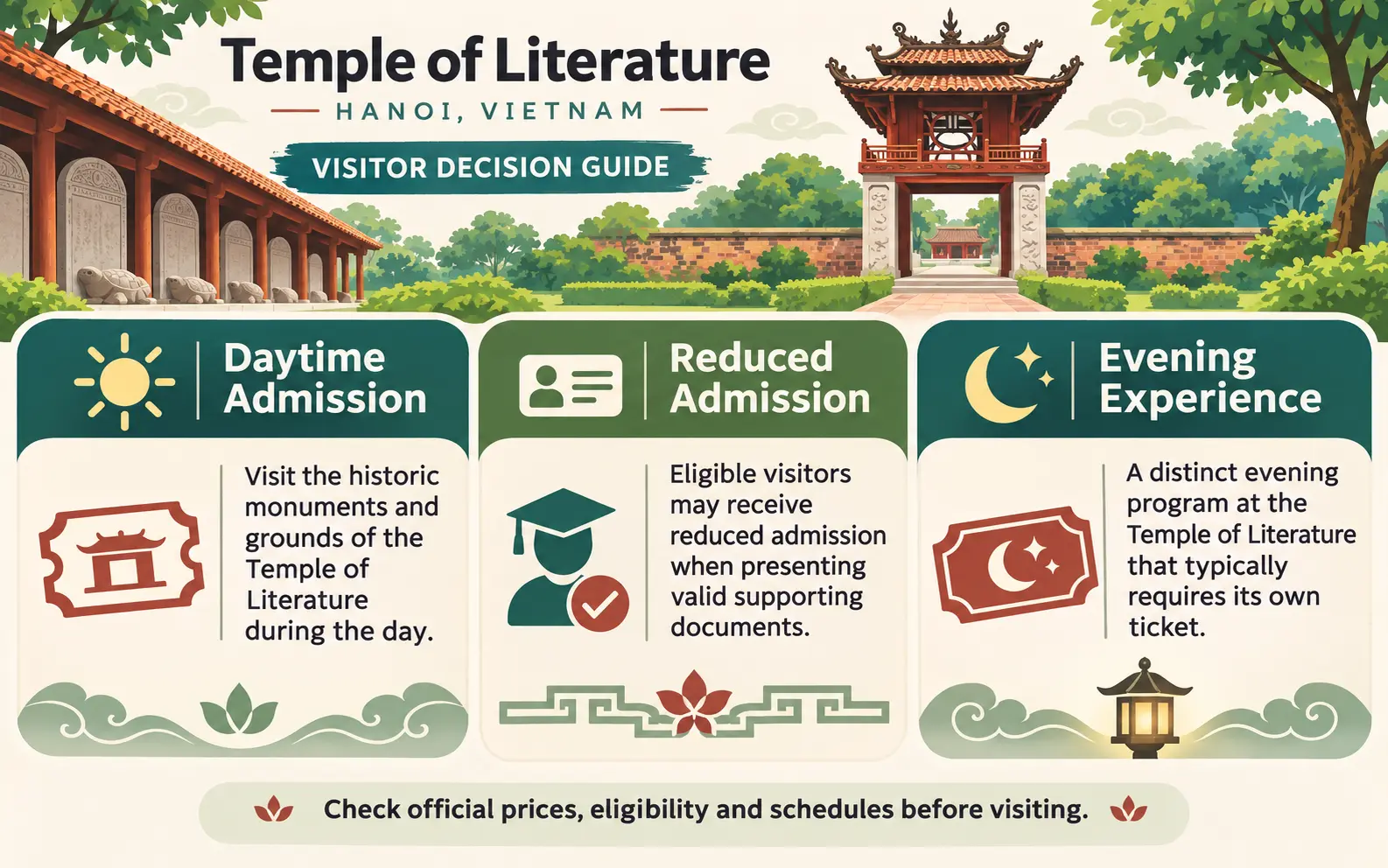
| Standard daytime admission | 70,000 VND per adult |
| Reduced daytime admission | 35,000 VND for eligible visitors with required documents |
| Free daytime admission | Children under 16 and certain other eligible visitors |
| Suggested time | About 60–90 minutes for a self-guided first visit; longer if you enjoy history or exhibitions |
| Separate evening programme | Yes; its packages, conditions and schedule are different from regular admission |
What is the Temple of Literature in Hanoi?
The name Temple of Literature usually refers to the historic complex containing two connected institutions. Văn Miếu was established in 1070 under Emperor Lý Thánh Tông to honour Confucius and other revered scholars. Quốc Tử Giám, the Imperial Academy, was founded in 1076 under Emperor Lý Nhân Tông and became the kingdom’s highest educational institution. It is often described as Vietnam’s first national university, although it should not be imagined as a modern university campus.
This distinction matters when walking around. The site is both a place associated with Confucian veneration and a reminder of how scholars were trained, examined and recognised in historic Vietnam. You are not visiting a Buddhist pagoda or a single museum building. The complex includes courtyards, gates, ceremonial buildings, stone inscriptions, gardens and exhibitions.
Why it matters beyond sightseeing
For centuries, passing royal examinations opened paths into public service and brought prestige to families and communities. Today the site remains strongly associated with respect for teachers, learning and academic achievement. You may see school groups or graduates taking photographs, especially around important academic periods. These contemporary uses help explain why Văn Miếu is meaningful to local visitors as well as international tourists.
Its historical buildings have changed over time. Some areas have been restored or reconstructed, so the complex should not be presented as a set of untouched eleventh-century structures. For an overview of the main historical phases, use the site management's historical timeline.
Temple of Literature Hanoi entrance fee and discounts
Published prices online can be inconsistent: some older travel pages still show a lower adult charge or different age cut-offs. The table below follows the venue's own daytime admission categories, rather than rates copied from resellers or historic blog posts.
| Daytime ticket | Published rate | Who qualifies |
|---|---|---|
| Standard | 70,000 VND | General adult admission |
| Reduced | 35,000 VND | Eligible students at schools in Vietnam with student ID; visitors aged 60+ with required identification; and other categories specified by the venue |
| Free | 0 VND | Children under 16, and visitors in other designated free-admission categories with supporting documents when applicable |
International students should not assume an automatic discount. The venue specifically identifies students enrolled at schools in Vietnam and requires a student ID. If you hold a foreign student card, ask the ticket counter whether it meets the current eligibility rules before budgeting for the reduced rate.
Similarly, the venue's free-entry rule is based on age under 16 for daytime visits. Do not confuse it with height-based rules advertised for some evening experiences. If a family member, senior or person with a disability may qualify for a reduced or free ticket, bring the relevant identification or supporting document and check with the site before travel.
Is a guided tour included in the entrance ticket?
A basic admission ticket gives access to the visitable heritage areas under the venue's current rules. Do not assume that it automatically includes an English-speaking personal guide, a private tour, transport or a special evening show. The site lists services such as an audio guide, QR information and on-site commentary, but language options, availability and any additional charges should be checked with staff.
Where to buy Temple of Literature tickets
For a straightforward visit, use the entrance at 58 Quốc Tử Giám Street and follow the official ticketing instructions at the venue. You can also review the official online ticket page before leaving your accommodation.
At the ticket counter
The operator's published payment policy allows cash or a bank transfer following staff instructions. Bring an acceptable payment method and ask before relying on an international card at the counter.
On the official website
Online checkout uses Vietnamese banking or e-wallet methods. The venue says international online payments are not yet available and directs international visitors to the counter.
If paying online, read the operator's instructions for the QR ticket, its validity period, refunds and what to do if payment succeeds but the ticket does not arrive. Do not mistake an entry-ticket listing for a third-party guided city tour; marketplace offers may add transport, commentary or other attractions at a separate price.
Temple of Literature Hanoi opening hours
The regular daytime schedule published by the management is 8:00 AM to 5:00 PM every day of the week. This is the clearest answer for visitors searching for Temple of Literature Hanoi opening hours. Some search results show seasonal hours or closure patterns taken from older guides; do not rely on them without checking the venue's current announcement.
| Visit type | Published or recommended approach | Important distinction |
|---|---|---|
| Regular daytime visit | 8:00 AM–5:00 PM, all days under the normal schedule | Entry fee follows the daytime ticket categories |
| Last admission | Confirm directly with the venue before arriving near closing time | The posted closing hour is not proof of a specific last-ticket time |
| Public holidays or special events | Check a fresh venue notice | Temporary access changes are possible |
| Evening cultural programme | Separate event timetable on selected evenings | Requires its own ticket and eligibility rules |
What about the Temple of Literature night tour?
The venue advertises a separate cultural programme featuring illuminated heritage spaces and performances. Its published visitor pages identify Wednesday, Saturday and Sunday for evening programming, but their English and Vietnamese versions do not currently agree on the exact starting hour. Treat the timetable as something to confirm for your intended date, not as a permanent daily opening extension.
The official night-tour page distinguishes one-show and two-show packages, with ticket categories based on children's height rather than the normal daytime under-16 rule. Prices and availability can change. Check that page and the operator's booking contact for the package, arrival time, inclusions, eligibility and any cancellation conditions before paying.
If your priority is seeing the architecture and reading heritage information in daylight, choose the regular visit. If you prefer a staged evening cultural experience, investigate the night programme as a separate option. A daytime ticket should not be treated as admission to the evening event.
What to see: the five main areas of Văn Miếu – Quốc Tử Giám
The inner complex is organised along a roughly south-to-north axis with five principal areas. Its gates and courtyards are part of the experience: instead of rushing to one famous building, follow the sequence and notice how the architecture moves from an introductory space toward the spaces dedicated to scholarship and ceremonies.
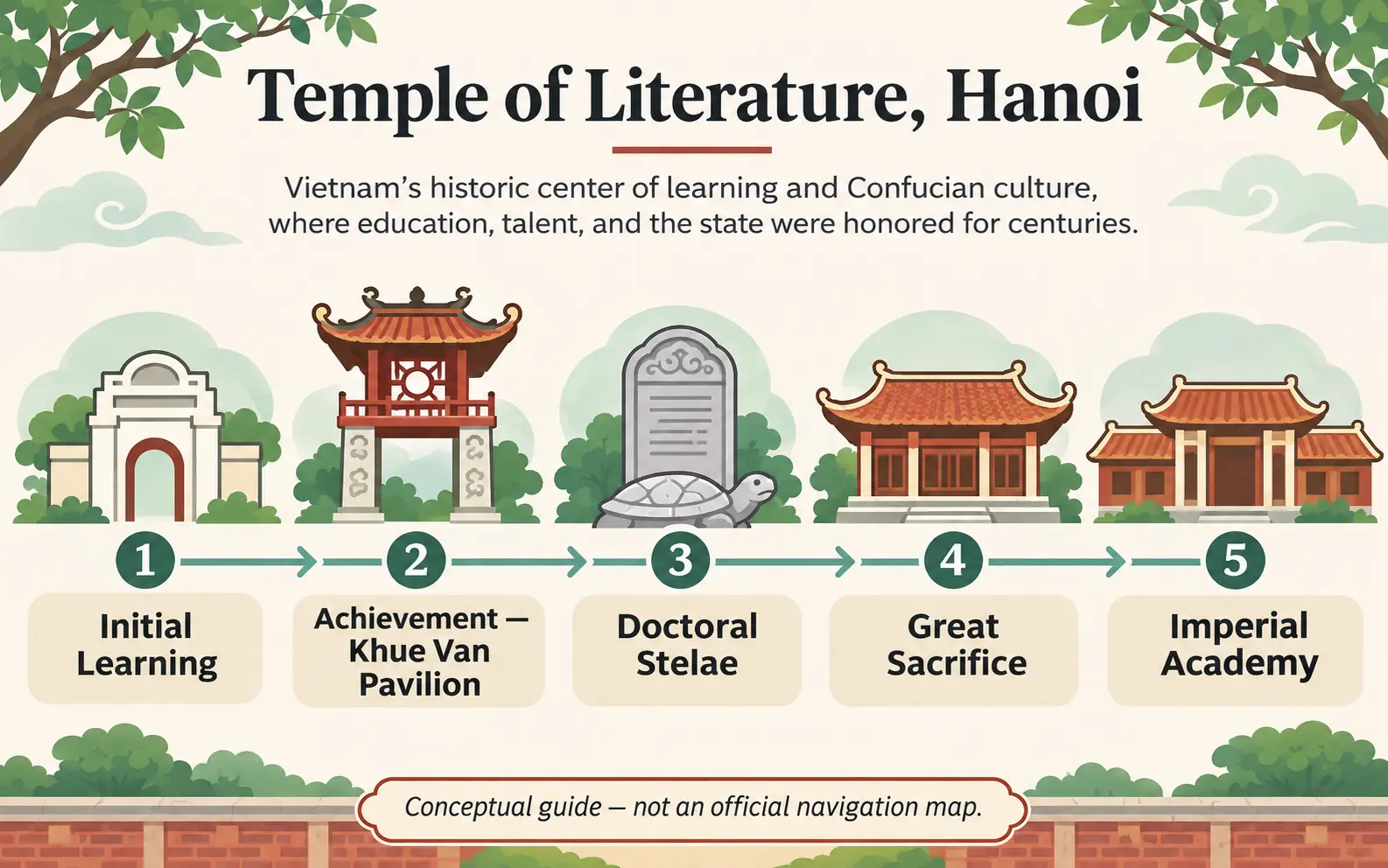
| Area | Main feature | What to notice |
|---|---|---|
| 1. Initial Learning | Đại Trung Gate | The first formal transition into the historic courtyards |
| 2. Achievement | Khuê Văn Các | Hanoi's well-known pavilion and its literary symbolism |
| 3. Doctoral Stele Garden | Thiên Quang Well and 82 stelae | Names and records of successful royal-examination candidates |
| 4. Great Sacrifice | Đại Thành Hall | The Confucian ceremonial and worship area |
| 5. Imperial Academy | Thái Học area | Educational history, reconstructed architecture and related displays |
Area 1: the Initial Learning Courtyard
After entering the complex, visitors move through the entrance area toward Đại Trung Gate. The arrangement of pathways, gates, trees and walls creates a calm transition away from Hanoi's traffic. Look at the alignment of the gateways rather than rushing through for the next photo. It helps you understand how the complex was designed as a sequence, not a collection of independent attractions.
Area 2: Khuê Văn Các, the pavilion associated with Hanoi
Khuê Văn Các is among the site's most recognisable architectural features. The pavilion was commissioned in 1805, and the venue's historical account states that it was selected as a symbol of Hanoi in 2012. Its elegant structure combines a square lower support with round openings above, traditionally interpreted in connection with literary and scholarly ideals.
Pause here to examine the roof, windows and symmetry. It is a meaningful photo stop, but its significance goes beyond appearance: the pavilion expresses the enduring social value placed on learning. For the architectural background, see the venue's explanation of the Achievement Courtyard.
Area 3: Thiên Quang Well and the Doctoral Stelae
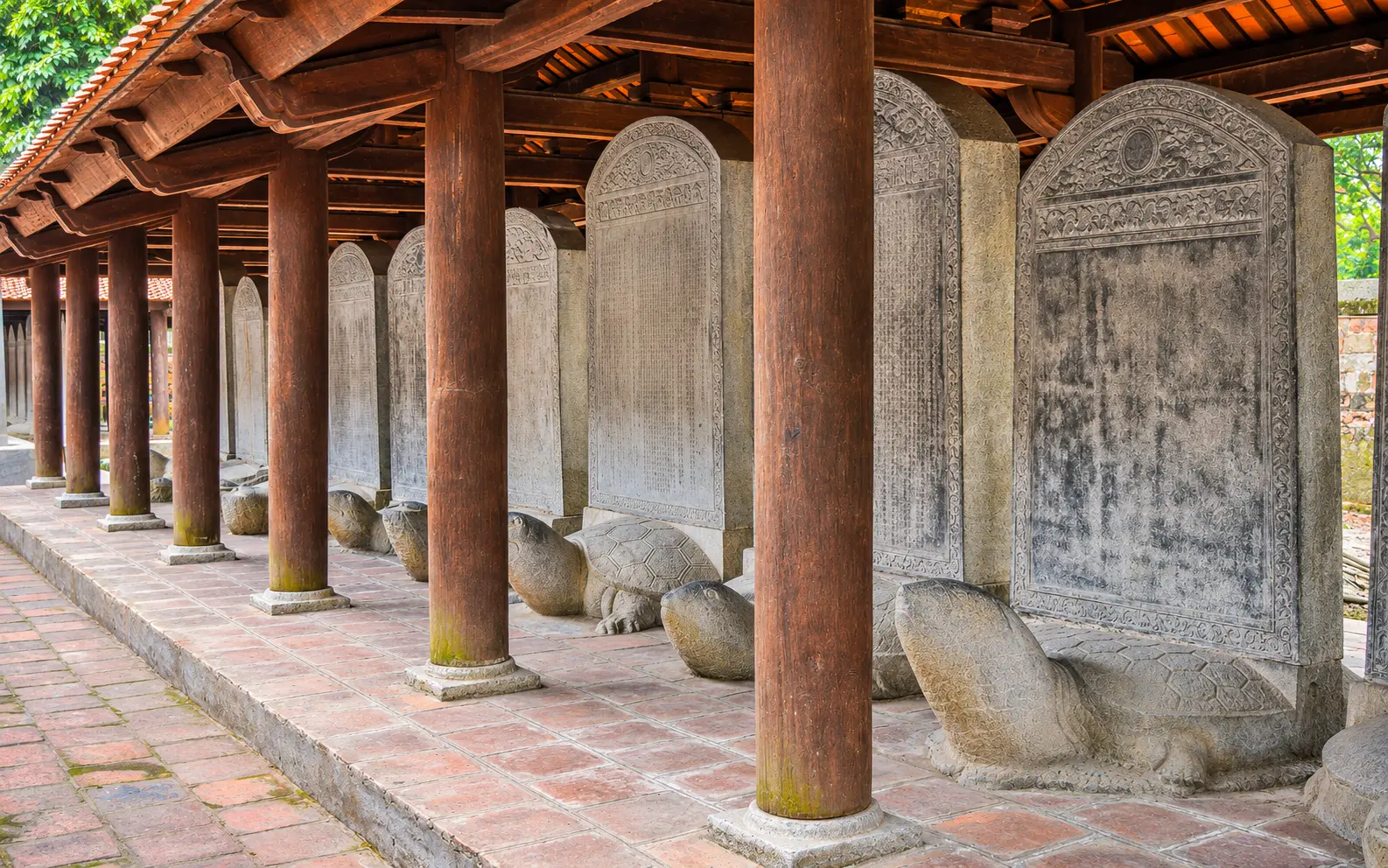
Near Thiên Quang Well, stone stelae mounted on turtle-shaped bases preserve records connected to Vietnam's royal examinations. These are important historical documents, not objects to rub or touch for good luck. Spend a few minutes observing the layout, carved texts and protective setting even if you cannot read the original Chinese characters.
There are 82 surviving doctoral stelae. Their inscriptions concern examinations held between 1442 and 1779; UNESCO registered this documentary collection in its Memory of the World programme in 2011. This recognition applies to the documentary heritage of the stelae. It should not be confused with a UNESCO World Heritage Site listing for the entire Temple of Literature.
Area 4: Đại Thành and the ceremonial spaces
The fourth area includes Đại Thành Hall and spaces associated with veneration of Confucius and distinguished scholars. The tone here is different from the open photography areas. Lower your voice, avoid interrupting ceremonies and follow instructions about entry, photography and where to stand. The site's visitor regulations specifically ask guests to dress respectfully in shrines and maintain quiet in sacred areas.
Area 5: Thái Học and the Imperial Academy story
The final main area connects the visit to the educational institution that gives Quốc Tử Giám its name. Look for information on the academy and the scholars honoured here. The current architecture reflects different historical phases, including later reconstruction, so the experience is best approached as a heritage interpretation of the academy's legacy rather than the unchanged classrooms of 1076.
For names, locations and any temporary closures, consult the official visitor map rather than treating a simplified online diagram as a navigation plan.
The 82 doctoral stelae: what makes them special?
Each surviving stele documents a royal examination and records names associated with the selection of educated officials. The inscriptions can also include dates and information about the people who prepared and engraved the text. Their significance is historical as well as artistic: they preserve evidence of how talent, scholarship and public service were understood across several centuries.
The turtle-shaped stone supports are especially memorable. Turtles have long-standing cultural associations with longevity and endurance, making them an evocative setting for a record intended to outlast generations. The material itself is fragile in the face of repeated contact. Do not touch the stelae or the stone turtles. This is consistent with the management's general rule protecting artefacts and historic structures.
For the authoritative description of their history and recognition, read UNESCO's Memory of the World entry.
Dress code, photography and respectful behaviour
Văn Miếu is a cultural landmark with sacred spaces. The official visitor regulations ask guests to wear respectful clothing when entering shrines and stay quiet in those areas. They do not, on the referenced visitor-information page, provide a universal centimetre-by-centimetre dress test. A practical choice is clothing that covers shoulders and knees, is comfortable in Hanoi's weather and is suitable for a heritage site.
Good visitor habits
- Speak softly in ceremonial areas.
- Respect barriers, signs and staff directions.
- Keep a comfortable distance from protected objects.
- Carry water and plan for time outdoors.
- Supervise children around stone steps and crowded paths.
Avoid
- Touching, rubbing or marking stone stelae.
- Stepping onto lawns or restricted platforms.
- Smoking inside the heritage site.
- Disrupting worship or cultural activities.
- Assuming every interior permits photography or flash.
For photography, check signs at the entrance to individual rooms. Restrictions may differ between outdoor courtyards, exhibitions and worship spaces. Avoid treating the absence of a visible prohibition in one area as permission everywhere. If you plan a commercial shoot, group event or professional filming, ask the site management about requirements in advance.
Best time to visit and how long to spend
A self-guided first visit can comfortably take 60–90 minutes. Allow more if you enjoy reading the displays, studying architecture or taking photographs. These are planning estimates, not a timed official route. The five main areas are close enough to explore in sequence, but your pace will depend on crowds, weather, exhibitions and mobility.
Early morning is a sensible option if you prefer cooler conditions and want a little flexibility before the venue closes. Midday can feel hot in warmer months because much of the visit is outdoors. A cloudy or lightly rainy day may be comfortable, but wet stone and thresholds deserve care. Hanoi's cooler months can be pleasant for walking; bring a light layer if the forecast calls for damp or chilly conditions.
A simple 75–90 minute first-time visit
- First 10–15 minutes: enter, orient yourself and pass through the first courtyard.
- Next 10–15 minutes: take in Khuê Văn Các and the architectural layout.
- Next 20 minutes: explore the well and doctoral stele area at an unhurried pace.
- Next 15–20 minutes: visit the ceremonial zone respectfully.
- Final 15–20 minutes: discover the Thái Học area, exhibitions and permitted exits.
Arriving near the published closing time is not ideal. The operator's public hours do not establish a guaranteed last admission time, and staff may need to close particular exhibits before the full site shuts. Check directly if your visit must happen late in the afternoon.
Getting to the Temple of Literature in Hanoi
The main entry is at 58 Quốc Tử Giám Street, in central Hanoi. From the Old Quarter and Hoàn Kiếm Lake area, walking may be practical for travellers comfortable with city traffic; the exact distance and time depend on your starting point. A taxi or ride-hailing service can reduce the walking required, although congestion and temporary road restrictions may affect the journey.
| Option | What to know |
|---|---|
| Walking | Useful from nearby central-Hanoi attractions; use a current map and cross busy roads carefully. |
| Taxi or app-based ride | Set the destination to the official entrance at 58 Quốc Tử Giám Street, not only the monument's central map pin. |
| Public bus | The site currently lists routes 02, 41, E08 and E09 near Tôn Đức Thắng Street, and route 38 near Quốc Tử Giám Street. Check service changes before travelling. |
| Motorbike or bicycle | The venue lists parking near Vườn Giám. Confirm access and parking instructions on arrival. |
Do not assume you will leave through the same gate used for entry. The operator lists an exit near 19–21 Văn Miếu Street and another path towards Vườn Giám. Check the current on-site route and meeting point if someone will collect you after the visit.
If you plan to continue sightseeing, the Vietnam National Fine Arts Museum is nearby. Other destinations in the wider central area can be paired with the visit, but confirm their own hours and ticket conditions rather than assuming a combined attraction pass exists.
Accessibility and visiting with children
Parts of the complex have historic gateways, changes in level and outdoor surfaces. Published traveller reviews differ on how easy they are to navigate with a wheelchair, pushchair or limited mobility, and this guide is not a physical access audit. Contact the venue directly to ask about step-free routes, accessible toilets, assistance and whether the exhibitions you want to see are reachable on your chosen date.
Families can enjoy the open courtyards, but young children may lose interest in detailed historical explanations. Plan shorter stops, keep children close near ceremonial areas and use the stelae as an opportunity to talk about protecting heritage. The venue's daytime age-based free admission can help with budgeting, but bring documentation if staff require proof of age.
Is the Temple of Literature worth visiting?
For a first-time visitor curious about Hanoi's history, education, architecture or traditional scholarly culture, the Temple of Literature is a strong choice. It offers something different from lakeside sightseeing and war-history museums: a place to understand how learning and service shaped public life over centuries.
It may be less appealing if you want a large interactive museum, need entirely step-free access without advance checks, or have very little interest in historical sites. In those cases, weigh the visit against your other priorities rather than going only because it appears on every Hanoi list.
You do not need to buy a guided tour to appreciate the main courtyards. Read the site's official signs and visitor information, use an audio guide if an appropriate option is available, or hire an independently verified guide if you prefer deeper interpretation. StartInVietnam does not claim to operate tours, sell tickets or certify guides at this attraction.
Temple of Literature Hanoi FAQ
Official sources and important updates
This independent editorial guide uses venue-published information for opening hours, admission and practical rules, with UNESCO for the doctoral stelae. Dynamic details such as ticket prices, special events, payment methods and closures should be reconfirmed shortly before travel.
- Văn Miếu – Quốc Tử Giám: Visitor Information — prices, hours, facilities, visitor rules, entrance and exit.
- Văn Miếu – Quốc Tử Giám: Official Tickets — payment options and QR ticket instructions.
- Văn Miếu – Quốc Tử Giám: Night Tour — separate event package and booking information.
- Văn Miếu – Quốc Tử Giám: Inner Temple — history and the five principal areas.
- Văn Miếu – Quốc Tử Giám: Khuê Văn Pavilion — architecture and symbolism.
- UNESCO Memory of the World: Stone Stele Records — international recognition of the 82 stelae.