An overnight cruise in Ha Long Bay can be a memorable way to see limestone islands beyond a short sightseeing trip, but the most appealing photograph or lowest advertised fare rarely tells you what you are actually buying. A good decision starts with the named vessel, the bay and route, how much time you will spend aboard, the full cost, and what happens if conditions change.
This guide helps you compare a Ha Long Bay overnight cruise without assuming that every operator follows the same timetable, includes the same activities or departs from the same pier. It also explains the questions to ask about safety, accessibility and cancellation before committing to a booking. Start with the length of stay, then use the cost and operator checklists to compare like with like.
Choose overnight if you want
An evening and morning on the water, a slower pace and a cabin experience that fits your budget and comfort needs.
Consider a day cruise if you want
A simpler commitment, fewer overnight logistics or a smaller total spend—and are comfortable returning to shore the same day.
Is a Ha Long Bay overnight cruise worth it?
There is no single answer to whether a Ha Long Bay overnight cruise is worth the money. Some travelers value watching the light change across the karst scenery, having dinner aboard and waking up near the bay. Others would rather spend their budget on a comfortable hotel and a day on the water. The right choice depends on the actual route, cabin and services—not simply the words “overnight cruise” in a search result.
Who benefits most from staying on the bay overnight?
Consider an overnight stay when the boat experience itself is part of the trip. The cabin, deck, meals and time after the day-trip crowds begin to leave may matter as much as any single sightseeing stop. A two-day, one-night program can work for people who enjoy a structured itinerary and are prepared to set aside two calendar days for travel, check-in, sailing and return.
Before deciding, read the actual embarkation and disembarkation times. Two calendar days do not mean two full days on the water. If you want an unhurried extra day, ask what a three-day, two-night package actually adds: a new route, an excursion, more free time, or simply a longer stay in the same area.
Who may prefer a day cruise instead?
A day cruise may suit someone with limited time, a tighter budget, a preference for a land-based hotel or concerns about overnight motion and confined cabins. It can also be easier to plan when accompanying travelers have needs that an unfamiliar boat cannot accommodate. But a day cruise is not automatically the more accessible choice: stairs, gangways, transfer boats and boarding arrangements still require specific checks.
Compare the total door-to-door travel time, not just the published sailing duration. A short cruise plus a long transfer from Hanoi may still take most of your day. Conversely, an overnight booking may be inconvenient if you need to reach an airport or another destination immediately after disembarking.
A quick overnight-cruise decision checklist
- Is the evening and morning on board a meaningful part of your trip?
- Can you commit the required calendar days, including transfers and a time buffer?
- Have you received a quote for your dates, number of guests and exact cabin type?
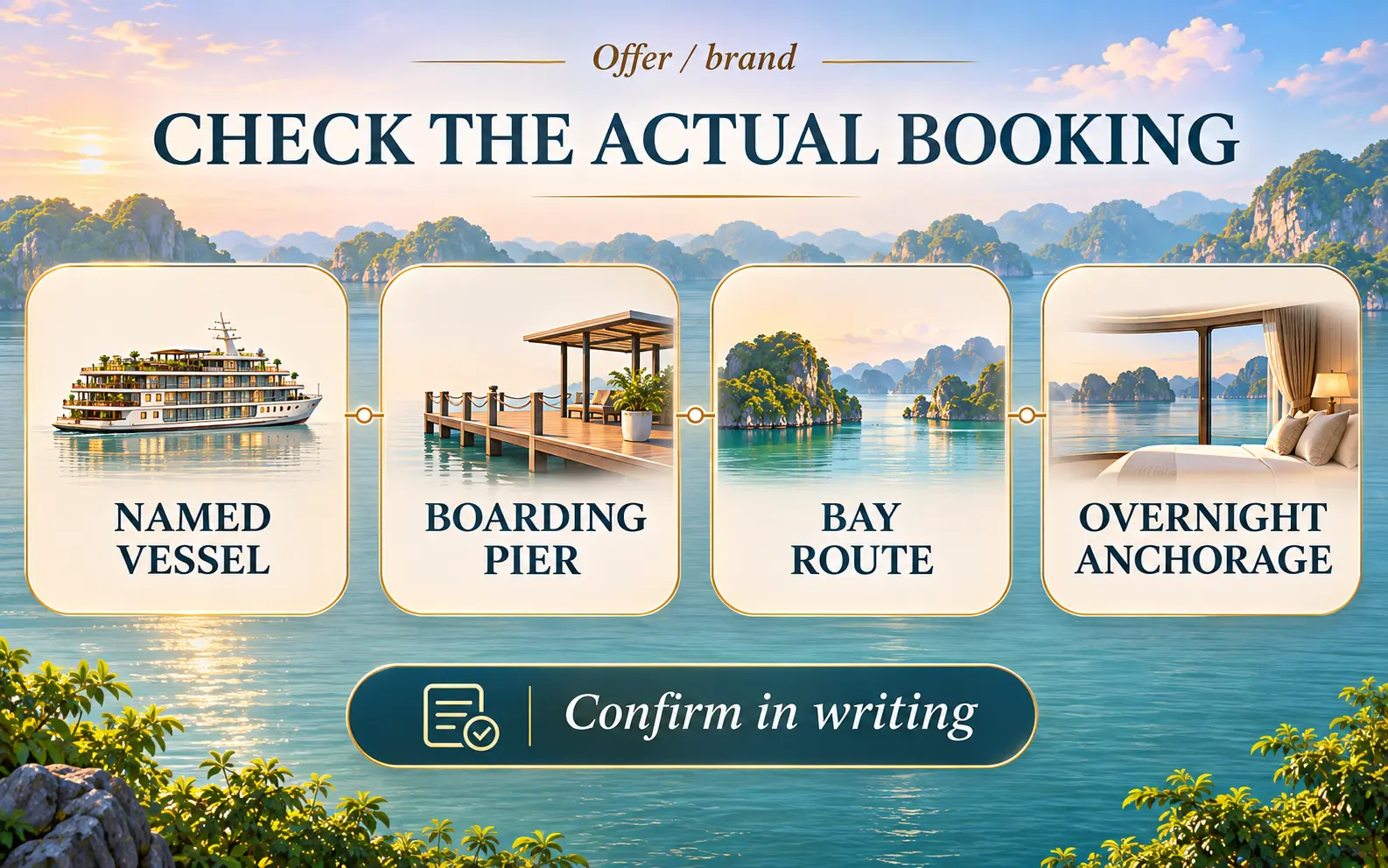
- Do you know the vessel name, boarding pier, expected route and overnight anchorage?
- Can the operator explain safety arrangements, weather changes and cancellation terms in writing?
If several answers are still unknown, compare options on paper before paying.
Day cruise vs 2 days 1 night vs 3 days 2 nights
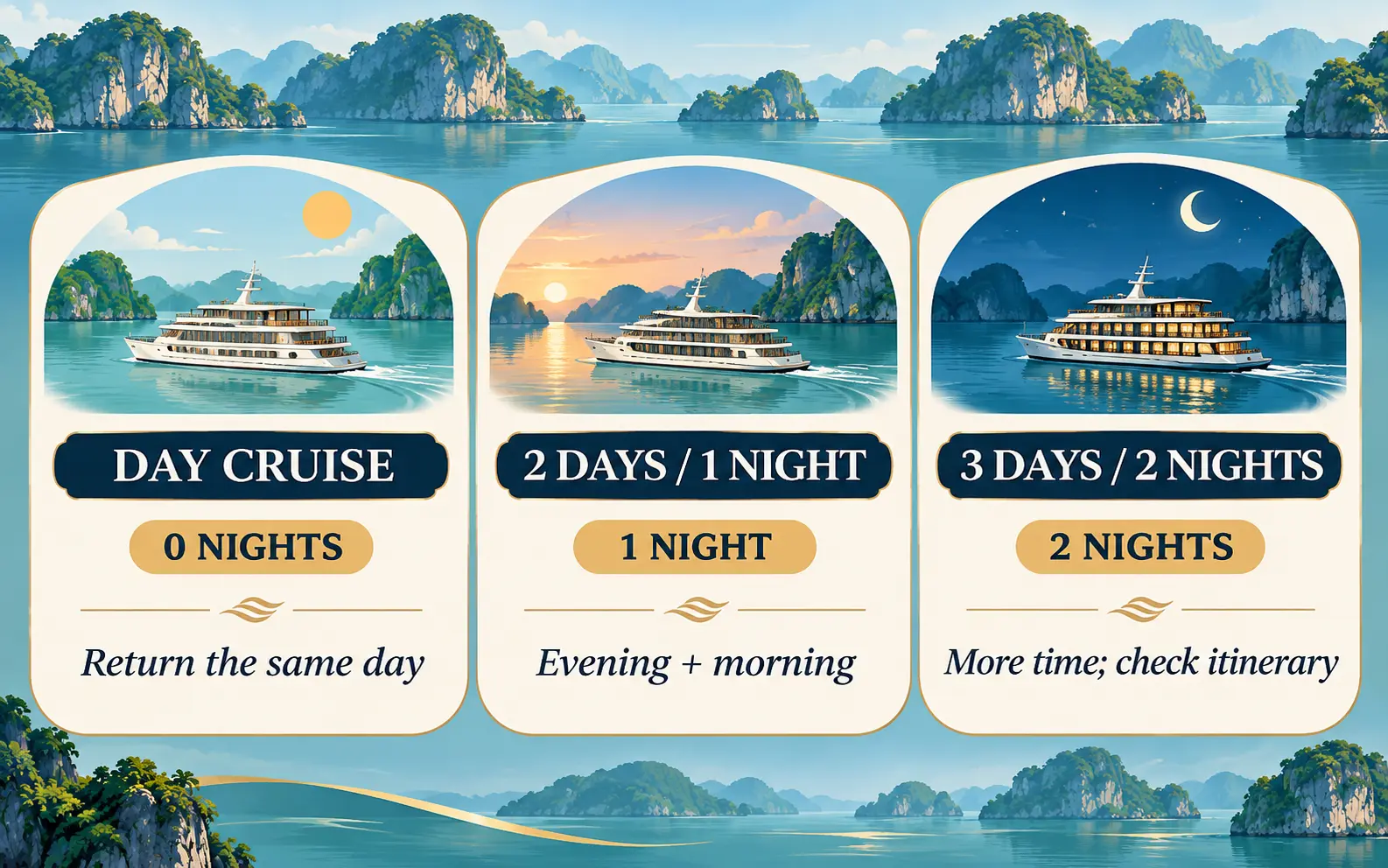
These labels describe how a package is marketed, not a universal schedule. A Ha Long Bay cruise for one night is usually presented as a two-day, one-night itinerary, while a longer stay may be sold as three days and two nights. The actual number of nights in a cabin, sightseeing time and transfer arrangements belong in the written itinerary.
| Option | What it generally means | Main advantage | What to verify |
|---|---|---|---|
| Day cruise | Board and return to shore on the same day | No overnight cabin commitment | Actual hours on water, pier, transfer and activity inclusions |
| 2 days / 1 night | Two calendar days with one night aboard | Evening and next-morning experience | Embarkation, disembarkation and number of hours aboard |
| 3 days / 2 nights | Three calendar days with two nights aboard | Potentially more time for a relaxed pace | Whether the extra day adds a different route or excursion |
A day cruise: what you gain and miss
Day trips can offer an introduction to the scenery without paying for a cabin. Depending on the specific route, they may include a stop for sightseeing or another optional activity. However, you will not spend the night aboard, and you may have less time for a quiet evening, a leisurely breakfast or activities that are scheduled the following morning.
Do not compare a bare day-cruise ticket with an overnight package as though they included the same services. Check meals, transfers, entry charges and activities first.
Two days, one night (2D1N): understand the real timetable
The phrase “2 days 1 night” means one overnight stay across two calendar dates; it does not guarantee 48 hours of cruising. A vessel may board passengers after a shore-side check-in and return the following morning or midday, leaving substantially less than two full days aboard. The schedule can also change for operational or weather reasons.
Ask for the detailed schedule showing where you meet the operator, when you step onto the main ship, when any tender is used, where you spend the night and when you are expected to leave the vessel. A clear timetable is especially important if you have a nonrefundable hotel, train or flight arranged afterward.
Three days, two nights (3D2N): what the extra night changes
A two-night itinerary can be worthwhile if it genuinely gives you more time on deck, a different area of the bay or an additional excursion. But do not assume that the longer package covers every famous cave or island. Some itineraries use a smaller day boat for an excursion while the main vessel stays in another area; others spend the extra time more slowly.
Request separate Day 1, Day 2 and Day 3 schedules. Check where each night is spent, whether the same cabin is yours throughout, which activities can be canceled and whether additional meals or transfers are included in the total quote.
Which bay and route will your cruise actually visit?
The name on a sales page may say “Ha Long Bay” even when some of the experience takes place in Lan Ha Bay or Bai Tu Long Bay. That does not automatically make the trip worse; it means the precise itinerary matters more than the label. Your practical task is to identify the bay, the boarding location and the overnight anchorage of the specific product you are buying.
Classic Ha Long, Lan Ha and Bai Tu Long in booking descriptions
These names refer to different parts of the wider coastal cruising area, and they appear in operator marketing in different ways. A cruise may focus on classic Ha Long scenery, advertise Lan Ha excursions or offer a Bai Tu Long itinerary. The more useful question is what route the named vessel will actually operate on your departure date, and whether planned stops are included or optional.
Official announcements have described regulated connected overnight routes between Ha Long and Lan Ha. That is useful context, but the existence of a route does not prove that any individual booking will use it. For primary-source context, read the Quang Ninh announcement on connected overnight itineraries; for your own trip, rely on the operator's confirmed route and departure documents.
Check the boat route and overnight anchorage
Ask for a written itinerary with the named ship, the bay or bays visited and the authorized overnight anchoring area. A marketing description such as “sleep among the limestone islands” is not specific enough to establish where the vessel will stay. The itinerary should also identify any transfer to a smaller boat and any stops that are contingent on conditions.
If the seller changes the vessel or the route, ask whether the revised option is equivalent for your priorities.
Confirm the pier, transfer boat and boarding point
Do not treat Ha Long International Cruise Port, Tuan Chau and Cat Ba departure points as interchangeable. They can differ in transfer time, ticketing, meeting instructions and the vessels operating from them. A package advertised as “from Hanoi” might mean a pickup service, not that the cruise itself sails from Hanoi.
Ask for the full pier address, meeting point, arrival window and contact number for the day of departure. If you must transfer by tender, ask where it happens, how baggage is handled and whether anyone in your party may have difficulty using the boarding arrangements.
Choose the vessel, cabin and level of comfort
Once you have narrowed down the duration and route, compare the actual vessels and rooms rather than choosing solely by branded photographs. Two cabins sold under the same cruise brand may differ in position, size, window type and occupancy. Even two products with similar star labels may have different inclusions or operational arrangements.
Confirm the actual ship, not only the brand name
Some sellers list a fleet, a representative vessel or an option that may be substituted according to availability. Before paying, ask for the exact vessel expected to operate your sailing and the company responsible for the voyage. Also ask what happens if the boat is replaced and whether you may decline or change a materially different replacement under the written booking terms.
A vessel name alone is not proof of current permission to operate. Seek confirmation of the ship's registration and relevant inspection status through the provider and, where available, the appropriate port or authority. Do not confuse a marketplace badge, a promotional rating or a photograph with such evidence.
Cabin type, deck and comfort tradeoffs
Confirm whether you are paying for a cabin or a per-person berth; whether the cabin is twin, double or family-sized; and how additional guests are accommodated. A “balcony cabin” should have its specific balcony arrangement confirmed, while a window cabin may have different views or restrictions. Check the deck level, expected noise, bed configuration, bathroom and air-conditioning details.
If you are sensitive to motion, stairs or noise, explain your needs before choosing a room. A requested cabin location is only helpful if the operator can confirm the exact ship and assign that cabin or an equivalent in writing.
Budget, comfort or luxury: what labels do not prove
A budget-focused package may be adequate for someone who prioritizes time outdoors over onboard amenities. A comfort-oriented trip might place more value on cabin layout and service. Luxury marketing may highlight space, dining or additional facilities. These are shopping categories, not regulated promises of a particular safety outcome.
A high advertised star count does not substitute for confirmation of the boat, operating arrangements or emergency procedures. Compare what a specific fare buys, the real cabin you will occupy and the cancellation conditions.
Ha Long Bay overnight cruise costs: compare the total
The question “how much does a Ha Long Bay overnight cruise cost?” cannot be answered responsibly with one timeless figure. The total may depend on sailing date, cabin, number and ages of travelers, route, transfer arrangements, inclusions and booking conditions. Reseller prices can also be presented per person, per cabin or under assumptions that are not obvious from a search snippet.
Rather than rely on an isolated price tag, compare the total amount your group will actually pay for equivalent dates and accommodations. Ask each provider to state the price, currency, payment schedule, inclusions, exclusions and amendment rules in writing.
Cabin rate vs per-person quote
When a listing says “from” a price, check the conditions behind it. Is that rate based on two adults sharing a standard cabin? Is it a price for the cabin, an individual passenger or a minimum group? Does the rate change for a solo traveler, children, a larger cabin or a holiday departure? What currency will the provider actually charge?
Ask for a final quotation with the dates, all travelers, cabin type and any taxes or mandatory charges explicitly shown. Keep the itinerary and the payment terms with the quote.
Bay entry and overnight fees are not the full cruise fare
Ha Long Bay's heritage management authority publishes route-specific visiting and overnight fees. These charges are not the same thing as the accommodation, food and services sold in a cruise package, and applicable amounts or routes may be revised. Confirm the rules relevant to your actual itinerary and departure rather than transferring an old fee table into a current booking decision.
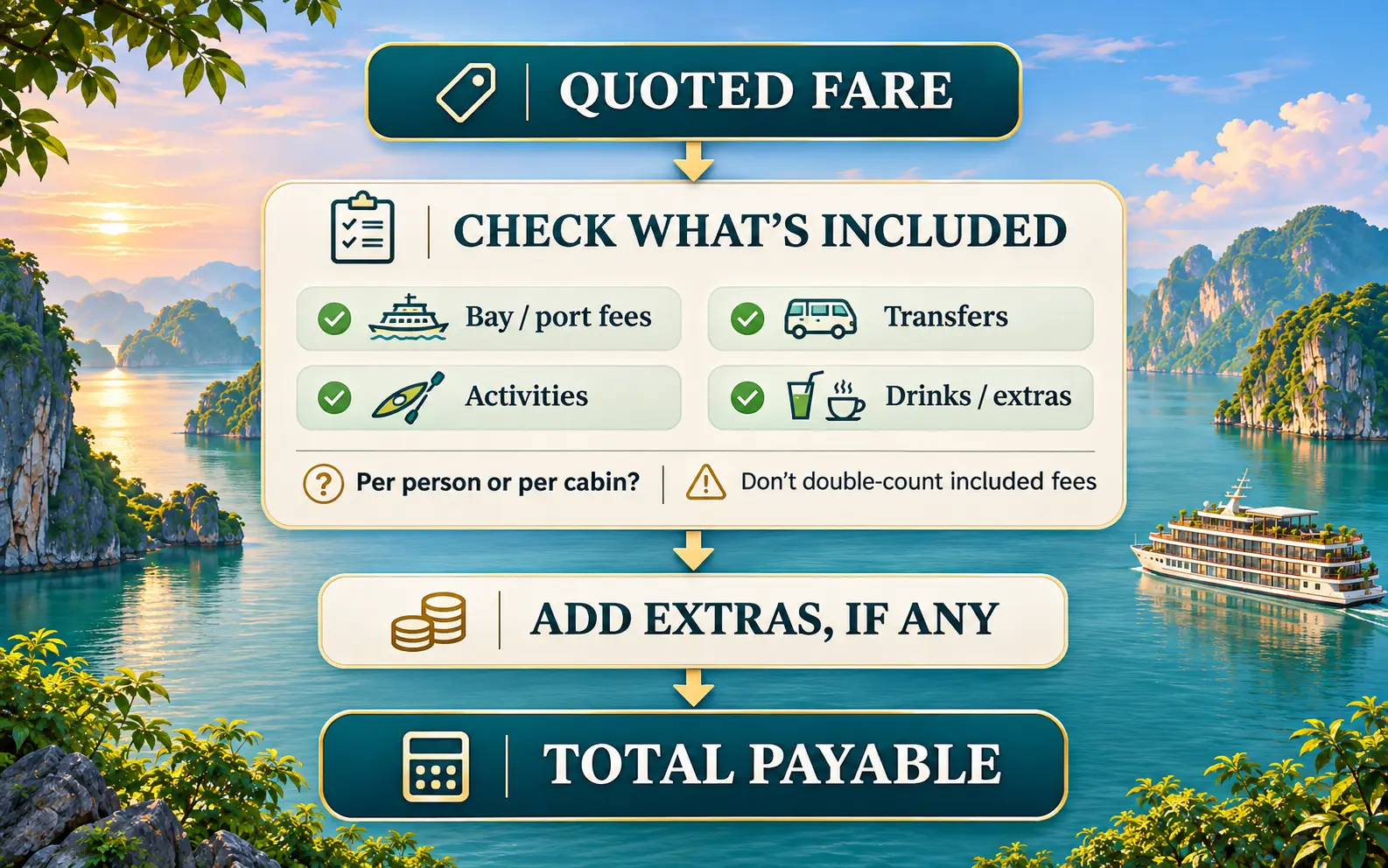
Most importantly, ask whether those charges are already included. An operator may bundle sightseeing or overnight fees into the published package price. Adding the same charges again would inflate the comparison. If a seller states that a fee is extra, ask which fee it is, who collects it and why it is not covered by the package.
Port charges, meals, activities and transfers: included or extra?
Separate departure-port charges from bay visiting fees, and separate both from the cabin fare. For example, Ha Long International Cruise Port has published its own passenger-fee notice. That notice applies to the named port; it is not a universal tariff for every boarding pier. The amount relevant to you may also already be included in your chosen package.
Compare meals, drinks, transportation from Hanoi, kayaking or other optional activities, taxes, tips, cabin upgrades and special-diet costs. Some activities may be included but unavailable if conditions change. A “full board” phrase should be backed by a list of meals and exclusions, not assumed to cover every drink or service on board.
A total-cost comparison before booking
| Line item | Cruise A | Cruise B | Question to ask |
|---|---|---|---|
| Base rate | Request quote | Request quote | Same date, guest count and cabin standard? |
| Bay and overnight fees | Included / extra? | Included / extra? | Relevant route, already bundled? |
| Port charges | Included / extra? | Included / extra? | Which actual departure port? |
| Meals and activities | Itemize | Itemize | Which items cost extra or depend on conditions? |
| Hanoi or onward transfer | Included / extra? | Included / extra? | Pickup area, bags and drop-off location? |
| Changes and cancellation | Written terms | Written terms | Refund or rebooking rules for the booked fare? |
| Total payable | Confirmed amount | Confirmed amount | All compulsory items accounted for without double-counting? |
What a one-night (2D1N) cruise may look like
It is useful to understand the shape of a two-day, one-night itinerary, but an illustrative timeline must not be mistaken for a guaranteed schedule. Operators such as Bhaya publish specific overnight programs showing how boarding, meals and activities may be arranged. Your confirmed booking—not another company's example—determines your actual day.
Boarding and the first afternoon
A typical pattern is to reach the pier, complete check-in, join the vessel and receive orientation before sailing or the first activity. Lunch or an early meal might take place aboard. Depending on the operator and route, the afternoon could involve sightseeing, a cave visit, time on deck or an activity using another craft.
However, not every departure follows that sequence. Do not plan around a particular cave, kayaking stop, swimming opportunity or boarding time until you have the actual schedule. Confirm whether transportation from Hanoi is part of the package or must be arranged independently.
Dinner, the night aboard and next morning
For many travelers, the reason to stay overnight is the quieter rhythm of evening and morning: a meal, time outside if conditions permit and a chance to see a different side of the seascape. Some programs also advertise cooking demonstrations, squid fishing, exercise sessions or other activities. These may be optional, weather-dependent or absent from your specific package.
Ask about the overnight mooring location, nighttime access to decks, meal times and what the crew will do if conditions deteriorate. Follow the vessel's safety instructions and do not assume that swimming, small-boat trips or deck access will be available at every hour.
Disembarking, onward transfer and tight connections
The second day may begin with breakfast and a final activity before returning toward the pier. Actual disembarkation time, baggage collection and road transport can differ. If a package advertises “two days,” check the hour at which you really leave the main ship, rather than assuming you can spend the entire second day aboard.
Avoid arranging a tight onward flight or train based only on the planned return time. Bad weather, traffic, additional transfer stages or operational adjustments can affect the schedule. Leave a practical buffer and ask the provider how delays are communicated.
How to choose the best cruise for your priorities
The best Ha Long Bay overnight cruise for one traveler might be a poor match for someone else. A family may prioritize connecting cabins and child-sized safety equipment; a couple may care more about a quiet deck and cabin privacy; a traveler with limited mobility may prioritize the actual boarding path above amenities. There is no credible universal ranking without consistent, verified comparisons.
Build a best-for-you shortlist
Begin with non-negotiable conditions: correct duration, actual vessel, suitable cabin, feasible boarding arrangement, verified total price and acceptable written cancellation terms. Then compare secondary preferences such as scenery, dining, activity choices and time to relax. Consider each option against the same criteria rather than allowing one striking photograph to dominate the choice.
For a practical shortlist, compare two or three real quotations in the same date window and with equivalent cabin occupancy. If a supplier cannot name the ship or explain the itinerary, leave that information unverified instead of awarding the option a high score. An attractive package should not bypass basic safety and booking checks.
Read reviews and check supplier claims critically
Travel reviews can reveal recurring concerns about cabins, noise, transfers or communication. They can also be subjective, outdated or about a different vessel in the same fleet. Look for details matching the ship and cabin you are considering. Be cautious about descriptions that promise an uncrowded bay, a guaranteed stop or an exceptional experience in all conditions.
Distinguish a firsthand review from a commercial tour listing and both from an official operating notice. A marketplace rating may help you identify questions to investigate, but it does not confirm the validity of a vessel's current documents, a particular sailing's authorization or the likelihood of disruption.
Safety checks to ask before paying
Safety is not something a travel article can certify for a named ship. Vietnam has technical requirements for overnight tourist vessels, and authorities publish information about oversight and inspections. For background, see the government record for overnight-vessel technical and environmental requirements and the heritage authority's inspection reporting. Neither source confirms the operating status of a vessel you have not identified.
Ask about vessel registration, operating status and actual sailing
Request the expected vessel name, operator, departure pier and itinerary. Ask the company how it confirms that the vessel is currently authorized and inspected for the intended service and route. If the booking intermediary is not the boat operator, request the actual operator's details rather than accepting only the intermediary's sales name.
Check how ship substitutions are handled. A promise that all alternatives are “equivalent” should be supported by cabin, accessibility, itinerary and refund details. The existence of a valid-looking website or a positive review is not enough to establish a ship's present operating condition.
Lifejackets, exits, fire precautions and briefing
Before your trip, ask whether the crew provides a safety briefing and where passengers can find appropriately sized lifejackets, exits and emergency instructions. Once aboard, pay attention to the briefing, locate the exits and ask questions if an instruction is unclear. Families should ask whether suitable flotation equipment is available for each child.
For any specific vessel, emergency procedures and equipment are matters for the operator and competent authorities to verify. This guide does not inspect ships, provide a certificate or guarantee that any voyage is free of risk. Do not allow a hospitality rating to replace these questions.
Tenders, steps, ladders and nighttime access
Some itineraries involve boarding from a pier, crossing a gangway or transferring by a smaller tender boat. Movement between decks may require narrow stairs, steep steps or ladders. Ask whether any excursion requires entering a small craft, walking on wet surfaces or using a ladder to return to the main vessel.
If anyone in your group needs assistance, ask for a written description of the complete boarding and disembarkation path. Discuss movement at night, access to the dining area and the practical location of the cabin. Never assume that a vessel with large public rooms is wheelchair accessible throughout.
What would make you pause before paying?
- The seller will not identify the ship, company or boarding pier.
- The route and overnight anchoring location remain vague after you ask.
- The amount due, compulsory extras or payment recipient cannot be confirmed.
- Terms for weather cancellation, replacement boats or schedule changes are missing.
- The provider avoids questions about lifejackets, transfers, passenger needs or check-in requirements.
These are reasons to investigate further, not proof that a particular company has broken the law. If essential questions remain unanswered, choose a provider that can explain its offering clearly.
Weather, sailing decisions and refund conditions
Conditions on the water can affect departures, routes, anchorages, swimming and kayaking. A forecast is an aid to planning; it is not permission for your specific boat to sail. Booking terms also vary, so a canceled excursion does not automatically have the same refund outcome as a canceled overnight voyage.
Check forecast and the same-day departure decision
Before traveling, consult the national marine weather forecast for regional conditions and contact your cruise operator for instructions. Regional wind or wave information alone does not establish whether the local port has approved departure. Ask the provider to confirm the actual sailing status through the appropriate authorities.
Check again near your transfer and boarding time. Conditions can change between booking and travel. Do not travel to a distant pier solely because an automated availability calendar still displays the departure as bookable.
What happens when weather changes activities or routes?
Weather, tide and operational decisions may lead to a different sightseeing stop, a shorter small-boat outing or the removal of swimming and kayaking. Read the written itinerary to see which activities are included, which are optional and which depend on safe conditions. The operator should explain who makes the decision and how passengers are informed.
If the substitute route, boat or duration differs from the product you purchased, ask what options the contract provides. A canceled activity does not automatically mean a full refund of the entire cruise.
Ask for cancellation and rescheduling terms in writing
Before paying, ask what happens if the port restricts departures, the operator cancels, a change occurs after boarding or you cancel for personal reasons. Request the rules for refunds, credits, rescheduling, deposits, partial services and any deductions. Those rules may vary by supplier and by the specific rate selected.
If you booked through a marketplace, ask whether it or the operator handles refunds. Never assume storm cancellations are refundable unless your rate terms explicitly say so.
Special considerations: families, mobility and food
The most important suitability questions depend on the actual vessel. A family-friendly photograph, a spacious lobby or an advertised meal plan does not necessarily answer whether your child can board safely, whether a passenger can use the stairs or whether a serious food restriction can be accommodated.
Children, extra beds and appropriately sized lifejackets
Ask about the minimum accepted age, adult-to-child arrangements, room occupancy, extra beds or cots and the additional cost of children. Confirm that each child's size can be accommodated by the available lifesaving equipment, and ask how crew members assist families during boarding or tender transfers.
Do not assume that a family cabin, swimming stop or childcare service exists on every ship. Compare the written terms and cabin layout for your actual party. For very young children, pay special attention to balcony access, steep stairs, deck barriers and whether the operator considers the planned activities suitable.
Mobility, stairs, tenders and cabin access
Describe specific needs rather than asking only whether a cruise is “accessible.” Can someone use a gangway without steps? Is a wheelchair able to reach the cabin, dining area and emergency assembly location? Will a tender be required? Are handrails present on the routes passengers must use?
Request written confirmation for the named ship and itinerary. If the operator cannot provide a reliable answer, treat the accessibility of that part of the trip as unknown. A different cabin, route or shore-based experience may be more appropriate than relying on a general claim.
Food allergies, seasickness and cabin comfort
Send dietary restrictions and allergy information before booking and ask whether the kitchen can manage them, how cross-contact is handled and which meals are included. “Vegetarian options” or “special diets on request” is not enough for someone who needs strict allergen controls. If arrangements are essential, request direct confirmation rather than assuming every kitchen can guarantee them.
For travelers sensitive to motion, discuss the vessel, cabin location and weather flexibility with the operator. Bring personal essentials appropriate to your needs and seek professional medical advice where necessary. Also check cabin ventilation, bathroom arrangement and noise considerations if these affect your comfort.
Departure ports, transfers and pre-booking checklist
A cruise can look easy to book but become complicated when the meeting point, transfer and documents are unclear. Most avoidable pre-trip confusion comes from assuming that “Ha Long departure,” “Hanoi pickup” and “port transfer included” all mean the same thing. They do not.
Which port should you depart from?
The correct port is the one on your confirmed booking, not the nearest pier shown in a travel photograph. Ask whether departure is from Ha Long International Cruise Port, Tuan Chau or another named location, and request a map pin or full written address from the operator.
Port-specific fees and boarding procedures may differ. If the boat is reached by tender, ask where you meet that tender and who helps with luggage. This is particularly important when comparing products sold by intermediaries who may use general location labels.
Hanoi transfers and passenger identity details
Clarify whether pickup from Hanoi is included, optional or arranged separately. Ask for the specific pickup zone, vehicle type, luggage rules, expected journey buffer and final drop-off point. A transfer advertised as “from Hanoi” does not imply that the ship departs from the city itself.
Foreign travelers may be asked for passport or nationality details to complete booking and visitor-ticket processes; follow the operator's legitimate requirements and check how sensitive information is collected. Quang Ninh has published visitor-ticket identity guidance, but the exact documents and collection process for your sailing should be confirmed directly with the provider.
The final ten questions to send an operator
Before you pay, copy the following questions into your own message and ask the provider to respond against the specific dates and guest count:
- What is the exact operating ship name and responsible company?
- Which pier and check-in point do we use, and when must we arrive?
- Which bay, approved route and overnight anchorage are planned?
- How many nights will we actually spend aboard, and what are the embarkation and disembarkation times?
- Which exact cabin and occupancy arrangement are included?
- What is the full payable amount for our party, and which compulsory fees are included?
- Which meals, transfers and activities are included, optional or weather-dependent?
- How are vessel inspection, lifejackets, safety briefing and tender transfers handled?
- Can the ship accommodate our children's, accessibility or dietary requirements?
- What are the written terms for bad weather, changed routes, replacement vessels, cancellation and refunds?
Compare the completeness of the answers, not just the politeness of the sales response. Keep confirmations and payment records together so you can refer to the agreed product if arrangements change.
Ha Long Bay overnight cruise FAQs
How much does a Ha Long Bay overnight cruise cost?
There is no dependable evergreen price that covers every ship and date. Request a quote for your travel dates, party size and cabin, then confirm whether bay tickets, port charges, meals, activities and transfers are already included. Check the cancellation conditions before comparing totals. A per-person promotional rate is not necessarily the amount your entire party will pay.
Is a one-night Halong Bay cruise worth it?
It can be, particularly if you value time on the water in the evening and following morning. A one-night trip may feel rushed if the transfers are long or if you expect two full days aboard. Review the precise 2D1N timetable, route and cabin before deciding whether the experience offers enough time for your travel style.
What is the best Ha Long Bay overnight cruise?
The best option is one that meets your priorities and can document what it is selling. Compare the named ship, planned route and overnight location, cabin suitability, all-in price, practical safety questions and written changes or refund terms. Treat star ratings and “best cruise” lists as starting points for research rather than proof that one vessel is best for everyone.
Does an overnight cruise always include meals and refunds?
No. Meals and activities are package-specific, and the outcome of a cancellation depends on the purchased rate, provider, reason and applicable conditions. Ask exactly which meals, taxes, bay and port fees are included, and obtain the written rules for cancellations, bad weather, substitution and rescheduling. Do not assume a booking is all-inclusive or automatically refundable.
The most useful next step is simple: choose the duration that suits you, request comparable written quotes, confirm the named vessel and exact route, and resolve any safety or cancellation questions before paying. An overnight cruise should be selected for the experience it actually offers—not for an unverified promise attached to a beautiful image.