Hue rewards travelers who are willing to slow down. Behind its moats and gateways are the stories of Vietnam’s Nguyen emperors; beyond them are quiet gardens, elaborate royal tombs, riverside walks, markets and food traditions that are just as memorable as the monuments. If you are deciding what to do in Hue on a first visit, the best approach is to choose a few places thoughtfully rather than rush through a long checklist.
This guide brings together the most worthwhile things to do in Hue, Vietnam, with practical choices for different interests and one-, two- and three-day stays. It also explains what the historic sites actually are, how to choose between the famous tombs, and which plans need extra time, good weather or advance checks. Opening arrangements, admission rules and local services can change, so official links are provided where those details matter.
Is Hue Worth Visiting? Choose Your Best First Day
For a traveler interested in Vietnamese history, architecture and regional culture, Hue is much more than a stop between Da Nang and Hanoi. The city was the capital under the Nguyen dynasty, and its Complex of Hue Monuments is on UNESCO’s World Heritage List. But you do not need to be a history specialist to enjoy it. The rhythm of the Perfume River, a bowl of local noodles and a walk through a historic neighborhood can make a rewarding day on their own.
Quick choices for heritage, food, crafts and unhurried travel
For first-time history lovers
Start with the Imperial City. Add one royal tomb on a second day if you want to understand how architecture and landscape expressed royal identity.
For food-focused travelers
Combine a central heritage walk with a meal of Hue specialties, a visit to Dong Ba Market and a relaxed evening by the river.
For culture and craft enthusiasts
Look into incense-making traditions, museum collections and royal music heritage, checking whether a specific demonstration or performance is actually available.
For a gentle-paced visit
Choose one major monument, a riverside stroll and enough room for coffee, rain or an unexpected restoration closure.

How long to spend in Hue if this is your first visit
One day works as a selective introduction, especially if you focus on the Imperial City and central Hue. Two days allow a more comfortable contrast between the historic center and one or two royal tombs outside it. Three days give you flexibility for food, culture, craft villages or a weather-dependent side trip. These are planning suggestions, not a promise that every site will be available or that travel between them will be quick.
If you prefer long visits to museums, are traveling with children, or need to pace walking and steps carefully, allow extra time. Hue can be more enjoyable with fewer tickets and more attention to what you are seeing.
What to prioritize if you only have a few hours
Choose a single anchor: the Imperial City for royal history, a riverside and food circuit for atmosphere, or a prearranged royal tomb visit if that is your main interest. Do not assume the Imperial City, distant tombs, countryside attractions and an afternoon transfer can all fit into a short stop. If arriving late, check last-admission rules before purchasing transport or tickets.
Explore Hue Imperial City, the Citadel and Forbidden Purple City
The most recognizable attraction in Hue is not one isolated building. It is a layered historical landscape of defensive walls, ceremonial spaces, palace compounds and restored or surviving structures. Understanding these layers makes the visit far more meaningful than trying to photograph every gate.
Hue Citadel vs Imperial City vs Forbidden Purple City
Hue Citadel refers to the fortified urban enclosure of the former capital. Imperial City, also called Hoang Thanh, is the inner royal and ceremonial precinct. Within that is the Forbidden Purple City, historically associated with the emperor’s private household and court life. These names are connected, but they are not interchangeable. UNESCO’s site description explains the relationship and the wider heritage complex, which also includes monuments beyond the Citadel.
Visitors often use the convenient term “Imperial City” for their main ticketed heritage visit. That does not mean every structure in the broader Citadel is covered by the same ticket or accessible at the same time.
Key architectural areas to understand on a first visit
The ceremonial approach around Ngo Mon Gate provides a sense of the scale of the imperial precinct. The Thai Hoa Palace area is especially useful for thinking about court protocol and official audiences, while other courtyards and restored spaces reveal how much of the royal city has changed over time. Labels, conservation work and access routes can evolve, so follow current interpretive signs rather than an old online floor plan.
As you walk, pay attention to the contrast between large formal axes and smaller gardens or passages. Some original buildings did not survive; others have been reconstructed or are undergoing conservation. This is part of the site’s story, not a reason to treat every building as an untouched original. Wear comfortable shoes, carry drinking water and respect barriers around fragile or restricted areas.
Time, ticket scope and temporary restoration checks
Give the Imperial City a substantial part of your day if you enjoy historical detail, photography or unhurried walks. Before leaving, check the Hue government’s monuments visitor information for current admissions and combination tickets, plus any site notices. Ticket sales closing, last entry and final exit may be different times; do not rely on a blanket “all sites close at five” rule.
Allow for heat, exposed courtyards, uneven surfaces and steps. A major heritage designation does not by itself certify an accessible route through every part of the complex. Travelers with mobility needs should confirm the precise entrance and available route with the monument manager before committing to a visit.
Which Royal Tombs in Hue Should You Visit?
The royal tombs are among the best things to do in Hue, but they are not interchangeable “extra stops” immediately next to the Imperial City. They sit in different landscaped settings outside the central sightseeing cluster, and each rewards a different kind of visitor. You will usually have a better experience choosing one or two than racing between several.
Minh Mang Tomb: landscaped architecture and longer walks
Minh Mang Tomb is a good choice if you appreciate symmetry, water features, tree-lined paths and formal planning. Architecture and natural setting are meant to be experienced together. It suits visitors who enjoy walking through a larger landscape and pausing to understand the procession of courtyards, gates and gardens. Expect outdoor exposure, and do not assume that every part of the route will be step-free or open.
Tu Duc Tomb: gardens, pavilions and a slower visit
Tu Duc Tomb offers a different mood: lakes, gardens and poetic associations often appeal to travelers looking for a reflective experience. The grounds lend themselves to a more leisurely visit, but the amount of walking depends on the areas that are available. Restoration or temporary restrictions may affect a particular pavilion or route. Check the current status rather than planning around a single photo from an older travel guide.
Khai Dinh Tomb: a hilltop visit with stairs
Khai Dinh Tomb is the choice for visitors drawn to dramatic architecture and richly decorated interiors. Its distinctive mix of materials and elaborate mosaics creates a striking contrast with the landscape-led settings of the other tombs. The approach involves ascending flights of steps and elevated platforms, making it a less suitable spontaneous stop for someone who cannot manage stairs. Do not assume that an alternative step-free route exists without direct confirmation.
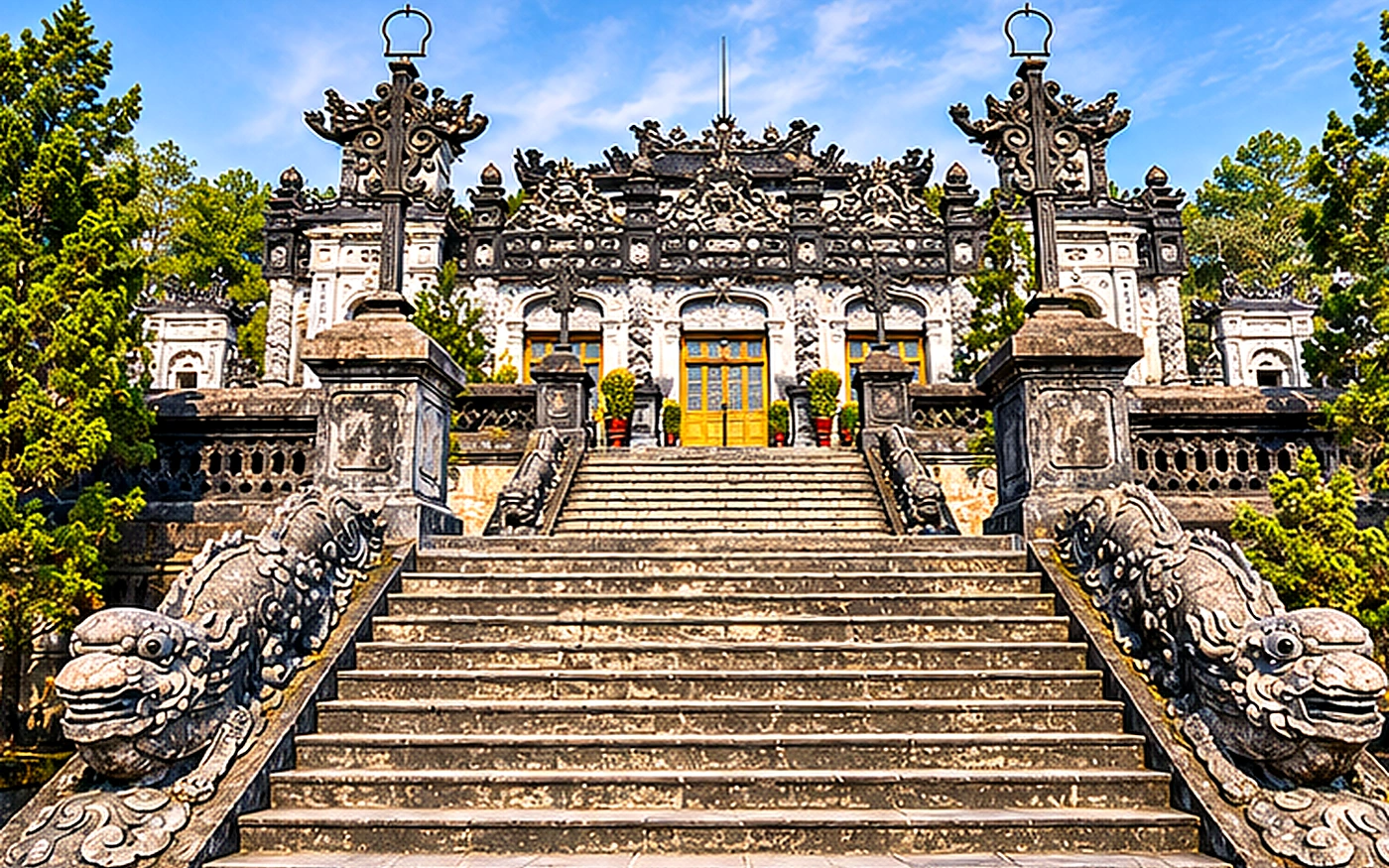
A practical one-or-two-tomb decision table
| Tomb | Choose it for | Planning consideration |
|---|---|---|
| Minh Mang | Formal layouts, gardens and water features | Allow time for an outdoor walking visit. |
| Tu Duc | A reflective atmosphere, lake and pavilions | Check which garden and building areas are accessible. |
| Khai Dinh | Striking stairs, contrasts and mosaic detail | Stepped approaches require particular care. |
If you have time for only one tomb, let personal interest decide: landscape and order, atmosphere and gardens, or bold decorative architecture. If you have time for two, choose contrasting experiences rather than a hurried checklist. For background on the architecture, see the national tourism authority’s guide to Hue’s tombs. Confirm admissions, roads and individual site restrictions separately.
Thien Mu Pagoda, Perfume River and Riverside Hue
Hue’s appeal is not confined to paid monuments. The Perfume River is a thread connecting neighborhoods, historic sites and everyday life. Leave room in your schedule for the riverfront; it makes a welcome contrast to the grandeur of palaces and tombs.
Visiting Thien Mu Pagoda respectfully
Thien Mu Pagoda is one of Hue’s best-known spiritual landmarks, associated with a historic pagoda complex overlooking the river. Its recognisable multi-level tower appears frequently in images of the city, but the place is a religious setting rather than simply a photo backdrop. Speak quietly, dress respectfully, avoid interrupting worship and follow any posted restrictions on photography or entry. Access to particular spaces may vary around ceremonies or conservation activity.
A pagoda visit pairs naturally with time by the river, though transport, weather and your walking pace will determine how much else to combine with it. The national Hue destination guide provides useful context for its place in the city’s cultural landscape.
Walk the riverfront and see Truong Tien Bridge
A walk near Truong Tien Bridge gives you a different view of Hue: people crossing the river, cafés, changing light and the shape of the city on both banks. Early or late in the day may be more comfortable than the hottest hours, but choose your route by current weather and local conditions. You can enjoy the bridge and riverside without relying on a particular lighting show, night market or vendor being present.
If your day has involved major monuments, an easy riverside pause can be more satisfying than squeezing in another distant site. Watch the surroundings at road crossings, keep valuables secure and avoid embankments or paths that authorities have closed during high water.
Should you take a dragon boat on the Perfume River?
A boat trip can offer a pleasant perspective on the river when conditions and the operator are suitable. It is an optional activity, not something you need in order to say you have experienced Hue. Check whether the vessel is authorized, whether usable lifejackets are available for everyone, and whether the crew is following relevant safety instructions. Do not board during unsafe weather or when local authorities have restricted river traffic.
Hue police have documented inspections of tourist dragon boats covering safety equipment and crew requirements. That oversight is important context for choosing carefully, not a guarantee that every available boat or advertised cruise meets those standards. No specific boat company is endorsed here.
Hue Food, Dong Ba Market and Everyday Culture
Many of the most memorable Hue experiences come in small bowls and plates. The city has an exceptionally rich food culture, from everyday market snacks to dishes associated with elaborate court traditions. Exploring the food does not require an expensive set menu; a few well-chosen local dishes can reveal a surprising range of textures and flavors.
Hue dishes worth learning about
Bun bo Hue is the city’s famous, deeply flavored noodle soup, commonly served with beef and often other meat ingredients. Com hen combines rice with tiny clams and an assortment of herbs, seasonings and textures. Banh beo are small steamed rice cakes served with toppings; banh nam and banh bot loc offer other distinctive rice- or tapioca-based preparations. Banh khoai is a crisp savory pancake, while nem lui typically features grilled, seasoned meat served with accompaniments.
Recipes vary. Shellfish, pork, peanuts, fish sauce and other ingredients may appear in foods that look simple. If you have allergies or dietary restrictions, ask explicitly about ingredients and cross-contact, and be prepared to choose a different dish if the answer is unclear. For a more detailed introduction, see Vietnam Tourism’s Hue food guide.
Dong Ba Market without an assumed fixed food tour
Dong Ba Market is a useful place to observe everyday buying, selling and local food culture. Go to browse with curiosity, give busy vendors room to work and ask before photographing people closely. A good visit can be as simple as identifying local produce, noticing how the stalls are organized and trying a food you can identify and comfortably eat.
Do not assume every food stall operates at the same hour or that a particular product will be available on your visit. If you buy food, use normal travel judgment about preparation, storage and drinking water. Keep your visit flexible rather than building an entire itinerary around a named vendor whose current operation has not been confirmed.
Coffee, local streets and an easy evening
Hue also invites unstructured time. Take a break at a café, walk around an area that interests you and notice the rhythm of daily life outside the ticketed heritage circuit. A quieter evening might be better spent near your accommodation or along a safe central route than traveling to an outer attraction after dark.
Use the day’s weather to choose where to linger. If heavy rain arrives, move to a safe indoor location rather than assuming all riverside paths, shops or outdoor entertainment areas will remain usable.
Craft Villages, Museums and Cultural Experiences
The city’s historical identity includes artisanship, collection-making and performance traditions. These activities can deepen a visit, provided you distinguish a place’s cultural significance from the separate question of whether a particular workshop, exhibit or show is available today.
Thuy Xuan incense village: craft tradition versus workshop
In the Thuy Xuan incense-making area, vivid arrangements of incense sticks are an eye-catching introduction to a local craft tradition. Look beyond the colors when you can: ask about materials, production and the skills behind the finished items. If you are interested in making incense yourself, confirm directly whether a particular seller offers a demonstration or a hands-on activity, whether there is a fee and whether booking is needed.
A colorful shopfront does not automatically mean that a workshop is included or that photography is free of conditions. Be considerate, seek permission before close-up portraits and support makers on terms you understand. The Hue municipal tourism listing provides background on the craft area, not a guarantee of any individual shop’s schedule.
Choose museums or heritage spaces by confirmed openings
If you would like context beyond monumental architecture, investigate the Hue Museum of Royal Antiquities or other local cultural venues relevant to your interests. Exhibits, admission arrangements and building access can change. Check a venue’s current notice before setting off, especially during restoration work or severe weather. This is also sensible for galleries and indoor cultural spaces that are frequently suggested as rainy-day alternatives.
When planning around exhibitions, ask what you actually want to learn: court objects, local art, architecture or the everyday life of the former capital. One carefully chosen museum visit can be more valuable than a sequence of rushed photo stops.
Nha Nhac and other performances are not interchangeable
Nha Nhac, Vietnamese court music, is recognised by UNESCO as intangible cultural heritage. This recognition is separate from the World Heritage inscription for Hue’s monuments. It also does not mean that every piece of music performed on a river boat is Nha Nhac, or that any particular theatre is presenting a show on the night you arrive.
If a performance is central to your visit, confirm the program name, venue, time, ticket conditions and organizer before making travel arrangements. Otherwise, treat the city’s music heritage as something to explore through interpretation and historical context rather than a guaranteed nightly activity.
Things to Do in Hue When It Rains
Rain is part of travel planning in central Vietnam, and in Hue it deserves more than a token “bring an umbrella” warning. Heavy rainfall can affect the river, roads and heritage sites. A good rainy-day plan begins with safety and official information, then chooses a realistic alternative.
Check official local forecasts and site closure notices first
Before a day of sightseeing, check the latest local weather outlook and any instructions issued by city authorities or monument managers. The Vietnam Meteorological and Hydrological Administration is a starting point for official meteorological information. Seasonal patterns describe what is common, not what will happen on a particular date.
If authorities warn of flooding, landslides, strong winds or closed roads, adjust the itinerary rather than trying to reach an attraction before it closes. A bridge, riverside walkway, mountain road or boat service may be affected even when the rain seems manageable at your hotel.
Pick covered cultural activities only if they are open
A museum, art space, café or a confirmed indoor cultural demonstration may be a better choice than an exposed garden or long countryside transfer. Call or check the venue directly: “indoors” does not mean “open during a weather emergency.” Some heritage buildings still require outdoor walking between entrances, so plan a route suitable for your party.
If every sensible attraction is closed, taking a rest day is a legitimate travel decision. You can enjoy local food near your accommodation, read about the sites you plan to visit later and rearrange the schedule when conditions improve.
Skip flooded roads, river trips and exposed routes when unsafe
Do not enter moving or standing floodwater, cross a closed route or board a sightseeing boat against warnings. Avoid steep, exposed steps when surfaces are slippery, especially if someone in your group has mobility challenges. A flexible itinerary gives you an alternative without turning bad weather into a high-risk adventure.
Optional Trips Outside Central Hue
Some experiences often listed under “top things to do in Hue” are actually substantial journeys beyond the city’s central heritage circuit. They can be appealing, but they should not be presented as effortless add-ons to a full day of imperial sightseeing.
Thuan An and nearby countryside as conditional extensions
Thuan An and nearby rural areas may appeal if you want a different landscape after time in the monuments. Consider them as optional extensions, particularly when weather, local access and the season suit the activity. A beach visit is not automatically a swimming recommendation: local conditions, warnings and supervision matter. You can also look into countryside traditions such as the Thanh Toan tile-roofed bridge area, subject to current access.
Bach Ma, the DMZ and Phong Nha require separate planning
Bach Ma National Park, historic sites associated with the former demilitarized zone, and the caves around Phong Nha are not downtown Hue stops. Each deserves separate research into travel distance, access rules, physical effort, weather and available transport. Do not bundle several remote destinations into a casual half-day plan. A trip towards Da Nang over the Hai Van Pass likewise depends on route conditions and transport decisions, not simply a list of scenic names.
If you have only one or two days in Hue, prioritize the city and nearby royal heritage. A longer excursion makes sense when it is a destination in its own right and your travel arrangements have been checked.
Why the abandoned Thuy Tien water park is not an open-attraction recommendation
Photos of the abandoned Ho Thuy Tien water park appear in some travel lists, but an intriguing image is not evidence of lawful public access or structural safety. Closed buildings, unstable stairs and restricted grounds can carry serious risks. This guide does not recommend entering derelict structures, bypassing barriers, paying someone informally for access or attempting risky photographs. Only consider any officially reopened public area if its legal access and safety status have been confirmed by the relevant authority.
One, Two or Three Days in Hue: Practical Itineraries
A good Hue itinerary separates central sightseeing from outlying royal tombs and from long-distance excursions. The options below are flexible sequences, not reservations or travel-time guarantees. Move activities around according to the weather, operating notices and your own pace.
One day: Imperial City, food and riverside time
Make the Imperial City your main historical visit. Leave enough time to understand the layout instead of racing through photo stops. Afterward, enjoy a meal of Hue specialties and explore an accessible central area, such as the vicinity of Dong Ba Market if it fits your route. End with an easy riverside walk, weather permitting. If the main monument is unavailable, substitute a confirmed cultural venue and spend more time on food and neighborhood exploration.
Two days: add selected tombs and a cultural stop
Keep the first day for the Imperial City and city center. Use the second for one or two carefully chosen tombs, with transport planned between them rather than an assumed walking connection. If your energy and site hours allow, pair the tomb day with a craft stop or a relaxed meal. Do not force all three major tombs into the day simply because a combination ticket may exist.
Three days: choose deeper culture or an optional excursion
On a third day, decide between more time inside Hue and a substantial trip beyond it. Within the city, consider a craft visit, a museum or a quiet morning at a temple and the river. For an outside excursion, research that particular destination rather than treating Bach Ma, the DMZ and Phong Nha as equivalent nearby options. Keep a weather fallback and do not schedule a demanding remote day immediately before an inflexible departure unless logistics are confirmed.
| Time in Hue | Main focus | Optional addition | What to avoid |
|---|---|---|---|
| 1 day | Imperial City, local food, central riverfront | Market or a nearby cultural stop | Stacking multiple distant tombs |
| 2 days | Day one in the center; day two with selected tombs | Thuy Xuan or a museum if confirmed | Assuming tombs form a walkable loop |
| 3 days | Heritage, food and a more relaxed cultural day | One separately planned countryside or longer excursion | Combining several remote destinations |
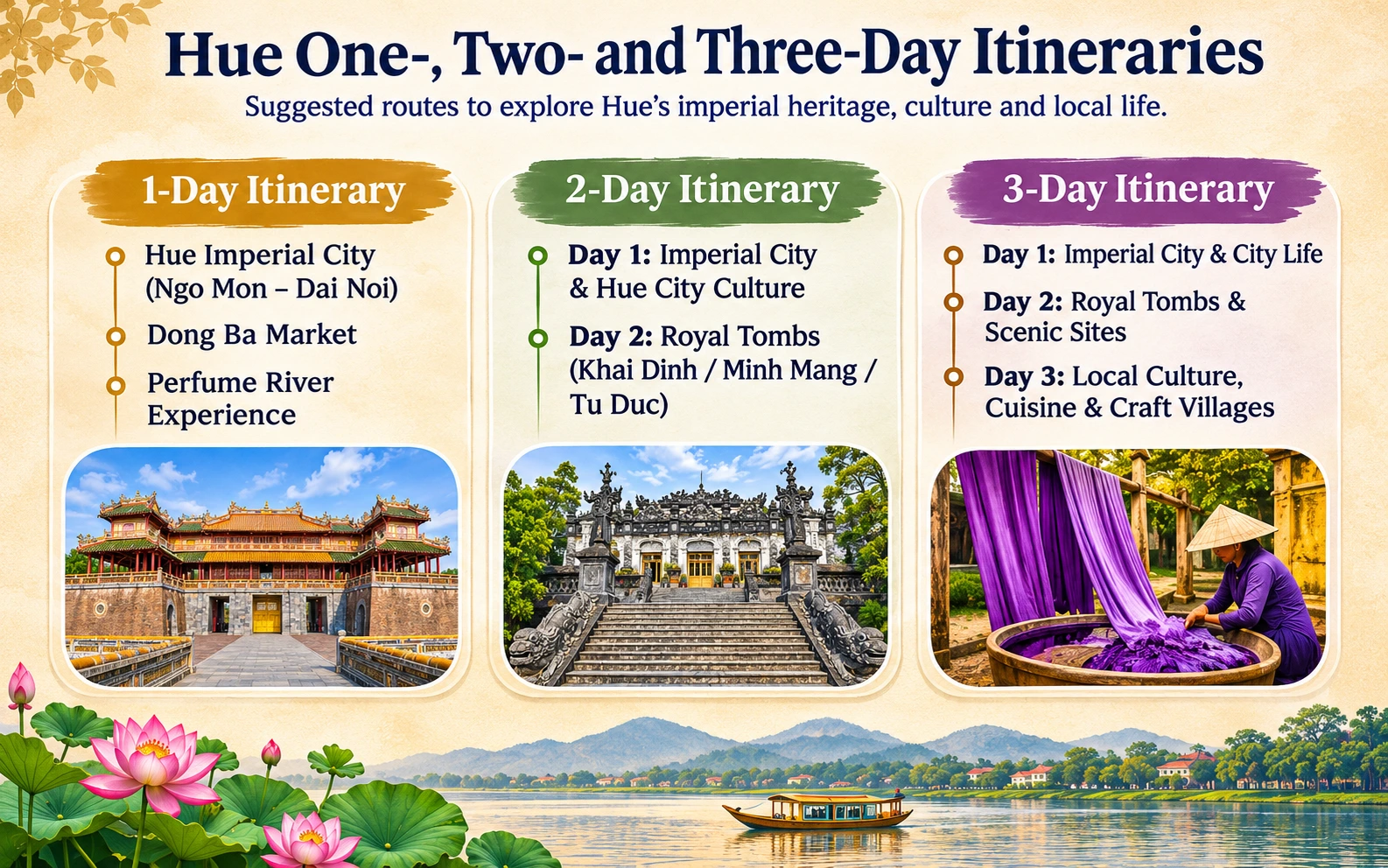
If you prefer visual planning, think in zones: Imperial City and central neighborhoods form one cluster; royal tombs require separate transport legs; national parks and distant heritage areas belong to a different scale of trip. The national tourism authority’s cultural itinerary provides another useful perspective on combining these experiences.
Hue Tickets, Seasonal Hours and Budget Basics
Tickets can make up a meaningful part of the cost of exploring Hue, particularly if you visit several royal monuments. Rather than memorize a price from an undated travel list, start by deciding exactly which sites you want, then check the current official tariff and whether a named combination actually covers them.
Official adult admission and named combinations
The Hue authorities publish admission information for the Imperial City and individual royal tombs, along with specific combinations. These combinations are defined by named sites; they are not automatically valid for any two or three monuments you choose. Review the official Hue monuments visitor information and select tickets that match your real plan. If you are only visiting one tomb, a larger pass may be unnecessary.
Check whether a price shown is the full applicable admission, a concession, a separate guide service or a third-party tour product. A ticket listing does not establish that a specific building is currently accessible, and a photo of an older price board should not be treated as current policy.
Ticket desk time is not the same as last entry or exit
Official visitor notices may distinguish ticket-selling hours, the time entry gates stop admitting visitors and the time visitors must leave. These boundaries can also vary by season, attraction and temporary notice. Read the exact label for the day and place you plan to visit instead of assuming that a published closing hour is the latest safe time to arrive.
A comfortable approach is to visit larger outdoor monuments earlier in your available window and avoid making the final admission cutoff your target. Leave room for ticket lines, unexpected closures and slow movement through the grounds.
Children, concessions and on-the-day changes
Age-based admissions and discounts can have precise conditions. A free-entry day intended for one eligible group does not necessarily apply to all international visitors. Confirm age rules, required documents and any local eligibility restrictions with the official ticket issuer. If you need mobility assistance, family facilities or a specific accessible route, confirm those requirements directly as well.
Beyond tickets, budget for transport to outlying tombs, meals, optional guides and changes caused by weather. Avoid using a generic daily total that promises the same costs to every traveler.
Getting to Hue, Getting Around and Visiting Responsibly
Hue can be reached through several transport modes, and the easiest way to explore depends on where you are staying and which sites you have chosen. The most important distinction is between walking around central neighborhoods and traveling to royal tombs or distant landscapes.
Phu Bai airport, train and city-centre arrival
Phu Bai International Airport serves Hue; check current flight and ground-transport arrangements through the airport operator. Hue also has rail connections, but train schedules, station access and onward transport should be confirmed from current operators. For any arrival, ask about the precise pickup location and the destination address before agreeing to a transfer.
Do not rely on a fixed airport fare or exact road time from a travel blog: route, traffic, weather and pickup arrangements affect both. If you arrive late or with substantial luggage, prioritize a straightforward, clearly priced transfer over an improvised complex sightseeing detour.
Getting between the centre and royal tombs
Central streets may suit short walks, but a tomb visit usually needs a separate transport plan. Options may include properly arranged taxis, drivers or other suitable local services, subject to current availability and your needs. Agree on the route, stops, waiting time and full price before departure. If you need an accessible vehicle, child seat or additional assistance, confirm it directly rather than assuming every provider offers it.
Keep your schedule simple enough to make changes. A planned tomb can close, a road can be affected by rain or a visitor may need longer at an attraction than expected. These are reasons to choose fewer well-matched stops, not reasons to rush.
Steps, heat, families and self-drive caution
Heritage sites often involve stone steps, irregular surfaces, limited shade and exposed courtyards. Carry water, wear suitable footwear, take breaks and plan around the people in your group. “Wheelchair accessible” is a site-specific claim that requires verified route details; no blanket certification is made here for the Imperial City or the tombs.
Self-driving a motorbike or other vehicle carries road-safety, license and insurance considerations. Foreign visitors should independently confirm whether their license documents are legally recognized in Vietnam and whether their insurance covers the vehicle and activity. If that is uncertain, choose an appropriate transport alternative. For broader travel precautions, see Vietnam Tourism’s health and safety guidance.
When to Visit Hue and Questions First-Time Visitors Ask
No single time of year guarantees clear skies or uninterrupted sightseeing. Hue’s appeal changes with light and weather, but the palace grounds, tombs and riverfront can feel very different in prolonged rain than on a dry, comfortable day.
When is the rainy season in Hue?
Hue generally has a wetter period in the later part of the year, when heavy rainfall and flooding can become serious concerns. Exact conditions vary from season to season and even from one neighborhood to another. Before booking an outdoor-heavy visit, consult updated forecasts and local instructions; once you are there, keep a flexible indoor alternative. Avoid judging a future trip by an old storm headline or assuming that a historically drier month guarantees safe conditions.
Is Hue better than Hoi An and how many days do you need?
These destinations reward different interests. Hue is an especially strong choice for imperial history, tomb landscapes and a layered cultural setting. Hoi An is better known for its preserved trading-town atmosphere and its own local experiences. Neither is objectively “better” for everyone. If heritage interpretation matters most, give Hue enough time for the Imperial City and a tomb. If you have only a brief stop, one full central day is still worthwhile; two or three days allow more variety and breathing room.
Can you visit the Imperial City and three tombs in one day?
It may look possible when attractions are reduced to dots on a map, but it is an ambitious plan for many first-time visitors. The sites are not one walkable complex, and each involves time for transport, ticketing, steps, interpretation and rest. Opening arrangements and road conditions may also change. Unless you have specific, confirmed logistics and are comfortable with a very fast pace, choose the Imperial City and fewer tombs. You are likely to remember more of Hue by doing less, more attentively.
This is an independent destination guide, not an offer to sell tickets or operate tours. Use linked official sources to reconfirm admission rules, temporary closures, weather conditions and transport requirements for your visit.