There is no single best way to experience Da Nang. One visitor wants an easy beach morning and a lively riverside evening; another wants historic caves, temples and mountain views. The most useful things to do in Da Nang, Vietnam, depend on how much time you have, how active you want to be and what the weather allows.
Da Nang (also written Danang) brings together a walkable-feeling riverfront, long stretches of coast, museums, dramatic landscapes and access to larger excursions. The trick is to distinguish the attractions in the central urban area from places that take a separate outing. This guide helps you build a realistic visit without treating every photo-worthy location as a must-do.
Before choosing your day
Opening arrangements, performance schedules, road access, cable cars, sea conditions and admission prices can change. Check official updates and local conditions before travel, especially for Dragon Bridge, Son Tra Peninsula, Marble Mountains and Ba Na Hills.
How to choose what to do in Da Nang
Start with one priority rather than a long checklist. The city offers different kinds of days, and a good plan leaves room for food stops, traffic, rain and unplanned discoveries. A gentle central-city day can be rewarding without a mountain excursion. Equally, a nature-focused day may mean skipping some city sights entirely.
| Your priority | Good starting point | Effort and conditions | Alternative |
|---|---|---|---|
| A relaxed first visit | Han River, Dragon Bridge area and a food stop | Generally flexible; some walking | Cham Sculpture Museum if weather turns |
| Sand and sea views | My Khe Beach and the coastal promenade | Low effort onshore; water safety varies | Cafes and city museums during rough weather |
| Caves and heritage | Marble Mountains | Uneven steps and potentially strenuous sections | A lower-effort museum visit |
| Green scenery | Permitted Son Tra viewpoints and Linh Ung area | Road and vehicle restrictions apply | City riverfront if access is limited |
| A major excursion | Ba Na Hills or a heritage day trip | Allow a substantial day; verify operations | Keep a flexible city day as backup |

If you have just one day, select the city and riverfront or one major destination. With two days, combine a city-and-coast day with either Marble Mountains or Son Tra. A third day gives you room for Ba Na Hills, Hoi An, My Son or another outing without racing between unrelated sites.
Top Da Nang attractions: Dragon Bridge and the Han River
For a first introduction to Da Nang attractions, begin by the Han River. This part of the city combines recognizable bridges, public views, evening activity and straightforward options for a short outing. You can enjoy the setting without purchasing a tour or trying to fit every nearby attraction into one walk.
See Dragon Bridge during the day or after dark
Dragon Bridge is one of Da Nang's most distinctive landmarks. From the riverside you can appreciate its dragon-shaped structure and the contrast between the illuminated bridge and the city around it. It is also known for its fire-and-water performance, but the show is a scheduled event, not a constant feature of the bridge.
Da Nang's tourism portal has described the regular performance as taking place at about 9 pm on Friday, Saturday and Sunday, with schedules subject to changes and special arrangements. Check the city's current visitor information before organizing an evening around it. Arrive with enough flexibility to find a suitable public viewing area and follow any crowd-control instructions. Do not assume an additional weekday show will take place merely because it has been discussed.
Enjoy the riverfront without chasing a show
The Han River area is worthwhile even on an ordinary evening. Consider a riverside walk, a view of the illuminated bridges and dinner nearby. Han River Bridge is a separate landmark from Dragon Bridge, with its own operating arrangements; do not confuse the two bridges or promise that both will perform on your chosen night.
A practical approach is to keep the evening simple: start with daylight views, stop for a meal, then return to the waterfront if conditions are comfortable. If it rains heavily or public areas are crowded, there is no need to force a bridge-side itinerary. The city has indoor cultural alternatives that work well at other times of day.
My Khe Beach and Da Nang's coastline
My Khe Beach is a natural choice for visitors who want to slow down. The broad coastal setting makes an early walk, a quiet pause by the sea or a simple beachside meal feel like a complete activity. You can also explore other stretches of coast, including the My An and Non Nuoc areas, depending on where you are staying and how far you want to travel.
Choose a beach activity that matches the conditions
Walking, taking photographs and relaxing ashore require less planning than swimming, surfing or other water sports. If you intend to enter the water, pay attention to flags, lifeguards, currents, wave conditions and any local instructions. A sunny sky does not by itself prove safe swimming conditions, and a beach popular with surfers is not automatically suitable for beginners.
For an easy day, pair a beach stroll with breakfast or a relaxed cafe stop. Wear sun protection, carry water and leave space to change plans if the wind or surf becomes unpleasant. If you are considering a lesson or equipment rental, assess the provider, safety arrangements and current marine conditions independently rather than relying on a generic online recommendation.
What if the weather is poor?
On rainy or windy days, the coastline may be better admired from a sheltered viewpoint than used for swimming. Move your main activity indoors, perhaps to the Museum of Cham Sculpture, and return to the beach another day if conditions improve. The city tourism weather guide offers broad seasonal ideas, but a local forecast and beach warnings matter more for the day you actually visit.
Marble Mountains: caves, steps and viewpoints
The Marble Mountains, or Ngu Hanh Son, bring together limestone formations, temple spaces, caves and viewpoints. They are a strong option for travelers interested in cultural landscapes rather than another city street. The visit can be memorable, but it is not just a flat walk between viewpoints.
Understand the physical effort before going
Much of a typical visit centers on Thuy Son, where steps and irregular surfaces connect several features. Some caves are dim, humid or reached by stairways. Comfortable footwear and realistic expectations are more helpful than trying to climb to every viewpoint. Respect religious spaces, move carefully on wet stone and turn back if a route exceeds your ability.
An elevator serves part of the site, but it does not remove every staircase or make all caves and viewpoints wheelchair accessible. Travelers with limited mobility should confirm the accessible sections before buying tickets and should not treat the elevator as proof of full access.

Check which admissions and services you need
Thuy Son, Am Phu Cave and elevator use may be treated as separate ticket or service components. Online prices can be old, apply only to particular visitor categories or omit extras. Consult the city's published admission reference and confirm the rules in effect on your visit. Do not assume one ticket covers every feature.
If your trip is short, choose the areas you most want to see rather than building a route around every cave and viewpoint. A separate, detailed Marble Mountains guide can handle exact entrances and route choices; for a first Da Nang plan, the key decision is whether you want a more active cultural outing.
Son Tra Peninsula and Linh Ung Pagoda
Son Tra Peninsula is the green counterpoint to Da Nang's urban coast. Visitors come for elevated sea views, temple grounds and a landscape that feels different from the riverfront. The Linh Ung Pagoda area is a familiar point of interest, but not every road, forest trail or viewpoint on the peninsula is open to unrestricted tourism.
Choose permitted routes, not an improvised mountain circuit
Access rules on Son Tra cover designated routes, visiting periods, checkpoints and vehicle restrictions. In particular, some mountain sections do not permit automatic scooters or certain larger vehicles. Do not assume a rented motorbike can take you to every viewpoint. Check the official Son Tra route and visitor guidance before traveling and follow signs and instructions on the ground.
Heavy rain, fog and slippery roads are reasons to shorten or cancel a peninsula excursion. If you are not confident about the permitted roads and transport, choose an easier viewpoint or a city-based alternative rather than improvising a route.
Treat wildlife and protected forest respectfully
Wildlife sightings are never guaranteed, and animals should not be fed, approached for close photographs or disturbed. The tourism authority has also warned against unauthorized trekking and ecotourism tours inside Son Tra's special-use forest. A tour advertised online is not proof of official permission. Stay on routes that are lawfully open and avoid entering unapproved forest trails.
If your main goal is a relaxed Da Nang day, a permitted temple-area visit with time for the view may be sufficient. Leave demanding mountain exploration to another occasion, with proper access and weather checks.
Ba Na Hills and the Golden Bridge
The Golden Bridge, held visually between giant sculpted hands, is among the region's most recognizable modern attractions. It forms part of the Sun World Ba Na Hills mountain resort experience, which also includes cable cars and other visitor areas. That makes it a different kind of outing from a spontaneous riverside walk.
Decide whether it deserves a major part of your day
If the Golden Bridge is a top priority, treat Ba Na Hills as a substantial excursion rather than squeezing it between several central-city sights. Build in room for transport, queues, changing mountain weather and the possibility that some attractions or services are unavailable. Views can be obscured by cloud or fog, even when conditions closer to the beach appear pleasant.
The operator's official Ba Na Hills site is the appropriate starting point for tickets, current operating information and announcements. Basic admission may cover the cable car and main areas, while some attractions or activities can carry additional conditions or charges. Check the package that applies to you; do not assume all services are included or that cable cars operate regardless of weather.
Have a weather backup
Keep an alternative city plan ready. If access or visibility is poor, the museum, local food and the urban waterfront can still make a satisfying day. You do not need to justify a costly excursion simply because it appears on every list of things to do in Da Nang.
This guide deliberately stays at the planning level. Exact Golden Bridge ticket categories, transport options and resort routes deserve their own detailed, frequently checked resource rather than an evergreen promise buried in a citywide overview.
Museums, markets and local food
Da Nang's best experiences are not limited to the outdoors. A museum morning or a leisurely meal gives useful context to the region, provides a break from the heat and offers a fallback when the weather changes.
Start with the Museum of Cham Sculpture
The Museum of Cham Sculpture introduces the artistic and religious heritage of the Cham civilization through sculpture and architectural fragments. It is especially worthwhile if you are also considering My Son Sanctuary, because the museum helps explain the history behind the monuments. Allow time to read the displays rather than rushing between rooms.
Museum hours, admission categories, temporary exhibitions and any occasional free-entry days should be checked through the city's museum information or the museum's current notices. A special free-admission event is not evidence that ordinary admission is always free.
Explore a market and eat something local
Han Market and Con Market are among the places visitors may consider for a glimpse of daily commerce and local flavors. Markets are active working environments, not staged attractions: keep aisles clear, ask before photographing people and check prices before ordering or purchasing.
Food is another easy way to explore the city without booking a full-day activity. Look for mi Quang (Quang-style noodles), bun cha ca (fish-cake noodle soup), banh xeo (crispy savory pancakes) and other Central Vietnamese dishes. Ask about ingredients if you have allergies or dietary restrictions. An appealing stall is not proof of a specific hygiene standard, so use normal food-safety judgment.
For a lighter rainy-day plan, combine the museum with a meal and a cafe, then add a short riverfront walk if the weather improves. This can be a more pleasant use of time than trying to keep a mountain or beach itinerary unchanged.
Day trips from Da Nang: Hoi An, My Son and Hai Van
The central Da Nang urban area is an excellent base, but some of the most talked-about experiences require travel away from its city-center attractions. Even where destinations share a wider administrative area, they should not be treated as if they were beside Dragon Bridge. Choose a day trip by interest and conditions, rather than trying to collect several far-apart places in one afternoon.
Hoi An
Choose historic streets, traditional buildings, craft heritage and a slower cultural outing. Plan Hoi An as its own destination rather than an extra stop during a busy Da Nang city walk.
My Son Sanctuary
Choose Cham temple archaeology and landscape. This is a separate UNESCO World Heritage property with its own visit conditions, not an exhibit inside Da Nang's museum.
Hai Van area
Choose coastal mountain scenery or a rail-based view. Road, weather and railway arrangements require their own checks; avoid a risky scenic-drive plan in poor conditions.
The UNESCO My Son Sanctuary listing is useful for heritage background, while the official Hai Van Pass overview explains the scenic setting. For Hoi An, decide whether you want a dedicated Ancient Town day rather than combining it with unrelated sightseeing. A detailed Hoi An activity guide should remain a separate article, not be repeated here.
Check the actual route, travel conditions, any admission restrictions and your return options before setting off. A scenic day trip is not a promise of available guided tours, train seats or safe roads in all seasons.
Da Nang itineraries for one, two or three days
These are modular ideas, not tightly timed schedules. Pick the blocks that match your energy level and adjust for actual access, opening hours, travel time and the weather. The best plan is one you can enjoy without constantly looking at the clock.
| Time available | Earlier in the day | Later in the day | Evening | Poor-weather option |
|---|---|---|---|---|
| One day | Choose the Museum of Cham Sculpture or a My Khe coastal walk | Explore the Han River area and take a relaxed food break | Enjoy the riverfront; check Dragon Bridge schedule if interested | Museum, markets and a sheltered meal |
| Two days | Day 1: city and coast | Day 2: choose Marble Mountains or a permitted Son Tra outing | Keep at least one flexible city evening | Swap outdoor Day 2 for cultural stops |
| Three days | Keep the first two days flexible | Day 3: choose Ba Na Hills, Hoi An, My Son or the Hai Van area | Rest or enjoy a simple local dinner after the excursion | Remain in the city if travel conditions are unsuitable |
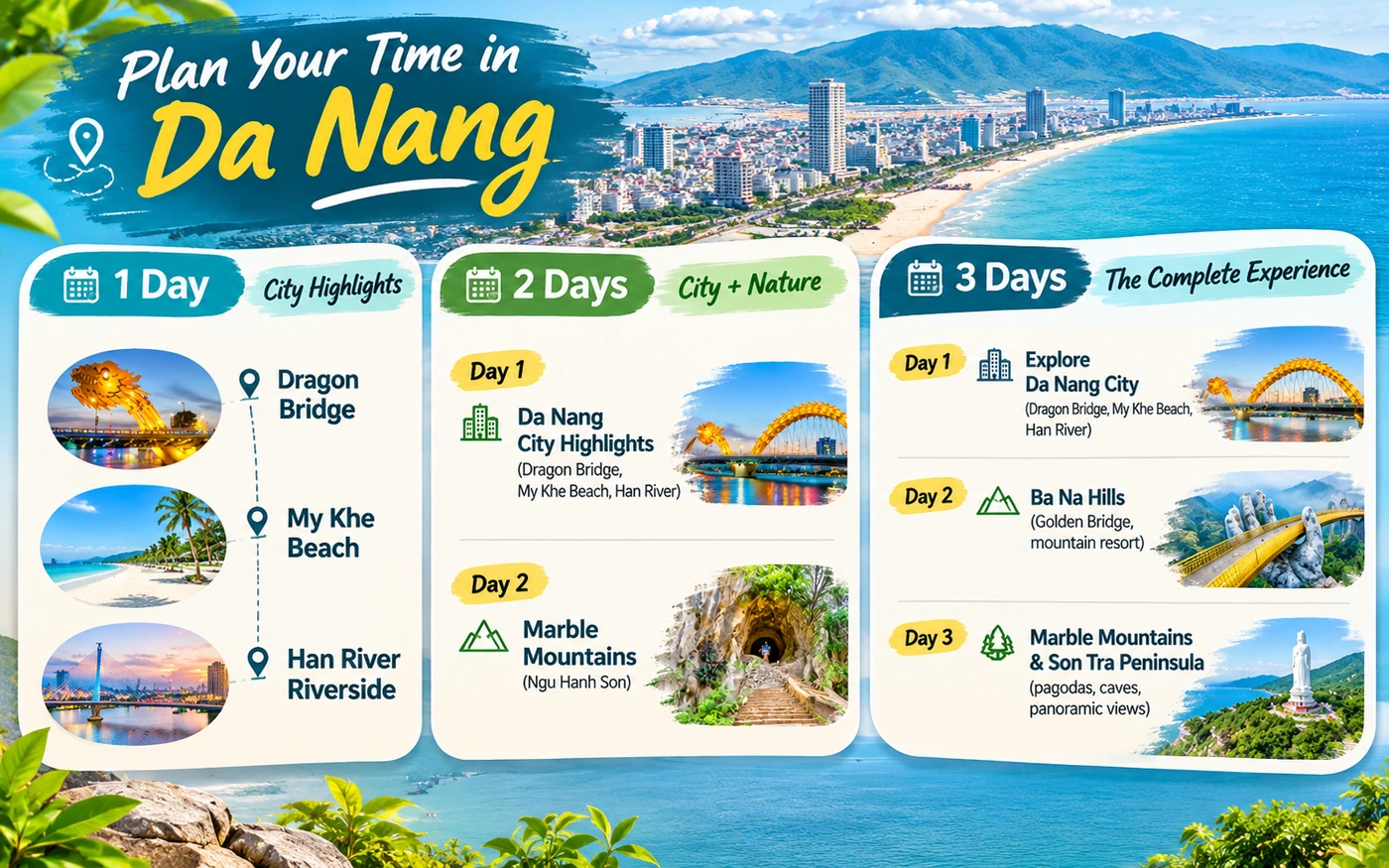
If you have only one day
Do not spend most of it changing locations. The Museum of Cham Sculpture, a market or food stop, and the Han River offer a city-focused introduction. If the beach is your priority, substitute a coastal block for the museum. Save the mountain attractions for a longer visit.
If you have two days
Give one day to the riverfront, food and coast. On the other, select a more demanding visit to Marble Mountains or a route-compliant Son Tra excursion. Both can be worthwhile, but neither needs to be rushed simply to tick a second landmark off a list.
If you have three days
Use the extra day for a destination that feels different: a resort and Golden Bridge experience at Ba Na Hills, heritage in Hoi An or My Son, or coastal mountain scenery near Hai Van. Choose one main excursion and keep a weather backup. More days can make the experience more relaxed, not just more crowded with stops.
Practical planning: weather, transport, costs and access
Weather changes the best activity
Da Nang has sunnier and wetter periods, but broad seasonal descriptions are not a substitute for a forecast. Heavy rain can affect mountain roads and visibility; wind and surf can affect beach plans; clouds may reduce the value of a viewpoint excursion. Build a flexible day instead of relying on a fixed picture-perfect schedule.
Keep museums, markets, food and cafes as options when outdoor plans are poor. On genuinely severe-weather days, even local travel may be inappropriate: follow official forecasts and warnings rather than assuming an indoor destination is automatically safe to reach.
Choose transport by the actual destination
For central urban stops, walking short sections and using a reputable taxi or app-based car service can be easier than managing a rental vehicle. Mountain and outlying journeys need more planning. Check whether your route and vehicle type are permitted, whether roads are affected by weather and whether you can return safely. In particular, Son Tra has restrictions that are not apparent from a generic city map.
Budget for more than admission
Some city views and beach walks may not require a ticket, while museums, heritage areas, resort attractions and some additional services do. Your real spending may also include transport, food, parking, optional guides and separate fees at a single destination. Compare the city tourism admission reference with the current venue or operator notice before treating any figure as final. Do not assume a listed price includes every activity.
Plan around your mobility and comfort
Flat riverfront choices, beaches, caves, mountains and large resort sites have very different access demands. Ask about steps, surfaces, rest areas and the distance from drop-off points before committing. A lift at one attraction is not a promise that the entire place is accessible, and a short route on a map may be strenuous in heat or rain.
A useful pre-visit checklist
- Check official opening updates and any special-event changes.
- Review the weather, road conditions and coastal safety warnings.
- Confirm admission components and what is excluded.
- Choose transport permitted on the route you actually plan to use.
- Keep a realistic alternative in case your main activity is unavailable.
Frequently asked questions
How many days do you need in Da Nang?
One day works for a focused taste of the riverfront, food and perhaps the coast. Two days allow a more relaxed city day plus a cultural or nature outing. Three days give you room for a separate excursion. Choose according to your pace rather than a rigid sightseeing quota.
What to do in Da Nang when it rains?
Consider the Museum of Cham Sculpture, a market, a meal or a cafe when conditions allow safe travel. Avoid forcing a beach, mountain road or cable-car excursion during bad weather, and follow local advisories if flooding or storms affect movement.
Which Da Nang attractions are easiest for a short city visit?
The Han River area, Dragon Bridge views, local food stops and a central museum make a manageable starting point. A coastal walk may also fit, depending on your location and conditions. Marble Mountains, Son Tra and Ba Na Hills call for more deliberate planning.
Is Ba Na Hills a separate full-day trip?
It is sensible to set aside a substantial part of a day rather than treat it as a quick downtown stop. Check cable-car operation, weather, ticket conditions and travel arrangements before deciding whether it fits your visit.
Can you visit Marble Mountains without much climbing?
You may be able to experience some parts with less climbing, and there is a lift serving part of the attraction. However, many routes, cave entrances and viewpoints still involve uneven steps. Confirm accessibility for your intended route rather than relying on the presence of a lift.
Is Hoi An one of Da Nang's downtown attractions?
No. Hoi An is a distinct heritage destination away from the central urban Da Nang sightseeing area and deserves its own time. Treat it as a separate outing, even if you are using Da Nang as your base.
Are there free things to do in Da Nang?
Enjoying public river views and walking along suitable beach areas can be low-cost choices. Admission, parking, activities and services may still cost money, while museums and landmark attractions can have their own fees. Check each location rather than assuming the entire visit is free.
The best Da Nang itinerary is not the one that includes every landmark. It is the one that suits your interests, leaves time to enjoy the city and remains flexible when local conditions change.