Sapa trekking is a way to explore the mountain villages, rice terraces and rural landscapes of northern Vietnam on foot. But choosing a trek is not simply a matter of finding the most scenic route. A short village visit, a full day in the Muong Hoa Valley, an overnight walk with a homestay and a climb of Fansipan are very different experiences.
For a first visit, consider a valley walk from Sa Pa with a route matched to your fitness, the weather and the available return transport. If you have two days, a confirmed overnight stay in a village can give you more time to explore without rushing back to town. Neither option requires you to pursue the longest or steepest trail.
The short answer
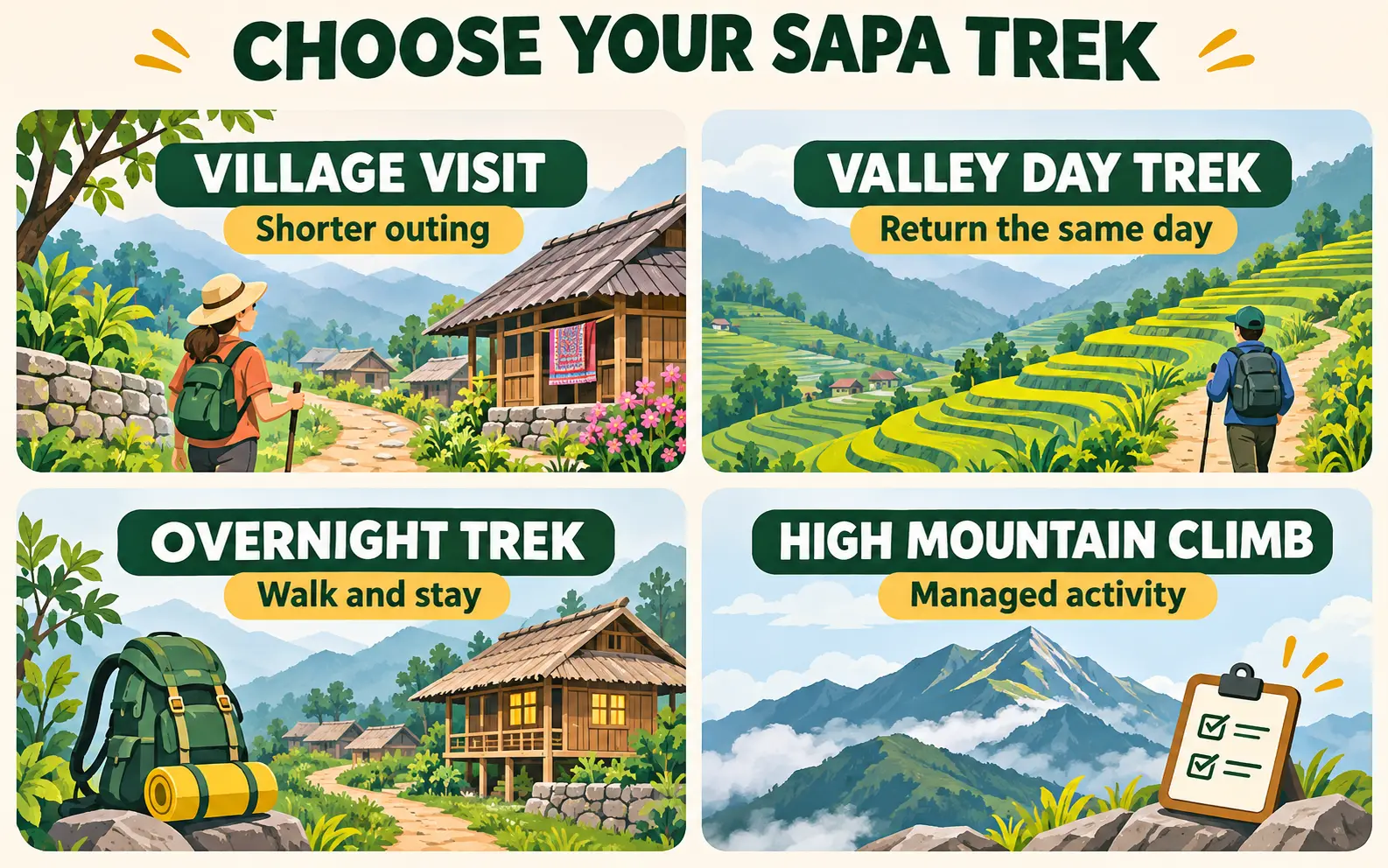
Choose a village visit for a shorter outing, a valley trek for a full day outdoors, or a two-day trek if you want to include an overnight stay. Confirm access, weather, walking difficulty and your way back before leaving. Treat Fansipan as a separate, managed mountain-climbing activity.
Sapa trekking at a glance
What kind of trek are you looking for?
Sa Pa is a highland destination in Lao Cai, Vietnam, with settlements spread across valleys and hillsides. Some outings focus on village life and scenery; others involve sustained walking on uneven ground. Decide whether you primarily want a cultural visit, an outdoor exercise day, an overnight experience or a mountain-climbing challenge. These goals call for different arrangements.
A good plan starts with what you can comfortably manage, rather than a famous village name. Even a short distance may involve a demanding descent or a slippery climb. An overnight itinerary can offer a more relaxed pace, but only if the daily walking stages are chosen accordingly.
Quick comparison: routes, terrain and planning checks
| Experience | Terrain and effort | Time format | Key checks |
|---|---|---|---|
| Cat Cat or Ta Phin village visit | Selected paths; possible steps, slopes and uneven surfaces | Shorter outing | Entry rules, walking conditions, transport back |
| Muong Hoa Valley trek | Terraces, hillside paths and possible steep sections | One day from Sa Pa | Route access, guide needs, weather and pickup point |
| Valley trek with homestay | Two walking stages; effort depends on itinerary | Two days, one night | Accommodation, second-day access, luggage and return |
| Fansipan climb | High mountain terrain and sustained physical demands | Managed mountain itinerary | Park requirements, authorization, guide and fitness |
Choose a trek that fits your group
Consider the least experienced walker, not the strongest. Ask about descents, steps, exposed sections, places to rest and opportunities to stop early. If anyone has mobility limitations, recurring knee pain or little experience on rough ground, request an alternative that avoids demanding terrain. A shorter village visit with road transport may be more enjoyable than a long walk that everyone struggles to finish.
What trekking in Sapa actually involves
Village walks versus mountain treks
A village walk usually concentrates on a settlement, its surrounding landscape and accessible paths. You might spend part of the day exploring on foot and use transport for the approach or return. A valley trek involves more continuous walking between areas, while mountain trekking may take you into more isolated or regulated terrain.
Do not assume that a path connecting two settlements is public simply because it appears on a map. Some paths cross working farms, private property or managed areas. The appropriate route is one you can use with permission and complete safely under the actual conditions.
How hard is Sapa trekking?
Difficulty depends on more than kilometres. Long descents can be tiring even for people who are comfortable walking on level streets. Wet soil, loose stones, narrow paths and slippery steps can turn an otherwise manageable outing into a difficult one. A route described as easy by an experienced mountain walker may feel very different to someone who rarely hikes.
When comparing itineraries, ask for the expected walking time, significant climbs and descents, surface conditions and whether the route has a practical exit. Describe your experience accurately. Do not rely on a difficulty label alone, particularly when an itinerary can change with weather or access restrictions.
Walking time, total time and travel from Hanoi
Walking time excludes many things that take up a travel day: getting to the starting point, waiting for transport, lunch, village visits, rest stops and the journey back. Ask for both the estimated time on foot and the expected finish time, allowing a margin for a slower pace.
The one- and two-day ideas in this guide start in Sa Pa, not Hanoi. Reaching the highlands from Hanoi and returning are separate travel arrangements. If traveling by rail, plan the onward road transfer from Lao Cai to Sa Pa; for road travel, confirm where your vehicle actually stops. If you arrive after an overnight journey, consider resting before attempting a demanding trek. Keep your onward departure flexible enough that a slower walk or disrupted road does not force you to rush.
Sapa trekking routes and village alternatives
The names below are useful for discussing potential routes with a local guide or accommodation host. They identify areas to explore, not a turn-by-turn navigation plan. Village access, trail conditions and permitted connections should be established for your intended day.
Muong Hoa Valley: Y Linh Ho, Lao Chai and Ta Van
The Muong Hoa Valley is a useful starting point when researching a classic Sa Pa trekking experience. Y Linh Ho, Lao Chai and Ta Van are associated with terraced agricultural landscapes and village visits. The Lao Cai tourism portal's guide to green rice landscapes identifies this area as a place to experience the terraces.
You do not need to walk through every village to enjoy the valley. A selected section may offer a better combination of scenery, manageable terrain and a reliable pickup point. Ask which parts are suitable for your ability, whether the route crosses farmland, and how the ending point connects to transport.
Be cautious about advertised distances. A road distance from town, the length of a walking segment and the total distance for a tour are not interchangeable. Ask whether the quoted distance includes detours, climbs or the walk to a meeting point.
Ta Van, Giang Ta Chai and Su Pan
These areas are candidates for a longer valley experience or a second-day extension. Rather than assuming that all three must form a single continuous walk, choose a confirmed overnight location and ask which onward paths are available from there.
Ask about crossings, slippery forest sections and any damage caused by recent rain. If a connecting path is unsuitable, a shorter walk near the accommodation followed by arranged road transport may make more sense. Do not try to preserve a planned village sequence by taking an unapproved shortcut.
For a two-day itinerary, the second day should be planned in relation to the first. Consider how tired you are likely to be, how much you must carry and whether you can end the walk earlier if necessary.
Cat Cat and Ta Phin: shorter village visits
Cat Cat and Ta Phin are alternatives for visitors who want village scenery and cultural context without committing to a long valley itinerary. The national Vietnam Tourism guide to Sa Pa describes these villages as options that visitors can explore without a guide. That is not blanket permission for every nearby path, nor a guarantee of free entry.
Cat Cat may involve steps and slopes; check whether the available route suits your mobility. In Ta Phin, agree in advance on any visit to a home or cultural activity and respect the host's conditions. For either destination, establish the actual entrance arrangements, available walking surfaces and transport before departure. You can combine a shorter walk with time in town instead of trying to fit several distant villages into one day.
Fansipan and remote trails are different undertakings
High mountain routes demand different preparation, fitness and equipment. Remote forest paths also require specific attention to access and rescue arrangements. This guide does not provide independent summit directions, and a two-day valley trek should not be considered equivalent to a two-day mountain ascent.
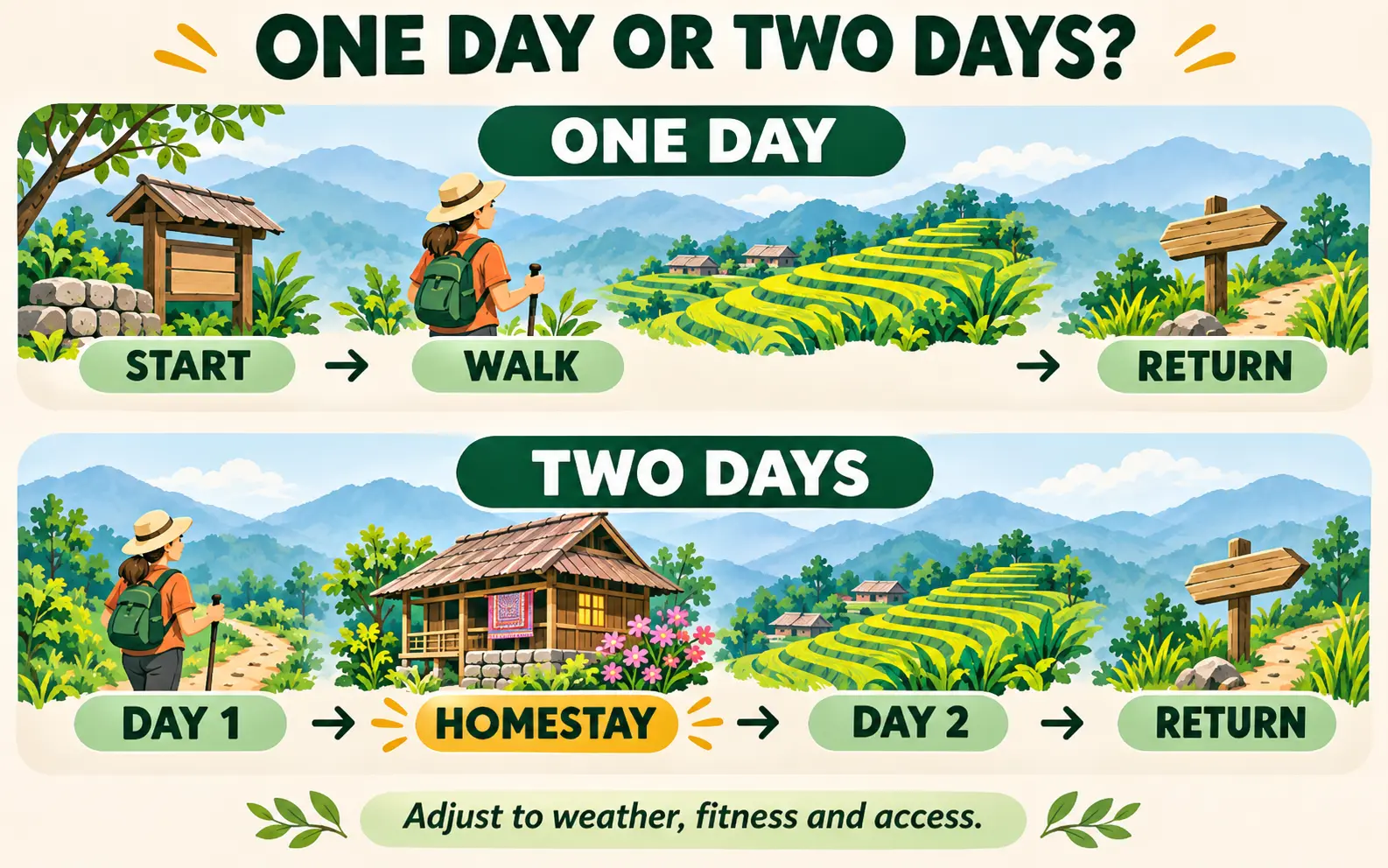
Sapa trekking in one day
A one-day trek is a practical format if you have a full day based in Sa Pa and prefer to return to your accommodation that evening. The objective is to choose a satisfying walking segment, allow time for breaks and return without unnecessary pressure.
A flexible one-day valley itinerary
Example planning sequence: a Muong Hoa Valley day
- Before departure: Check the forecast, confirm the route and access, meet your guide if using one, and agree on the end point. Carry your essentials rather than relying on shops along the way.
- First walking stage: Explore a confirmed section around Y Linh Ho, Lao Chai or Ta Van according to conditions. Keep a steady pace and leave time for short rests.
- Midday: Take a meal and water break at a place agreed in advance. Check the group's energy, weather and remaining time before deciding whether to continue.
- Final stage: Finish at the agreed accessible pickup point and use your confirmed transport back to Sa Pa. Shorten the walk if the original plan is no longer suitable.
This is an illustrative sequence, not a timed tour or assurance that a particular path is open. A guide may suggest an alternative starting point or a different direction to suit the day. A good route is one that works in practice, not necessarily one that includes the greatest number of named villages.
Shorter and less demanding alternatives
If you have limited walking experience, a shorter stretch of valley or a village visit can still provide time outdoors and opportunities to learn about the area. Arrange transport closer to the place you want to explore and confirm a realistic walking limit. If one member of your group needs to stop, make sure there is a safe, accessible way to do so.
When conditions are unsuitable for outdoor walking, a town-based day or a postponed trek is a reasonable choice. Do not substitute another exposed hillside route simply because your original plan cannot go ahead.
Before leaving: access, time and return transport
Confirm the last usable pickup point and whether a vehicle can actually reach it. If your trek ends away from town, ask who arranges the return and what happens if the walk finishes early. A route advertised as a full day may include several hours of non-walking activity, so clarify the expected effort before paying.
Tell your accommodation or another reliable contact where you intend to go. Keep enough daylight for the return, including unexpected stops. If you have an evening transfer to another destination, consider leaving a generous margin or arranging the trek on a different day.
Sapa trekking in two days with a homestay
A two-day trek with one night in a village offers time to experience the valley at a different pace. You can spend more time away from town and avoid making the first day a rushed round trip. The added night also introduces practical decisions about accommodation, food, luggage, weather and the second day's route.
Day 1: walk to a confirmed overnight stop
Start in Sa Pa after checking conditions and confirming your accommodation. Choose a suitable valley segment that leads towards the overnight stop, rather than setting an ambitious walking target. Ta Van is one area to discuss when considering a village stay; the exact choice should depend on the available host, route and access.
Agree on how luggage will reach the homestay. If you carry it, account for the extra weight when selecting the first day's walk. If a transfer is included, confirm who handles it and when it arrives. Keep medication, water and other essential personal items with you.
Leave enough time to reach the accommodation, settle in and discuss the next day's plan. An evening meal with hosts can be part of the experience when offered and agreed, but it is not something every overnight booking includes.
Day 2: choose a suitable extension or shorter return
Reassess the forecast, path conditions and how everyone feels before setting out. An extension towards Giang Ta Chai or Su Pan may be worth discussing with a local guide when the relevant paths are accessible. A shorter return or an arranged vehicle transfer is equally valid if conditions or fitness make a longer route unsuitable.
Plan around the actual pickup location, not a line on a map. Check whether your accommodation can assist with changes, whether there are additional charges and how you can reach the agreed contact. A confirmed return arrangement matters as much on day two as it does on a day trek.
What to ask about the homestay
A homestay may be a family-run guest space, a shared sleeping arrangement or a more private room. The label alone tells you little about the facilities. Ask for a clear description before booking, especially if you have particular requirements.
Overnight accommodation checklist
- Private or shared room, bedding and warmth at night.
- Toilet facilities, washing arrangements and hot water availability.
- Meals, drinking water, dietary needs and allergy communication.
- Electricity, charging, mobile reception and luggage arrangements.
- Guest registration, arrival time, payment and cancellation terms.
- Privacy expectations and the host's arrangements for receiving visitors.
Do not assume every family offers the same facilities or cultural activities. Choose accommodation that matches your needs and respect the host's daily routines. A two-day trip can be rewarding without requiring an especially remote stay or an elaborate program.
When to go: seasons, weather and rice terraces
Spring, autumn, summer and winter
Sa Pa's highland climate makes season a meaningful consideration, but the best time for a trek depends on what you want to see and how much uncertainty you can accommodate. Conditions at a village, on a hillside and high on Fansipan can differ considerably.
Spring
Often a reasonable season to consider walking, with changing temperatures and the possibility of mist or rain. Bring layers and allow for limited visibility.
Summer
A greener landscape may coincide with wetter conditions. Pay particular attention to slippery ground, heavy rainfall and disruptions to paths and roads.
Autumn
An appealing period for valley scenery and harvest landscapes when conditions align. Rain and storm-related disruption are still possible.
Winter
Prepare for cold, damp or foggy conditions, especially at higher elevations. Check whether overnight accommodation provides adequate warmth.
The national tourism guide highlights March to May and September to November as appealing travel periods. Use these months as broad planning windows, not as promises of dry paths or golden rice. Seasonal descriptions cannot predict a particular walking day. If outdoor activities are central to your visit, keep a spare day in Sa Pa rather than committing every available hour to a fixed program.
Rice terraces and harvest timing
The terraces are working agricultural land, not a landscape designed around tourist schedules. Water-filled fields, newly planted rice, green growth, mature golden crops and harvested plots offer different views. Farming schedules vary between locations, elevations and years. Even adjacent fields may not be at the same stage.
If seeing a particular rice landscape matters to you, ask a local accommodation host or guide about recent conditions in the specific valley you intend to visit. Do not plan around a photograph alone. Rain, clouds and farming activity can change both visibility and which paths are appropriate to use.
When to change or postpone the trek
Check the National Center for Hydro-Meteorological Forecasting and relevant local disaster warnings, as well as the latest advice from people responsible for your intended route. A forecast for Sa Pa town does not establish conditions on every hillside or crossing.
Heavy rainfall, landslide or flash-flood warnings, unsafe stream crossings, thunderstorms and poor visibility are reasons to reconsider a walking plan. Road access may also be affected even when it is not raining at your accommodation. Follow closures and local instructions, and do not enter an affected area to see how far you can get.
Do you need a guide for Sapa trekking?
What you can consider visiting independently
Independent sightseeing and independent mountain trekking should not be treated as the same activity. For a simple village visit, you may be able to explore designated visitor areas at your own pace. The national tourism guide identifies Cat Cat and Ta Phin as possible independent village visits. Confirm which paths are open to visitors, whether an entry fee applies and how to get back to your accommodation.
Online walking accounts can help you understand what other travelers experienced, but they cannot establish current access. A downloadable map or an old blog route is not permission to cross private land, use a damaged bridge or enter a restricted area. If you cannot confirm the route and a safe exit, choose a managed visit or arrange an appropriate guide instead.
When a local guide or organized trek is appropriate
A knowledgeable local guide can help interpret the landscape, communicate with residents and choose a route that reflects weather, terrain and the group's pace. This is especially useful for unfamiliar valley paths, longer walking days and overnight arrangements. Discuss your preferences before the trek rather than assuming that every guide offers the same style of experience.
Consider an organized trek where the itinerary involves remote areas, complex connections, substantial climbs or a managed natural area. Fansipan summit climbing has its own authorization and guide arrangements, as described above. Do not substitute informal navigation advice for those requirements.
A guide is not a guarantee against injury, weather disruption or other risks. Ask how a change of route is handled and whether the guide or organizer is willing to shorten a trek when conditions deteriorate. The ability to adapt matters more than a promise to complete every attraction.
How to check guide credentials and operator arrangements
Vietnam has a legal framework for tour guiding and tourism activities involving risk. Relevant starting points are the Law on Tourism and Decree 168/2017/ND-CP. Confirm the current rules, including amendments and the requirements applicable to the particular activity, with the competent authority.
Before paying, establish who will actually organize and lead the walk. Ask for the guide's relevant credentials, the scope of the service, applicable permissions and the operator's safety arrangements. For an organized adventure activity, ask about risk briefing, equipment, communications and emergency response. A marketplace listing, social media profile or favorable review is not a substitute for these checks.
If you are arranging a trek directly with a local provider, ask the same questions you would ask when booking through an agency. Clear communication, an agreed itinerary and transparent payment terms help both sides understand what is expected.
How much does Sapa trekking cost?
Compare the total cost, not the headline price
The cost of trekking in Sa Pa depends on the route, group size, guide arrangements, transfers, admission requirements and whether you stay overnight. A shared guided outing and a private customized itinerary can have different pricing structures. Instead of treating a price from an older travel report as a current rate, request comparable quotes for your own dates.
| Cost component | One day | Two days, one night |
|---|---|---|
| Guide or organized service | Confirm group size, duration and private or shared rate | Confirm both days and any overnight guide arrangements |
| Access and admission | Check applicable village or visitor fees | Check all planned stops and any managed area requirements |
| Transport | Start and return transfers | Start, luggage if needed and day-two return |
| Food and water | Lunch, snacks and drinking water as applicable | Meals from departure through return, plus water |
| Accommodation | Usually separate from the walk | Agreed room, bedding and overnight facilities |
| Insurance and contingency | Suitable coverage and a reserve for changes | Suitable coverage, extra transport or an alternative stay if needed |
What a guided day or overnight quote should include
Ask for a written quote specifying the currency, whether the price is per person or per group, the number of participants and the services included. For an overnight package, establish which meals are provided and the type of accommodation. For both formats, clarify whether the guide, admission charges, pickup and return transport are included.
Also ask what happens if the provider cancels, if you need to shorten the route, or if weather makes an overnight stop inaccessible. A less expensive quote may exclude important services; a more expensive package may include things you do not need. Compare like for like, including the arrangements for changes rather than just the planned itinerary.
Fees, exclusions and duplicate listings
Entry charges and local service prices may change. Confirm them with the relevant manager or provider before departure. If an admission charge is included in your package, do not count it a second time in your budget. Make a separate allowance for discretionary purchases and agreed optional activities.
The same trek may appear on multiple booking websites. Compare the actual operator, itinerary and inclusions before assuming that two listings represent different experiences. Customer reviews can help identify questions to ask, but they do not establish what your booking includes.
What to pack and how to plan for safety
Footwear, layers, water and essential items
Pack for the walking conditions rather than for photographs. For an ordinary valley itinerary, the following is a useful starting list. A remote or high mountain itinerary requires additional activity-specific preparation and equipment guidance from the organizer.
- Footwear: comfortable walking shoes with appropriate traction, and suitable socks. Use footwear you have already tested.
- Clothing: breathable layers, a rain jacket, and warmer layers according to the forecast and elevation.
- Food and water: sufficient drinking water and snacks for the planned walk, including a margin for delay. Confirm safe refill options.
- Personal essentials: necessary medication, basic first-aid supplies, sun protection, insect repellent and tissues.
- Communication: charged phone, offline information, power bank and important contacts saved independently of an internet connection.
- Overnight additions: dry clothing, toiletries and any items your confirmed homestay does not provide. Keep belongings protected from rain.
Ask whether walking poles are suitable for your itinerary and whether you need to bring them. Carry only what you can manage without compromising your balance or comfort, but do not leave essential medication or weather protection behind to save weight.
Insurance, communication and emergency planning
Check your travel insurance before arranging a trek. Ask whether it covers the specific activity, elevation, medical care, emergency evacuation and any requirement to use a qualified guide. Do not assume that ordinary travel coverage extends to all mountain activities. The UK government's Vietnam travel safety guidance and Canada's Vietnam travel advice provide useful starting points for planning outdoor activities.
Give a reliable contact the names of your guide or host, your intended route and the time you expect to return. Save the relevant emergency and assistance contacts before you depart. Ask the organizer how they would arrange help and evacuation if someone became unable to walk. Rescue services and mobile coverage may be limited.
For connectivity preparation, see our Vietnam eSIM guide. A data plan can be useful, but it does not guarantee reception on a rural trail. Keep directions, accommodation details and essential contacts available offline.
Know when to turn back
Agree before leaving that anyone in the group can raise a concern and that changing the plan is acceptable. Worsening visibility, unexpected trail damage, significant fatigue, illness or loss of a reliable return arrangement should prompt a reassessment. Do not cross floodwater or continue into an area that has been closed.
If you cannot continue safely, stop and seek appropriate assistance rather than trying to reach a destination by an unfamiliar shortcut. In an emergency, contact the relevant local responders or your organizer and follow professional instructions. A completed itinerary is never more important than the well-being of the people on it.
Responsible trekking and local communities
Respect homes, farms and village access
Sa Pa's villages are places where people live and work. Treat a walk through the landscape as a visit to someone's community, not an unrestricted outdoor attraction. Stay on paths that you have permission to use, avoid stepping into planted fields and do not open gates or enter homes without an invitation.
Follow the instructions of hosts and local managers, including any restrictions on cultural sites or activities. Carry your rubbish out and use designated facilities. If a route is unsuitable because of farming work or a community event, accept the alternative rather than insisting on access.
Photography and cultural consent
Ask before taking identifiable photographs of people, particularly in homes or during daily activities. Be especially careful with children and obtain appropriate permission from a parent or guardian. Respect a refusal without bargaining or trying to photograph from another angle. Ask separately if you intend to publish a portrait online.
The region is home to distinct communities, including Hmong and Dao people. Avoid assuming that every household shares the same customs, clothing or preferences. If you want to learn about a cultural practice, ask your host or guide what they are comfortable explaining. Do not expect a performance simply because you have paid for a trek.
Choose services that benefit local people
When comparing guiding services and homestays, ask who provides the service, how the local hosts are compensated and what the price covers. Choose arrangements that respect residents' time and agreed payment terms. Buying crafts or food directly from local producers can be a positive part of a visit when it is voluntary and fairly agreed.
The national tourism site's Sa Pa guide for sustainable travelers offers ideas for community-oriented experiences. A responsible-travel claim by a provider is not proof of its working conditions or environmental practices; ask practical questions rather than relying on a label.
Your pre-trek checklist and official guidance
Before booking a guide or homestay
- Choose a duration and route format that matches the group's ability.
- Identify the organizer, guide and accommodation, and confirm applicable credentials and access requirements.
- Get the proposed route, expected effort, inclusions, cost and change policy in writing.
- Check insurance, emergency arrangements and how to shorten the walk.
- Confirm overnight facilities and transport where relevant.
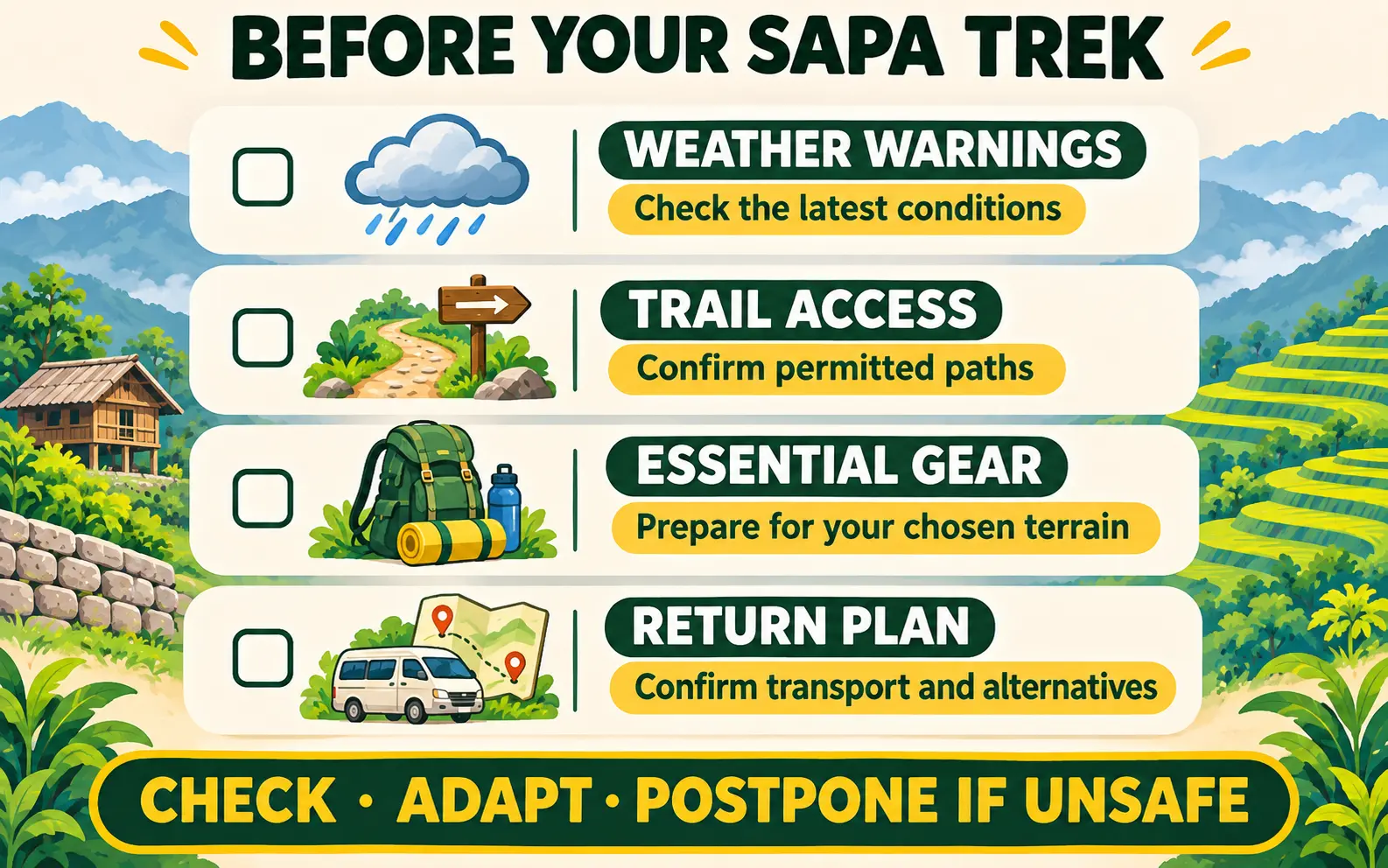
Before setting out from Sa Pa
- Check current weather, warnings and the condition of the intended paths and roads.
- Confirm access, meeting point, walking plan and an achievable finish time.
- Check water, food, footwear, weather layers and personal essentials.
- Share your plan and save important details offline.
- Confirm the return pickup and agree on circumstances in which the plan will be shortened or postponed.
Official sources and editorial disclosure
Use destination information to identify options, then consult the relevant authority or manager for actual access. The following sources are useful starting points:
- Vietnam Tourism: Sa Pa destination guide for destination context.
- Lao Cai tourism portal for regional visitor information.
- Hoang Lien park management tourism website for managed mountain activities.
- National weather forecasting center and Lao Cai disaster prevention portal for current warnings.
- UK travel advice and Canadian travel advice for general safety preparation.
This is an independent editorial planning guide, not a guided service, a verified trail map or a certification of any tour provider. The examples describe possible planning formats. Check the applicable rules, fees, access, weather and actual arrangements for your visit.
Frequently asked questions about Sapa trekking
Is one day enough for Sapa trekking?
One full day based in Sa Pa can be enough to explore a suitable village or valley segment. It is not necessary to complete an extensive itinerary to see terraced fields and experience the highland landscape. If you are arriving from Hanoi that day, allow for the transfer and rest instead of assuming you also have a full trekking day. Confirm the chosen walk and return transport before setting out.
Is a two-day trek with a homestay worth it?
It may be a good choice if you want an overnight experience outside town and have enough time to adjust the itinerary when needed. An overnight stay can also reduce the pressure to return on the first day. Consider the accommodation facilities, daily walking effort, weather and total cost. A day trek may suit you better if you prefer the comfort of your town accommodation or have limited time.
Can you trek in Sapa without a guide?
Some designated village visitor areas can be explored independently, subject to their access rules and actual conditions. This does not mean every trail is open for independent trekking. For longer or unfamiliar paths, a local guide can help with route selection and communication. For Fansipan summit trekking and other managed activities, confirm and comply with the relevant authorization and guiding requirements.
Can beginners or families go trekking in Sapa?
Beginners and some families may prefer a short village visit or a limited valley segment rather than a full-day mountain walk. Suitability depends on the youngest or least experienced participant, the actual terrain, weather, supervision and applicable restrictions. Ask about steps, descents, rest points, age requirements and the possibility of stopping early. Do not rely on an advertised difficulty grade as a guarantee.
Choose the experience, not the distance
A well-planned Sapa trek is one that matches your ability, respects the communities you visit and leaves room to adapt. Decide on the type of experience first, confirm the practical details, and be prepared to change the plan when conditions require it.