Can you teach English in Vietnam without a degree? Sometimes, but the answer depends on which qualification you lack, where you plan to teach, and whether you can lawfully work in Vietnam. A person with an accepted college-level diploma is in a different position from someone who has no tertiary qualification and only a TEFL certificate.
This guide explains the distinction between teaching credentials and work authorization, compares language centres with schools, and explains why a forthcoming change to Vietnam's foreign-worker rules is not a general permission to teach without qualifications.
Legal position checked: 23 October 2026
Decree 219/2025/ND-CP is the foreign-worker framework in force on this date. Decree 393/2026/ND-CP was issued on 20 October 2026 but is scheduled to take effect on 5 December 2026. The later decree is discussed separately below. This article is general information, not a personal eligibility decision or legal advice.
Can You Teach English in Vietnam Without a Degree? The Short Answer
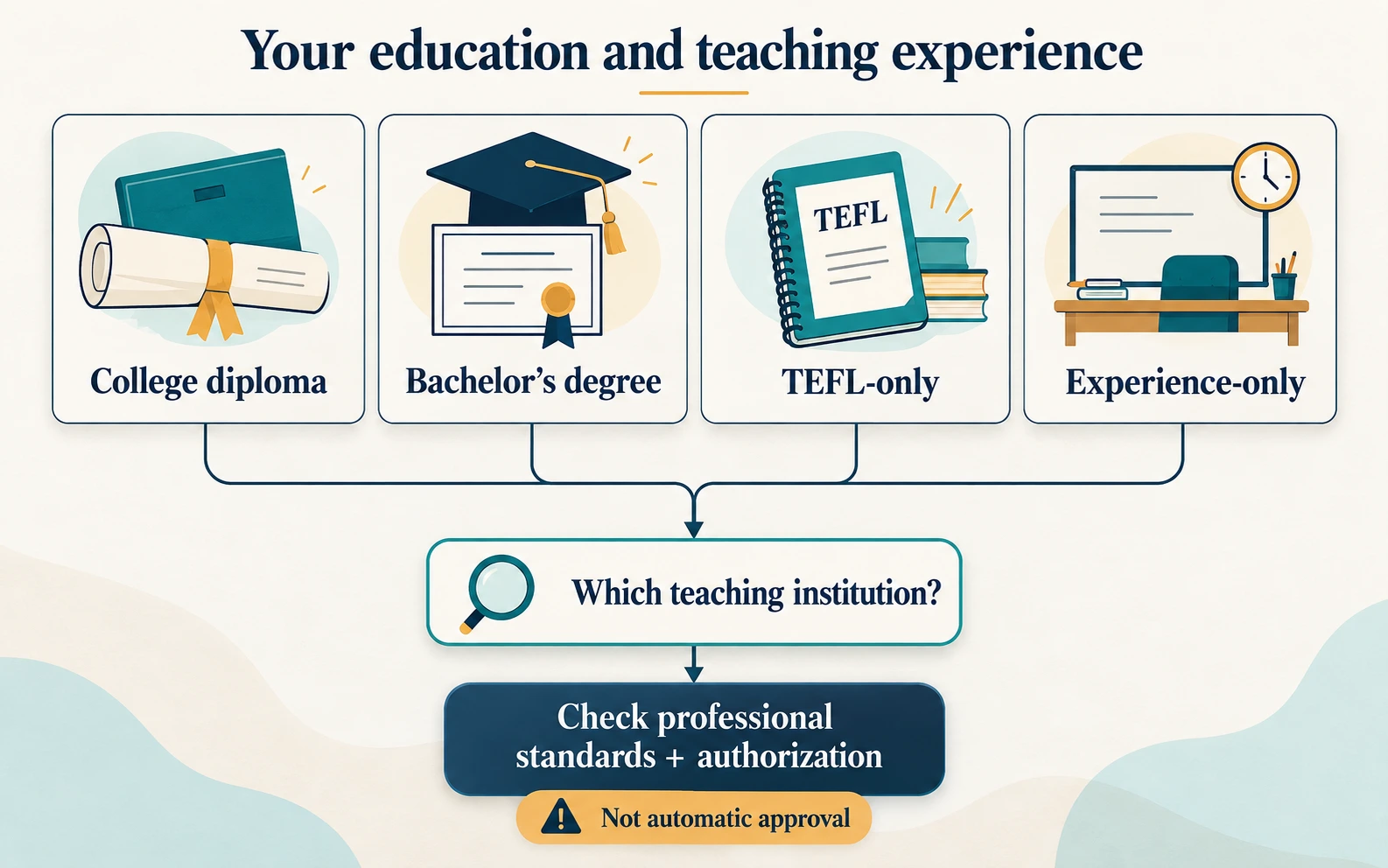
If by “without a degree” you mean without a bachelor's degree but with a relevant college-level qualification, certain education-sector standards recognise college-level credentials for specified roles. That does not mean you automatically qualify for a work permit or an offer of employment.
If you mean no college or university diploma at all, a standalone TEFL/TESOL certificate or several years of informal experience does not establish an ordinary legal route to teach at a regulated language centre or school under the rules reviewed here.
A college diploma may matter
Some centre-teaching standards specify a qualifying college diploma or higher, with the relevant additional certificate or subject requirements.
TEFL alone is not a degree
A TEFL/TESOL course can develop teaching skills, but it should not be presented as automatically replacing a statutory tertiary qualification.
Permission to work is separate
Even when your teaching credentials meet an education standard, you must check the applicable work authorization and entry/stay requirements.
The safest starting question is not simply “Can I find a school willing to hire me?” It is “Which exact education and work-authorization rules apply to this role, my documents and the date of the application?”
What Does “Without a Degree” Actually Mean?
English-language discussions often use degree to mean a four-year bachelor's degree. Vietnamese rules may refer instead to a particular level of education, including cao đẳng (college) or đại học (university). These are not interchangeable labels, and a foreign credential must be evaluated for its relevance and accepted level.
| What you have | What it may mean for teaching | What still needs checking |
|---|---|---|
| No bachelor's, but a college diploma | May fit certain college-level teacher standards. | Exact subject, diploma equivalence, additional certificates, school type and work authorization. |
| Bachelor's degree outside education | Can be relevant for some routes, but a suitable degree and pedagogical training may still be required. | Subject match, employer rules, applicable teacher standards and permit classification. |
| TEFL/TESOL/CELTA only | Shows training, not by itself a college or university diploma. | Whether a qualifying tertiary credential is required for the exact teaching role. |
| Work experience only | May support an employment application; it is not automatically a teacher-qualification substitute. | Applicable legal route, documentary proof and education-sector standards. |
A centre's marketing language such as “Level 5 TEFL,” “internationally accredited” or “120-hour certificate” does not itself prove that a Vietnamese authority treats the certificate as a college diploma. Ask what legal rule and recognition process the employer relies on.
The Two Tests Every Foreign English Teacher Must Check
Two sets of requirements can apply at the same time. Passing one is not the same as passing the other.
Test 1 — Work authorization
Can you legally take this work in Vietnam?
Confirm the appropriate foreign-worker classification, whether a work permit or valid exemption is required, which organization is responsible for documentation, and how the actual work relates to your immigration status.
Test 2 — Teaching qualifications
Do you satisfy the education rules for this role?
Confirm the type of institution, level of learners, language and subject taught, qualification level, subject specialization, professional teaching training and any specific institutional requirements.
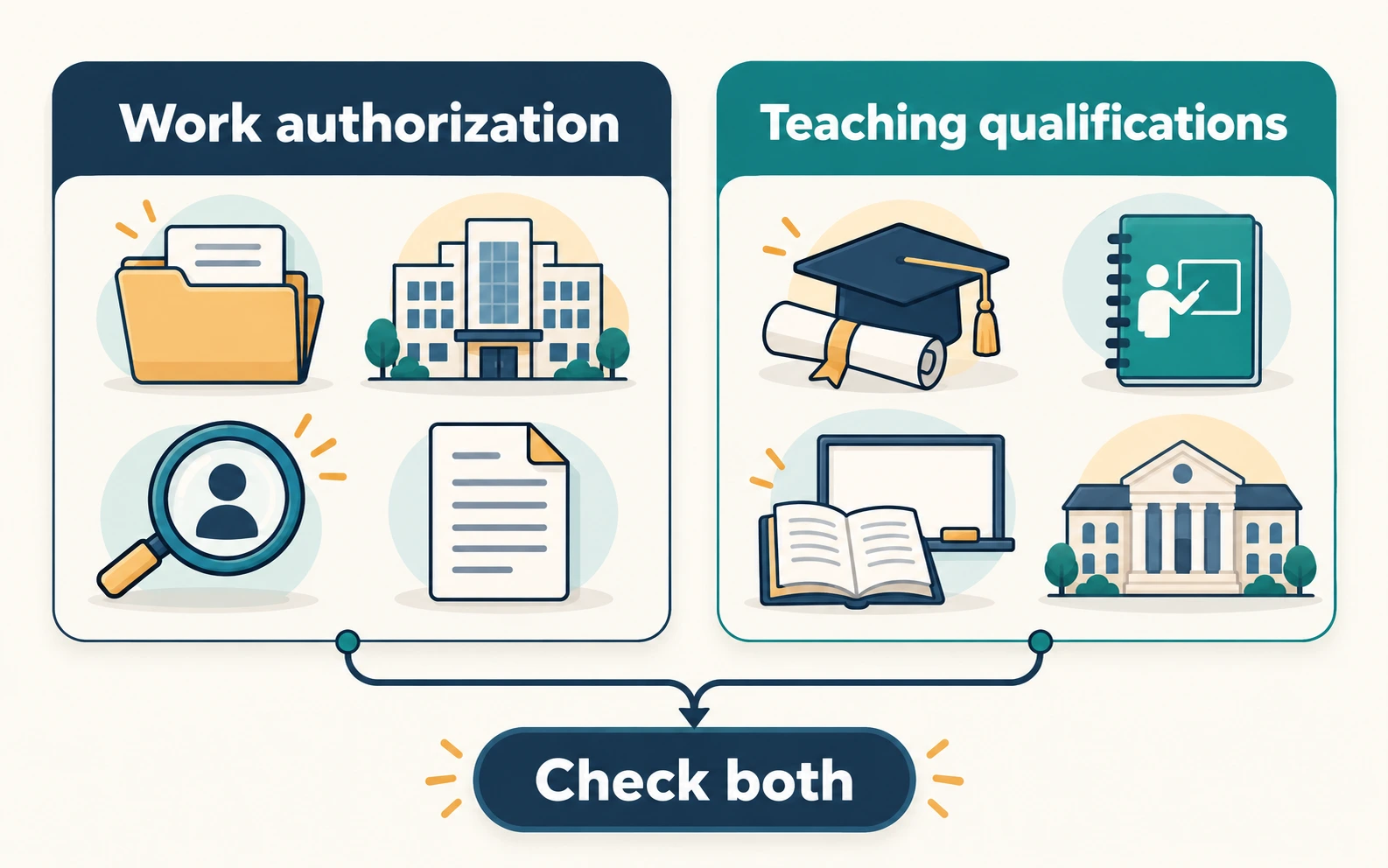
For example, being academically qualified to teach at a centre does not mean a visitor e-visa permits you to work there. Conversely, the existence of a possible work-permit category does not cancel qualification rules set for teachers by education law.
Which Vietnam Work-Permit Rules Apply — and When?
Advice published in different years may describe different legal regimes. The date matters, particularly now that a replacement foreign-worker decree has been issued but is not yet effective.
Decree 219/2025/ND-CP
This is the operative foreign-worker framework as of this article's check date. Its general expert routes normally refer to a university degree or equivalent plus relevant experience. Education-sector qualification rules still need separate attention.
Decree 393/2026/ND-CP
The replacement decree introduces a general expert route involving at least five years of relevant work experience. It also separately addresses experts teaching or conducting academic activities at educational institutions.
Under Article 35 of Decree 393, work permits and qualifying exemption documents issued under the earlier framework generally remain valid to their stated expiry date. Applications submitted before 5 December 2026 are covered by a specific transition rule referring to Decree 219. Those rules concern processing and continuity; they do not turn an unqualified teaching position into a lawful one.
Important if you are reading this after 5 December 2026
Check whether Decree 393 took effect as scheduled and whether any later education-sector rules have changed. The analysis here is dated 23 October 2026; the future regime is described from the issued text, not as an already effective rule on that date.
Can You Teach at a Vietnam Language Centre Without a Bachelor's Degree?
Potentially, if you hold the required college-level qualification and additional credentials for the relevant route. Article 18 of Circular 21/2018/TT-BGDĐT distinguishes native speakers teaching their own foreign language from other foreign teachers. The following is a practical summary of the specific provisions, not an approval of any individual diploma.
| Teacher category | Education/qualification route described | Key caution |
|---|---|---|
| Native speaker teaching their native language | College diploma or higher and an appropriate foreign-language teaching-training certificate. | Native-speaker status alone is not the entire rule. |
| Other foreign-language teacher — route A | College diploma or higher in foreign-language teacher education. | The field and diploma must be suitable. |
| Other foreign-language teacher — route B | College diploma or higher in a foreign language plus appropriate language-teaching training. | A generic short course may not establish the required equivalence. |
| Other foreign-language teacher — route C | College diploma or higher, qualifying high-level language proficiency and appropriate teaching training. | Proficiency and training both matter; equivalent qualifications require checking. |
The centre must still assess whether its actual activity falls under the relevant rules, whether the candidate's overseas documentation is acceptable, and whether work authorization is available. Do not assume that being fluent, being a native speaker or being offered cash-paid classes overrides the requirements.
Source: Ministry of Education and Training, Circular 21/2018, Article 18. Applicability and amendments should be rechecked when an actual contract is considered.
What About Primary Schools, Secondary Schools and International Schools?
Do not assume that an advertisement for a “teacher” at a language centre and one for a classroom teacher in a school follow the same credential rules.
Primary school foreign-language teaching
Article 20(2) of Decree 93/2026 permits a specific college-or-higher qualification route for certain special subjects, including foreign languages at primary level, with the appropriate subject qualification or relevant discipline plus pedagogical training. The exact employer and school classification remain important.
Lower and upper secondary schools
The ordinary standard under Article 28 of the Law on Teachers refers to an appropriate bachelor's qualification in teacher education, or a relevant bachelor's qualification with required pedagogical certification, subject to applicable statutory exceptions. Do not extend the special primary-language rule to these levels.
International or other programmes
A school may teach an international curriculum or have overseas links. That branding does not by itself identify a qualification exemption. Verify the institution's licence, the programme, the precise post and the professional standards that apply to it.
Some employers may require more than the statutory minimum: a recognized teaching licence, classroom experience, specific subject training or safeguarding checks. An employer preference is not the same as a national legal minimum, and vice versa.
Sources: Government explanation of Decree 93/2026, Article 20 and Law on Teachers, Article 28; official Decree 93 record.
Can Five Years of Experience Replace a Bachelor's Degree?
This is the most easily misunderstood part of the current debate. Decree 393/2026 has a five-year experience route for some experts, but it does not declare that every foreign English teacher can replace a required teaching qualification with five years' experience.
In the issued text of the decree scheduled to take effect on 5 December 2026, Article 4(3)(e) describes an expert with at least five years of experience suitable for the proposed role. Article 4(3)(đ) separately describes experts teaching, researching or undertaking academic exchange at educational institutions by reference to applicable education-sector requirements. Article 20 sets out different documentation routes for these categories.
What the five-year route does not prove
- That five years of private tutoring makes someone a legally qualified school teacher.
- That a language centre can ignore its applicable diploma and teaching-certificate standards.
- That an employer can change the job title to avoid education requirements.
- That someone may begin teaching before the required authorization is established.
Experience may be valuable evidence for a lawful application in an appropriate category. But the classification, experience records, education-sector rules and competent authority's decision must be considered together. If you are relying on the boundary between Article 4(3)(đ) and Article 4(3)(e), seek a reasoned assessment from the employer's qualified Vietnamese legal adviser before accepting a job.
Source: official Decree 393 record; published full-text reproduction of Articles 4, 20, 35 and 36 (cross-check against the signed official instrument before legal reliance).
Do TEFL, TESOL or CELTA Certificates Help?
They can help you prepare to teach and can be relevant when a specific rule or employer requires suitable teaching training. Their exact content, provider, assessment and recognition matter. The name on a certificate is not a substitute for checking the applicable law.
TEFL
A broad term for teaching-English-as-a-foreign-language training. Course hours and quality vary; a TEFL certificate is not automatically an academic diploma.
TESOL
A broad label for teaching English to speakers of other languages. Recognition depends on the particular programme and the specific legal or employer requirement.
CELTA
A particular teaching qualification often valued by employers; it does not automatically replace a required college or university qualification in Vietnamese law.
If a training provider advertises a course as “the solution” to teaching without a degree, request the exact current Vietnamese rule it claims the course satisfies. Avoid making relocation or course-purchase decisions on the basis of promotional copy alone.
Work Permits, Exemptions and Entry Visas: What Is Different?
These are connected but distinct questions. A visa or entry permission addresses entry and stay; a work permit or valid exemption concerns work authorization under relevant employment rules. Neither automatically proves you meet professional teacher standards.
| Document or status | What it addresses | What it does not establish by itself |
|---|---|---|
| Work permit | Authorization to perform specified work under the applicable rules. | Unrestricted permission for any other employer, role or teaching setting. |
| Valid work-permit exemption | A defined exemption category, sometimes involving confirmation or notification procedures. | A general exemption for all teaching, freelance tutoring or part-time jobs. |
| Visa or e-visa | Permission relating to entry/stay within its legal scope. | Automatic authorization to take teaching employment. |
| Employer's verbal assurance | A statement about the employer's intended hiring process. | Proof of legal eligibility, a permit, an exemption or approval. |
Some education-related work-permit exemptions are narrowly defined for approved programmes or other qualifying activities. Do not assume that an informal short teaching arrangement, an e-visa, remote lessons or a brief stay qualifies. Ask the employer to identify the applicable provision and documentary process. Remote work can also raise immigration, employment and tax questions that are not answered by a teaching certificate.
Realistic Qualification Scenarios: What Should You Check First?
These examples are illustrative. A positive possibility is not a guarantee that a person will receive a work permit or be hired.
| Your situation | Starting assessment | Next check |
|---|---|---|
| Native English speaker; relevant college qualification; suitable teaching certificate | There is a college-level route described for native-speaking language-centre teachers. | Diploma recognition, teaching certificate suitability, centre status and work authorization. |
| Non-native English speaker; college qualification in a relevant language field | May fit one of the language-centre routes if all required additional conditions are met. | Exact qualification branch, language training/proficiency documents and authorization. |
| No tertiary diploma; 120-hour TEFL certificate | The certificate alone does not establish an ordinary regulated-teaching route. | Do not accept an assurance that TEFL equals a college qualification without official evidence. |
| Relevant college diploma; applying for primary-school foreign-language teaching | A special college-level rule exists for this subject and school level. | Subject match, pedagogical training, school classification and foreign-worker rules. |
| College diploma only; applying for secondary-school teaching | The primary-school exception does not automatically extend to secondary school. | Applicable bachelor's-level standard, any legally relevant exception and employer criteria. |
| No bachelor's; five years' relevant experience; job begins after 5 December 2026 | Experience may be relevant to the new expert provisions, but not a blanket waiver for teaching. | How the education-specific expert route interacts with professional teacher standards. |
What Documents Should You Prepare Before Accepting a Teaching Offer?
The list below is a planning checklist, not a universal mandatory document list or a promise that these papers will be accepted. Requirements depend on your route and employer.
Credentials and employment evidence
- Diploma or degree, transcript and accurate course/field details.
- Teaching-training certificate, with provider and course details.
- Language proficiency evidence if your applicable pathway requires it.
- Documented relevant employment history and reference letters when required.
- Any professional teaching licence or pedagogical qualification relevant to the school.
Role and authorization information
- Full legal name and licence category of the employing institution.
- Written job description, teaching level, subject, location and contract terms.
- The work-permit or exemption category the employer intends to use.
- Employer's document checklist, translation/legalization requirements and timeline.
- Applicable entry and stay arrangements verified for the specific case.
Six questions to ask an employer in writing
- What is the institution's legal status, and which education rules apply to the advertised position?
- Which precise provision confirms that my actual diploma or qualification is acceptable?
- Will the role be classified as a teacher, an education expert or another position, and why?
- Who will complete the work-permit or exemption procedure, and what proof will I receive before starting?
- Are any academic documents required to be translated, authenticated, legalized or assessed for equivalence?
- If the answer depends on Decree 393, how will the employer handle the effective date, transition rules and teaching-specific standards?
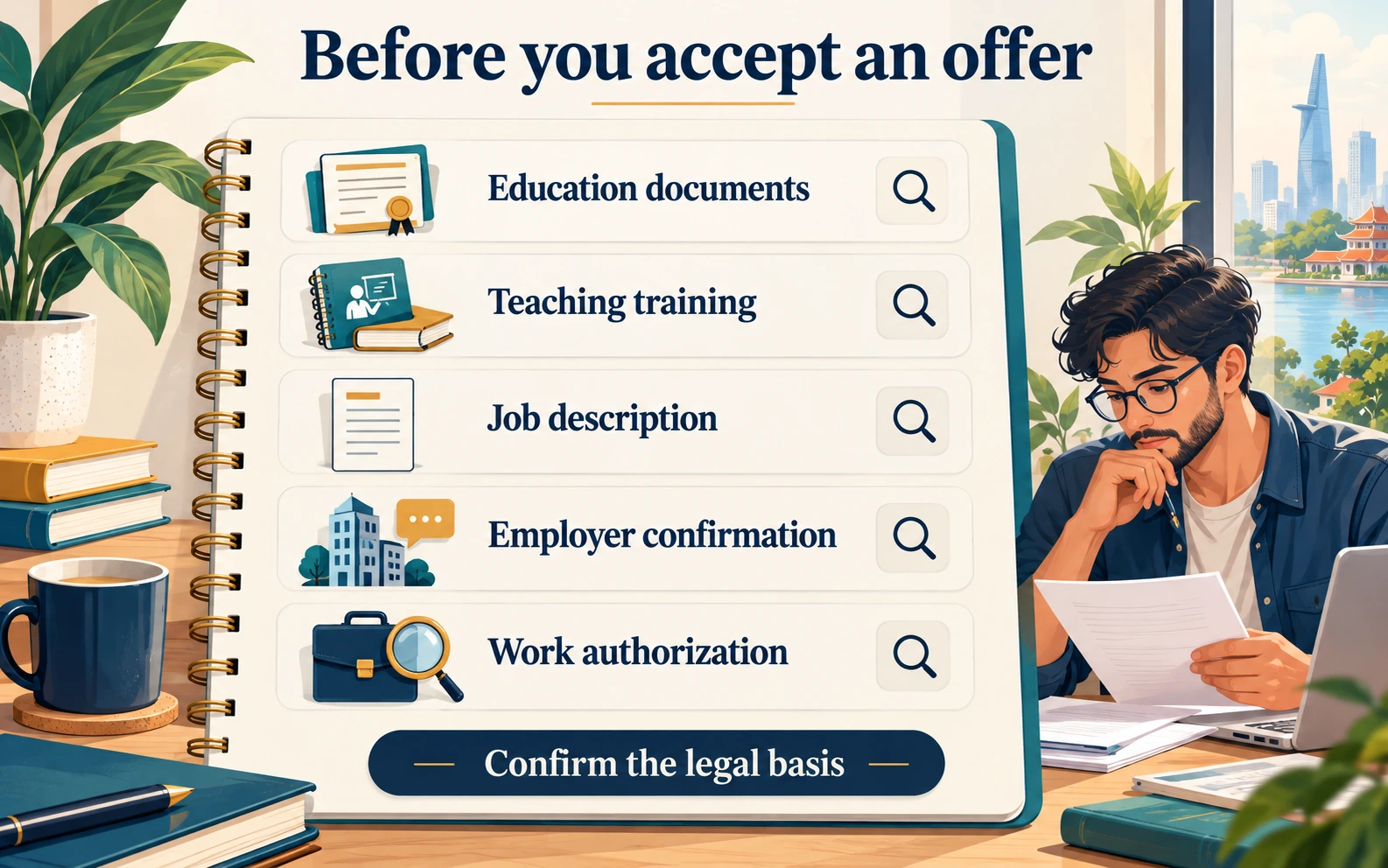
Be careful with shortcuts
Be wary of an offer to teach first and “sort out the paperwork later,” or a claim that cash payments, a different job title or a tourist entry document removes the need for checks. If the employer cannot explain the legal basis, request independent advice before working.
What If You Do Not Meet the Teaching Requirements?
There is no reliable “no-degree teaching loophole” to recommend. Depending on your circumstances, a safer path may be to complete an appropriate recognized tertiary qualification, obtain missing pedagogical training, or explore different roles for which you can independently establish the correct employment requirements.
Do not treat freelance tutoring, volunteer work, online teaching from Vietnam or a job at a less formal institution as inherently exempt. Whether work is lawful depends on the actual facts, including the relevant employer, work performed, immigration status and rules in force. Experience can strengthen a future application, but it does not retroactively legalize unauthorized teaching.
If you are comparing Vietnam with another country, verify that country's rules separately. A qualification that works in one market cannot be assumed to satisfy Vietnamese education or foreign-worker law.
Frequently Asked Questions
Can I teach English in Vietnam with a TEFL certificate but no college diploma?
A TEFL certificate by itself does not establish the college-level qualifications described in the ordinary language-centre standards reviewed here. Do not assume that a centre's interest in hiring you resolves the legal requirements.
Can I teach English in Vietnam with an associate degree or college diploma?
A qualifying college-level credential may be relevant to certain roles, including some language-centre routes and the special primary-school foreign-language rule. Whether your overseas award is accepted, and what additional certificates you need, must be checked.
Do native English speakers need a qualification?
Native-speaker status is not a complete exemption. Article 18(5) of Circular 21/2018 describes both a college-or-higher qualification and suitable teaching training for native speakers teaching a foreign language at relevant centres.
Can five years' teaching experience replace my degree?
Do not rely on that as a general rule. Decree 393's prospective five-year expert route must be distinguished from the education-specific expert provision and the standards applicable to teachers. It is not effective until 5 December 2026.
Is a bachelor's degree mandatory for every English-teaching job?
Not as a blanket statement covering every institution and qualification pathway. Some specific rules mention college-level qualifications; other school positions have bachelor's-level standards. An individual role must be classified correctly.
Can an employer arrange a work permit if I do not meet teacher standards?
An employer may assist with a lawful application, but assistance does not remove education requirements. Ask for the actual authorization pathway and a clear assessment of your credentials.
Can I teach part-time or online using a tourist e-visa?
A tourist e-visa is not, on its own, permission to take teaching employment. Part-time, private and cross-border online activity can create fact-specific immigration, labour and tax questions; do not assume automatic permission.
Does Decree 393 automatically change the position of existing teachers?
No. Its transition provisions preserve certain existing authorizations and address pending applications. They do not grant a universal exemption from teaching standards, and they do not make earlier unauthorized employment lawful.
Official Sources and How to Verify Your Case
Legal requirements are specific to the date, employer, role and documents. The following sources are provided so readers can check the applicable instruments rather than relying only on recruitment websites or online anecdotes.
- Government legal-document record — Decree 219/2025/ND-CP (foreign-worker rules in force at the check date).
- Government legal-document record — Decree 393/2026/ND-CP (issued 20 October 2026; effective date listed as 5 December 2026).
- Ministry of Education and Training — Circular 21/2018/TT-BGDĐT, especially Article 18 (language-centre teachers).
- Government legal-document record — Decree 93/2026/ND-CP (Law on Teachers implementation, including Article 20).
- Government explanation of teacher education standards, including the Law on Teachers, Article 28.
Editorial note: Reviewed 23 October 2026 using public legal sources; the detailed provisions of Decree 393 were cross-checked against a published full-text reproduction, but the government signed PDF has not been independently matched page by page for this article. This is informational editorial content, not government guidance, a legal opinion, or confirmation that an individual is eligible for a job, permit or exemption. Verify later amendments and seek qualified advice before making consequential employment or immigration decisions.