Looking for non-native English teacher jobs in Vietnam? You may be able to apply for suitable teaching roles even if English is not your first language. The harder questions are which employers will consider your application, which qualifications the specific position requires, and how you can work legally. This guide shows you how to check all three without relying on misleading job ads or blanket promises.
It is written primarily for foreign applicants who are not native English speakers. Vietnamese applicants may face different employment and professional rules. Neither group should assume that a certificate or a particular nationality guarantees a teaching job.
Quick answer
Some Vietnamese employers expressly consider qualified non-native English speakers. But acceptance for an interview is different from meeting the applicable teacher-qualification standards and obtaining lawful work authorization. Confirm the school type, specific role and current employer criteria before paying for relocation or accepting a start date.
Can a Non-Native English Speaker Teach in Vietnam?
Potentially, yes. There is no sound basis for saying that every foreign non-native English speaker is automatically excluded from all English-teaching roles. For example, VUS says it may consider a non-native applicant who supplies an introduction video. A YOLA recruitment FAQ also says non-native applicants may be considered when they demonstrate English and teaching skills on video. Both employers apply their own additional criteria, and their published wording should be checked again for the specific position.
That is not a promise of work. Some advertisements favor particular accents, passports, experience or teaching backgrounds; others assess demonstrated proficiency and classroom ability. A school's recruiting preference is not automatically a legal qualification rule. Equally, a general regulatory pathway is not a guarantee that a particular employer will hire you.
Useful approach: describe your English proficiency, academic credentials and teaching experience accurately rather than trying to fit an undefined "native-speaker" label.
What Does “Non-Native” Mean in a Teaching Job Advertisement?
In recruitment discussions, non-native English speaker usually means someone who did not acquire English as a first language. It does not measure teaching quality on its own. A highly proficient multilingual teacher may have strong pronunciation, excellent lesson planning and substantial classroom experience. Conversely, speaking English as a first language does not remove professional and immigration requirements.
Be careful with advertising categories such as native level, C1/C2, European or country-specific passport lists. Ask whether the organization requires a particular test score, evaluates a teaching demonstration, or has a specific work-authorization/document rule. Do not assume all employers define these terms consistently.
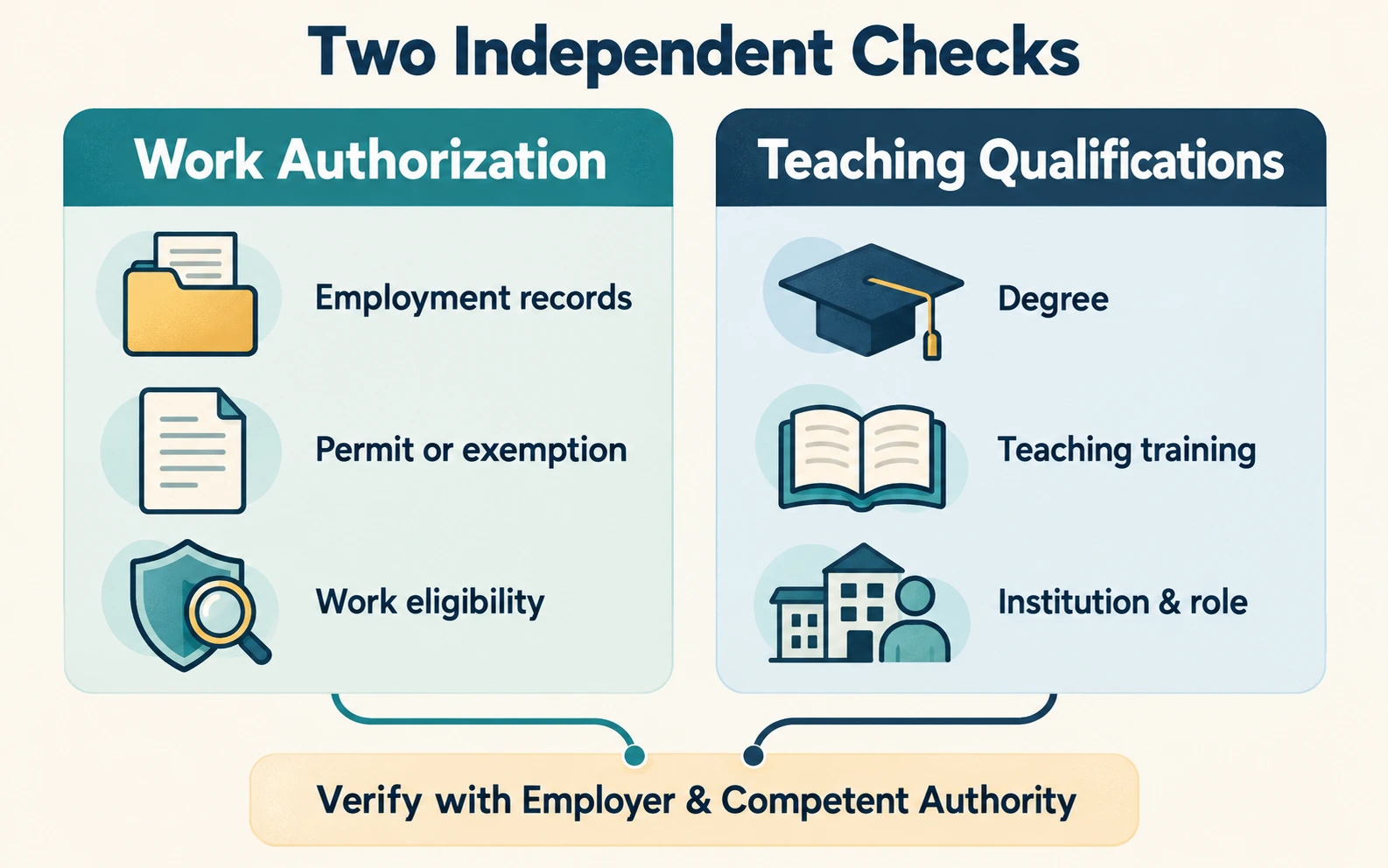
Two Separate Checks: Work Authorization and Teaching Qualifications
A strong application needs more than an attractive CV. These are separate questions, and a “yes” to one does not answer the other.
Check 1 — Can you legally perform this work?
Identify the employer, position, proposed workplace and applicable work-permit or exemption procedure. An entry visa or an employer's informal promise does not by itself establish permission to teach for pay.
Check 2 — Are you professionally qualified for this teaching role?
Examine the requirements for the precise institution and teaching assignment, then compare your degree, subject specialization, pedagogy training and English-language evidence with those standards.
For a foreign teacher at a language center, the Government Information Portal explains the distinction using Article 18 of Circular 21/2018/TT-BGDĐT. That older government Q&A discusses a former foreign-worker decree, so use it for the quoted teaching-standard concept, not as an up-to-date standalone procedure for work permits.
What Qualifications Might You Need?
There is no reliable one-line rule covering every school, center and teaching assignment. Your highest qualification, field of study, pedagogy training and English-language proof all matter.
Language-center teaching: what the regulation says
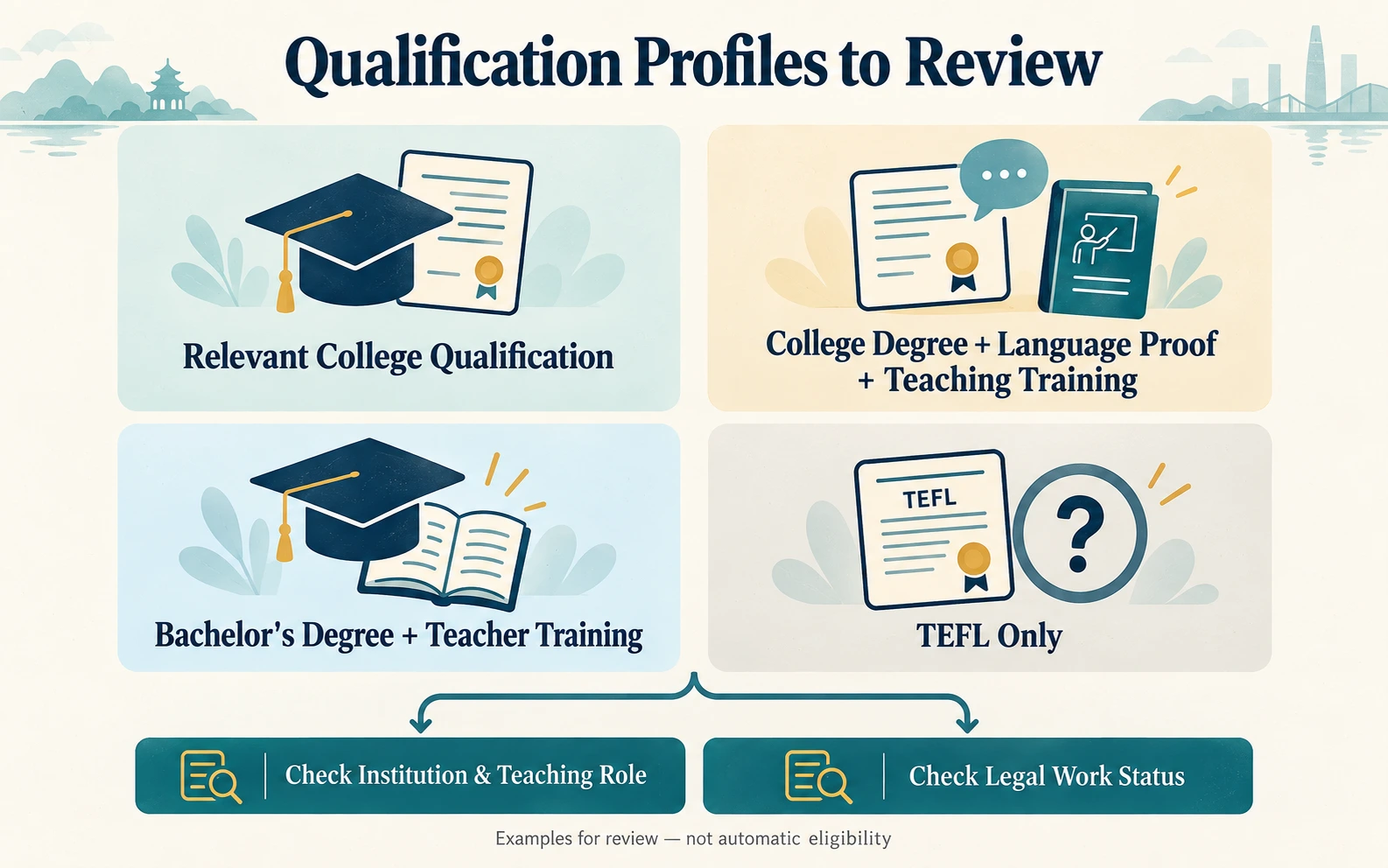
Article 18(6) of Circular 21/2018/TT-BGDĐT describes alternative qualification routes for foreign teachers of foreign languages at language centers. In simplified English, the described routes include: (1) a suitable college-level foreign-language teacher-training diploma or higher; (2) a foreign-language college diploma or higher plus appropriate foreign-language teaching training; or (3) a college diploma or higher together with qualifying language-proficiency proof (Vietnamese six-level framework level 5 or equivalent) and appropriate foreign-language teaching training. Each route contains conditions; none is a universal approval or a substitute for work authorization.
Professional assessment of a specific diploma, certificate, institution type and any later amendment is essential. Do not treat a generic short course, a self-reported CEFR level or an unverified diploma as automatically satisfying a legally specified credential.
| Applicant profile | What to investigate | What not to assume |
|---|---|---|
| Relevant college diploma in foreign-language pedagogy | Whether the exact credential fits the applicable center standard; employer-specific requirements; authorization. | That every employer accepts a college qualification. |
| College diploma in languages + teaching training | Diploma subject, recognition and teaching-certificate suitability under the relevant route. | That any certificate branded “TEFL” automatically qualifies. |
| College diploma in another field + language proof + teaching training | Documented equivalent of the required language level and acceptable pedagogy training. | That an informal self-assessment of C1/C2 suffices. |
| Bachelor's degree + TEFL/TESOL | Role, institution, subject match, language proof and recruitment criteria. | That having two documents guarantees hiring or a permit. |
| TEFL certificate but no post-secondary diploma | Whether any lawful, suitable role exists and which standard applies. | That TEFL alone replaces all tertiary qualification requirements. |
| Several years of experience but no qualifying diploma | Whether experience is relevant to the specific rule, rather than to a generic worker category. | That experience automatically waives teacher-qualification rules. |
What about public schools and international schools?
Do not transfer the language-center rule word for word to a school. The Law on Teachers (Law 73/2025/QH15) and Decree 93/2026/NĐ-CP include qualification rules for different educational levels and specific subjects. The general framework for primary and secondary teachers can differ from an English-language center; Decree 93/2026 also describes a specific college-level route for certain primary-school foreign-language teaching. Exact scope, institutional status and recruitment requirements require separate review.
If a position is advertised as “international school English teacher,” request the official job description and ask which curriculum, teaching license and Vietnamese legal standard applies. The word “international” is not itself a legal exemption.
Which Teaching Roles Should You Search For?
Language centers
General English, young learners, conversation classes and some exam preparation. Check center-specific teacher standards, teaching hours and evenings/weekend availability.
Primary and secondary schools
Classroom teaching under school programs. School-level pedagogy, subject credentials, and the particular institution's employment status may matter.
Test preparation and specialist programs
IELTS, TOEFL, academic writing, debate or business English. Employers may require proven scores, demonstrable subject expertise or relevant teaching history.
Teaching-adjacent positions
Curriculum support, academic coordination or teaching assistance may use different descriptions and legal rules. Never assume the same permit route applies.
A job title is a clue, not proof of qualification or authorization. Confirm whether you would teach independently, assist a licensed teacher, deliver a contracted service or work in another capacity.
What Vietnamese Employers Actually Say About Non-Native Applicants
Employer-published recruitment criteria are more useful than broad promises made by a course seller or forum commenter. Two examples illustrate why you must check the current role, not just a company's general reputation.
| Employer | Published information | Important qualification |
|---|---|---|
| VUS | Its expatriate-teacher page says non-native applicants may be considered with an introduction video and requires a bachelor's degree, a teaching certificate and native-level English proficiency. | This is VUS recruiting policy, not a nationwide rule. Its FAQ makes broad legal statements that should not replace current official legislation. |
| YOLA — earlier recruitment FAQ | States it may consider non-native speakers who supply an introduction video; the FAQ lists IELTS 7.0 for non-native applicants. | A separate current YOLA recruitment page asks for English-proficiency evidence but does not publish that same score in its visible FAQ. Confirm the exact current requirement with the employer. |
These pages demonstrate conditional consideration, not confirmed openings reserved for non-native applicants. They do not establish an employment relationship with StartInVietnam, and this site is not recruiting on either employer's behalf.
When contacting a school, ask a precise question: “I am a foreign non-native English speaker with [degree/major], [teacher training], [English-language evidence] and [experience]. Does this specific position accept my background, and which documents must your team verify before a lawful start date?”
Where to Find Non-Native English Teacher Jobs in Vietnam
Use a two-stage search: discover opportunities on boards, then verify them on the hiring organization's own channel. A third-party listing can be outdated, incomplete or incorrectly tagged.
| Channel | How to use it | Verification step |
|---|---|---|
| VUS recruitment | Read published teacher requirements and application steps directly. | Ask whether your exact non-native profile is considered for the current role. |
| YOLA teacher careers | Review role details, qualifications and its application process. | Clarify any differences across YOLA recruitment pages and required proficiency proof. |
| Teast — Vietnam listings | Search teaching jobs and read job descriptions, including any non-native tag. | Check whether the original employer confirms the vacancy, pay units and application method. |
| Vietnam Teaching Jobs | Filter by location, type, experience and teaching specialty. | Verify the vacancy's date, employer identity and nationality/qualification criteria. |
| ESLGorilla | Use its teaching-job and country search tools for discovery. | Do not treat general claims about C1/C2, permits or salaries as official law or confirmed individual offers. |
Try targeted queries such as "non-native" "English teacher" "Vietnam", "English
teacher" "foreign applicants" "Hanoi" and site:school-domain.example "teacher
recruitment" (replace the example domain with a real employer website). Look at the publication
date and employer source, not a headline claiming hundreds of jobs.
StartInVietnam does not presently maintain a verified live vacancy list for this topic. The websites above are independent third-party resources, not partners or endorsed recruitment agents.
How to Check a Job Advertisement Before Applying
A job can be real yet unsuitable for your credentials or employment situation. Use this checklist before sending money, traveling for an interview or handing over identity documents.
Confirm the opportunity
- Identify the legal employer and school location.
- Find the vacancy on an official recruitment page or independently confirm it.
- Check post date, deadline, class age group, hours and contract type.
- Ask explicitly whether foreign non-native candidates are considered.
Confirm the terms and process
- Ask whether advertised pay is gross or net, hourly or monthly, and whether hours are guaranteed.
- Ask who checks credential recognition, work-permit status and visa/residence steps.
- Verify the offer, contract, payment schedule and document-handling method.
- Be wary of pressure to pay an unverified recruiter or start teaching on a tourist entry.

Do not confuse a platform's “verified” marketing label with official confirmation of qualifications, a valid work permit or guaranteed salary. The safest approach is direct confirmation with the employing institution.
How to Build a Competitive Application as a Non-Native Teacher
Your application should make employer screening easier while remaining truthful about documents that still need checking.
- Use a specific CV headline. State your teaching specialization, years of relevant classroom experience, target age range and strongest educational credentials.
- Document English proficiency. Include a current recognized test score or other formal evidence where the employer requests it. A self-described “native level” is not a substitute for a required certificate.
- Show teaching technique. A short, clear introduction video can demonstrate pacing, pronunciation, classroom language and your suitability for students at the intended level. Follow the employer's requested length and format.
- Prepare credential evidence. Keep readable copies of diploma, transcripts, teaching certificate, relevant work references and identity documents. Ask which originals, certifications, translations or legalizations are actually required.
- Ask about work authorization before accepting. Establish who will arrange or verify the correct permit/exemption process and which lawful immigration status you must hold at each step.
- Apply selectively. Compare each employer's stated language, degree, experience and schedule requirements against your record instead of mass-applying to ads that explicitly exclude your profile.
A useful introductory message is: “I am a qualified English teacher from [country] with [degree], [teacher-training certificate] and [years] of experience. My English proficiency evidence is [test/certificate]. Are foreign non-native English-speaking candidates considered for the [role] at [campus], and what documentation is required for a compliant employment process?”
Work Permits, Visas and Upcoming Regulatory Changes
Legal-reference date: 25 October 2026. Vietnam's Decree 219/2025/NĐ-CP is the currently effective foreign-worker framework at that date. Whether a person requires a work permit or qualifies for a specific exemption depends on the actual work arrangement and legal facts. An exemption is not established merely because the applicant teaches English, holds a TEFL certificate or has an employer who wants to hire them.
A visa, e-visa or tourist entry should not be treated as automatic permission to undertake paid teaching. Equally, a school saying it “supports visas” is not proof that the applicant's particular legal pathway has been approved. Ask the employer about the documentary basis, responsible authority and legally permitted start date.
Important date for future applicants
The Government's official record shows that Decree 393/2026/NĐ-CP was issued on 20 October 2026 and is scheduled to take effect on 5 December 2026. It is not yet effective on the reference date of this guide. Candidates and employers planning a later start must check the law then in force, including any transition provisions. Experience-based foreign-worker classifications should never be assumed to override separate professional teacher standards.
Specific exemptions can also have narrow criteria. For example, a March 2026 government answer about a particular international-school exemption shows why applicants should not generalize from one institution to every school. The relevant authority should assess the precise file where questions remain.
This section is general public information, not individualized immigration, employment or education-law advice. Official regulations and the competent authorities control.
Non-Native English Speaker vs. Teacher Without a Degree
These are different questions. “Non-native” describes a language background, while “without a degree” describes a credential gap. A foreign non-native teacher with a qualifying diploma may be able to pursue suitable roles; a native speaker lacking the qualifications for a particular institution does not become eligible simply through nationality or first language.
Likewise, “without a bachelor's degree” is not identical to “without any post-secondary diploma.” Certain specific educational standards include college-level pathways; employer policies can still require a bachelor's degree. Check both sets of requirements before you invest in a course or travel plan.
Common Mistakes That Make the Job Search Harder
- Assuming every school rejects non-native applicants. Some explicitly consider them, although screening criteria can be demanding.
- Assuming IELTS 7.0 is the national law for all foreign non-native teachers. A published employer threshold is not automatically a statutory requirement for every role.
- Buying a 120-hour TEFL course and assuming that is sufficient. Course length alone does not resolve credential recognition, institutional teaching standards or work authorization.
- Copying advice from old visa articles. Check the date and the current foreign-worker decree, especially for work beginning after a scheduled legal change.
- Treating job-board tags as employer confirmation. Verify the actual hiring entity and whether it still considers your profile.
- Relocating solely on a tentative offer. Clarify documentation, payment terms, legal start date and financial contingency plans first.
Frequently Asked Questions
Can someone from a non-English-speaking country apply to teach English in Vietnam?
Yes, applying may be possible when an employer considers the candidate's profile. Acceptance for consideration is not the same as meeting the professional standards and obtaining lawful employment authorization.
Is IELTS 7.0 compulsory for every non-native teacher?
No universal IELTS 7.0 rule should be inferred from a recruitment FAQ. Individual employers may specify a score; relevant regulations may require a qualifying proficiency level or equivalent documentation for particular routes. Confirm the exact standard and accepted evidence for your role.
Will a TEFL or TESOL certificate guarantee a teaching job?
No. A certificate may support your application, but its appropriateness, your diploma, teaching role, employer requirements and legal work status must all be checked.
Can I teach if I have a college diploma but not a bachelor's degree?
Some specifically defined qualification routes may involve a suitable college-level diploma, particularly in the language-center framework. That does not mean every diploma or position qualifies, and employers may require more. Confirm applicable rules and work authorization individually.
Can I arrive on a tourist or e-visa and start paid teaching?
Do not assume tourist entry or an e-visa confers permission to work. Confirm the required immigration status and work-permit or valid exemption procedure before any paid work starts.
Does five years of teaching experience remove diploma requirements?
Not automatically. A foreign-worker classification based on experience is separate from the professional teaching requirements of the institution and exact role.
Does StartInVietnam have non-native teaching vacancies or provide recruitment?
This article is independent informational guidance. StartInVietnam is not claiming a verified live inventory, employer partnership, sponsorship or placement service for these positions.
Your Next Steps
- Choose a realistic teaching role and institution type.
- List your education, language-proficiency evidence, teaching training and relevant experience.
- Check the applicable professional standard and the employer's own published policy.
- Find openings through official recruitment pages and independent boards; verify each vacancy at the source.
- Resolve work authorization and immigration questions before agreeing to teach.
The goal is not to persuade every employer that “non-native” should not matter. It is to find roles where your documented skills match the employer's real requirements and where a compliant employment path exists.
Sources and Editorial Notes
The legal discussion is anchored in official Vietnamese sources and dated to 25 October 2026. Employer recruitment policies are third-party facts that may change without notice. None of the references below is a legal opinion on an individual application.
- Government Information Portal: foreign teacher and language-center qualification discussion, quoting Circular 21/2018, Article 18 (older work-permit-law context must not be reused).
- Decree 219/2025/NĐ-CP: foreign workers (official government document record).
- Decree 393/2026/NĐ-CP: new foreign-worker regulation (official issue/effective-date record).
- Law on Teachers 73/2025/QH15 and Decree 93/2026/NĐ-CP.
- Government explanation of Article 20, Decree 93/2026, including a special primary foreign-language route.
- VUS expatriate-teacher criteria and FAQ; YOLA teaching recruitment; YOLA earlier recruitment FAQ.
Editorial disclosure: External job websites are provided as places to conduct your own search. Listings, quotas, remuneration, eligibility and vacancies have not been independently verified for any individual candidate. Laws and recruitment policies can change; reconfirm before acting.