Living in Hanoi as an expat can mean early breakfasts on neighborhood streets, lively cafés, a deep sense of local history and a daily routine that takes time to learn. It can also mean busy roads, seasonal air pollution, unfamiliar paperwork and an apartment search that deserves more attention than a few attractive photos. This guide helps you decide whether Hanoi suits you, choose an area to explore and settle in with fewer surprises.
Hanoi at a glance: what to expect
You may enjoy Hanoi if you value:
- Street-level food culture, cafés and a city with distinct local character.
- Exploring neighborhoods on foot and developing a regular local routine.
- Meeting people through shared activities rather than expecting an instant social circle.
Think carefully if you need:
- Quiet streets, consistently clear air or a predictable commute every day.
- A completely frictionless administrative or English-language experience.
- A home chosen without seeing the building, checking charges or testing the route.
Is Hanoi a good place to live as an expat?
Hanoi is not one experience. Life around the Old Quarter can feel very different from a residential street west of the center, and your working hours may matter more than the neighborhood's reputation. The useful question is not whether Hanoi is universally good for foreigners. It is whether its everyday compromises match your priorities.
What people often appreciate
Food and social life are visible parts of the day. Markets, small restaurants and cafés make it possible to build familiar routines without treating every weekend like a sightseeing trip. You can spend a quiet morning by a lake, take a walk through older streets and discover places that rarely appear in travel itineraries. Local relationships can become an important part of feeling at home.
What is harder than a short visit suggests
Traffic crossings, road noise, summer heat, damp periods and the seasonal drop in air quality can affect your comfort. Sidewalk access, building maintenance and English-language support vary by location and provider. Some people love Hanoi's intensity; others find that they need a quieter home, a shorter journey or more indoor space to balance it.
A practical fit test: rank your three non-negotiables before searching for housing. For example: being within an acceptable journey of work, having a quiet bedroom and having shops or social activities nearby. Use those priorities to reject unsuitable homes early, even if their photographs look excellent.
Best areas to live in Hanoi: choose by routine, not reputation
Expats often discuss areas such as Tây Hồ (West Lake), Ba Đình, Trúc Bạch, Cầu Giấy, Đống Đa and Hoàn Kiếm. These are useful everyday geographic labels, not guarantees about a particular street or building. Hanoi moved to a new system of 126 wards and communes on 1 July 2025; check the current ward when completing formal address documents, rather than assuming older district descriptions are still administrative addresses. Source: Hanoi government update, 1 July 2025.
| Area to explore | Consider it if... | Check before committing |
|---|---|---|
| Tây Hồ / West Lake | You want to explore lakeside routines, cafés and international social options. | Actual commute, noise on your street, building ventilation and access during busy periods. |
| Ba Đình / Trúc Bạch | You prefer a location from which to explore central neighborhoods and established residential streets. | Street-by-street noise, traffic access, apartment condition and route to work. |
| Cầu Giấy / western corridor | Your workplace or teaching location is west of the center, or metro access may be useful. | Which operational station is actually close, safe walking routes and rush-hour travel. |
| Đống Đa | You want to assess a more locally oriented residential routine with access to several parts of the city. | Street congestion, building upkeep and whether daily errands are convenient on foot. |
| Hoàn Kiếm / Old Quarter area | You prioritize access to historic streets and frequent city-center activities. | Late-evening noise, visitor activity, delivery access and suitability for long-term rest. |
| Hai Bà Trưng / Long Biên | You have work, family or personal reasons to compare alternatives outside the usual expat shortlists. | River crossings where relevant, transit connections, the precise workplace route and local services. |

A better way to shortlist neighborhoods
- Start with a real destination. If you work or study, locate the actual campus or office entrance. A brand name or general neighborhood is not enough.
- Test the journey at the correct hour. A route that seems easy on Sunday may feel different during a weekday school or office start time.
- Walk the immediate streets. Look for grocery options, safe crossings, access to transport, evening activity and places you would genuinely use.
- Compare the apartment, not just the area. A well-kept unit on one street may suit you better than a poorly maintained property in a fashionable location.
For a teacher, a home near the actual school may be worth more than being close to a familiar expat café. For someone working from home, ventilation, noise and reliable connectivity may outweigh travel convenience. There is no single best area for everyone.
Renting in Hanoi: inspect the home and the agreement
Online rental descriptions are useful for finding places to inspect, but they are not proof of availability, ownership, building quality or final costs. Ask for the full address, arrange a viewing when feasible and get the proposed terms in writing before transferring a deposit. An attractive listed asking price is not a verified neighborhood average.
Apartment viewing checklist
- Check windows, airflow, dampness, mold and signs of leaks.
- Test water pressure, hot water, air conditioning and Internet availability.
- Ask about stairs, lifts, access hours and safe exits.
- Listen for road, construction and neighboring-unit noise.
- Request written rent, deposit, billing rates and management fees.
- Clarify cleaning, repairs, visitor rules and early-exit terms.
- Check who is authorized to sign and receive payment.
- Confirm who handles the required foreign-guest stay declaration.
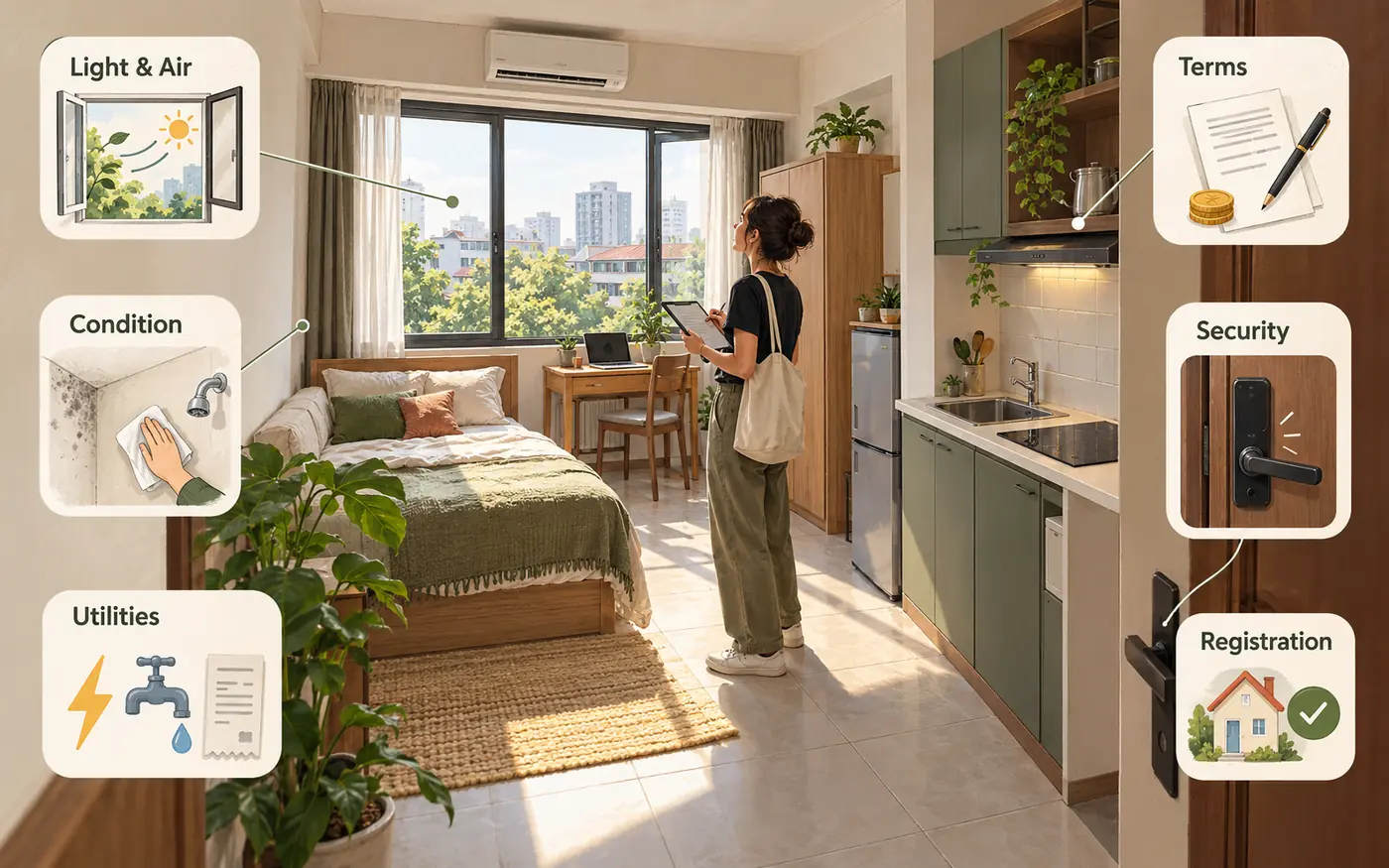
Foreign-guest temporary-stay declaration
Vietnam has a separate requirement to declare a foreign guest's temporary stay at an accommodation establishment. In an October 2026 explanation, the Ministry of Public Security said the accommodation owner, operator, legal representative or authorized party is responsible for making the declaration, including for a stay of just one night. A guest is expected to cooperate by presenting the relevant passport and stay documents. If an agent manages your rental, clarify in the agreement who actually submits the declaration. Source: Ministry of Public Security, 23 October 2026.
This accommodation declaration is not the same as obtaining a Temporary Residence Card (TRC), extending a visa or receiving work authorization. Do not assume that a landlord offering to register your stay is handling any of those other processes.
What about monthly rent and the overall cost of living?
Your total cost depends on accommodation type, the actual contract, utilities billed by the property, food, commuting and personal habits. Budget comparisons can be misleading when one source includes rent and another excludes it. Build your own estimate from a written rental offer and the way you plan to live. This article focuses on choosing a workable daily routine rather than publishing unsupported rental averages.
Getting around Hanoi without guessing your commute
Moving around Hanoi usually requires combining several options. A route can involve walking, a metro journey, a bus or a licensed ride-hailing or taxi service. The right mix depends on where your home and destination actually are, not a broad claim that one neighborhood is "central."
Using Hanoi Metro
Hanoi Metro's notice effective 9 February 2026 covers Line 2A (Cát Linh–Hà Đông) and the operating elevated section of Line 3.1 (Nhổn–Cầu Giấy). The operator states daily service hours of 5:30 a.m. to 10:00 p.m. under that timetable. The underground extension toward Hà Nội Railway Station was still under construction in the government's May 2026 project update, so do not plan a journey as though those unfinished stations were already open. Schedules and station access should be rechecked before travel. Hanoi Metro operating notice; government project update, 9 May 2026.
For foreigners using the Hanoi Metro app, the operator's published help page describes a "Foreigner Registration" route requiring passport and portrait images, followed by system approval. It also describes ticket-purchase alternatives. Check the latest steps and ticket conditions directly rather than assuming every user has immediate access to the same app features. Source: Hanoi Metro passenger FAQ.
Buses, ride-hailing and walking
Public buses and booked rides may help cover gaps between metro stations and your actual destination. Test your route during the hours you will use it, including the last stretch on foot. Hanoi's walkability is highly street-specific: a short distance on a map does not necessarily mean an easy sidewalk or crossing. At night or during heavy rain, leave extra flexibility in your plan.
Should you ride a motorbike?
Do not treat motorbike use as a default requirement for living in Hanoi. Before renting or riding, check your license category, the legal recognition of your documents, insurance coverage, protective equipment and local road rules. Requirements may differ by nationality and vehicle type. Driving without the appropriate authorization is not a sensible shortcut. Official consular guidance can help with nationality-specific questions, but Vietnamese rules and the competent authorities govern local legality.
Weather, air quality and staying healthy
Seasonal comfort matters
Hanoi has hot, humid periods, heavy rain at times and a cooler part of the year. Rather than choosing an apartment from an annual average temperature, think about the months when you will spend the most time indoors. Check whether the home has suitable cooling, ventilation, hot water, and a way to manage moisture and condensation.
Air pollution is a real consideration
Air pollution should be part of a realistic decision about living in Hanoi, especially if you have particular health needs. In a 28 September 2026 commentary, WHO and UNDP representatives described poorer air quality arriving with the cooler months. That does not mean every neighborhood has the same conditions or that every day is equally polluted.
Check recent and forecast local air-quality reports with the relevant time period clearly shown. Plan flexible outdoor exercise on worse days, and discuss personal health precautions with a qualified clinician when needed. A consumer air-quality reading is not a substitute for medical advice, and a short-lived observation should not be presented as a year-round average.
Healthcare planning
Before you need care, identify a medical facility that can address your requirements and ask about language support, opening hours, payment and whether your insurance is accepted. Keep essential medical information and prescribed medication details accessible. Vietnam's ambulance emergency number is 115; emergency call handling may be in Vietnamese. Check insurance coverage for treatment and, where appropriate, evacuation. Source: UK government health guidance for Vietnam.
Daily essentials: phone, internet, food and community
Getting connected
Confirm mobile SIM registration requirements with the specific operator and sales channel you choose. A valid passport is listed in MobiFone's published foreign-customer purchase policy, but that does not prove all carriers, plans or shops use identical procedures. If stable connectivity is critical, test mobile reception inside the apartment and ask the landlord which home Internet service is installed, how outages are reported and who pays for it.
Money and administrative errands
Carry a practical payment backup while you learn which merchants accept your card or preferred payment method. Before opening a bank account, ask the chosen bank for its current eligibility and document requirements for your particular residence status. A generic online account-opening checklist may not apply to every foreign customer. Keep digital and secure physical copies of your rental agreement, passport identification page and relevant status documents where appropriate.
Food and daily shopping
Hanoi's everyday food culture is one of the most enjoyable ways to get to know the city. Start with a few reliable nearby places for breakfast, lunch, groceries and drinking water. Observe how prices are displayed and how food is stored, and pay attention to personal dietary needs and food hygiene. A neighborhood becomes much easier to live in when you know the ordinary things: where to buy fruit, how to get a delivery and which shop is still open after work.
Building a social circle
Friendships often become easier when activities recur. Try a language exchange, a sport, a shared hobby or a community event that meets regularly. Attend a few times before deciding whether you fit in. Online expat groups can help you discover activities, but their advice on visas, apartments, jobs and payments should be independently checked. Never assume that a group, venue or organizer is officially partnered with StartInVietnam.
Learning small amounts of Vietnamese can improve everyday interactions. A few polite phrases, the ability to show your address and patience when there is a language gap can go a long way. You do not need flawless Vietnamese to begin, but relying on English everywhere can make practical errands harder.
Living in Hanoi as an English teacher
For teachers, location can affect more than rent. Teaching may involve morning, afternoon, evening or weekend hours depending on the employer and assignment. A home that feels ideal for cafés and social life may become frustrating if the actual school is a long journey away. Confirm your genuine work location and schedule before signing a long tenancy; do not assume every advertised teaching role is active or located at the campus you expect.
If you already have a confirmed job
Ask for the precise campus address, expected shifts, any multi-site duties and realistic start or finish times. Test the journey in both directions, including late-evening options.
If you are still exploring teaching
Choose flexible initial accommodation where possible. Research legitimate employers and current requirements before committing to an apartment solely because a blog says teachers live nearby.
Work eligibility is separate from your right to visit
Entry permission, permission to reside and authorization to work are different questions. A tourist or e-visa should never be assumed to authorize teaching. As of this guide's 30 October 2026 source review, Vietnam's government records identify Decree 219/2025 on foreign workers as effective from 7 August 2025 and Decree 393/2026 as scheduled to take effect on 5 December 2026, not yet in force on the review date. Individual exemptions and documents depend on current rules and circumstances; check with the employer, competent authorities and a qualified professional where needed. Decree 219/2025 official record; Decree 393/2026 official record.
The same caution applies to working remotely for an overseas organization: do not infer legal permission from the popularity of a lifestyle or from how other people describe their own arrangements.
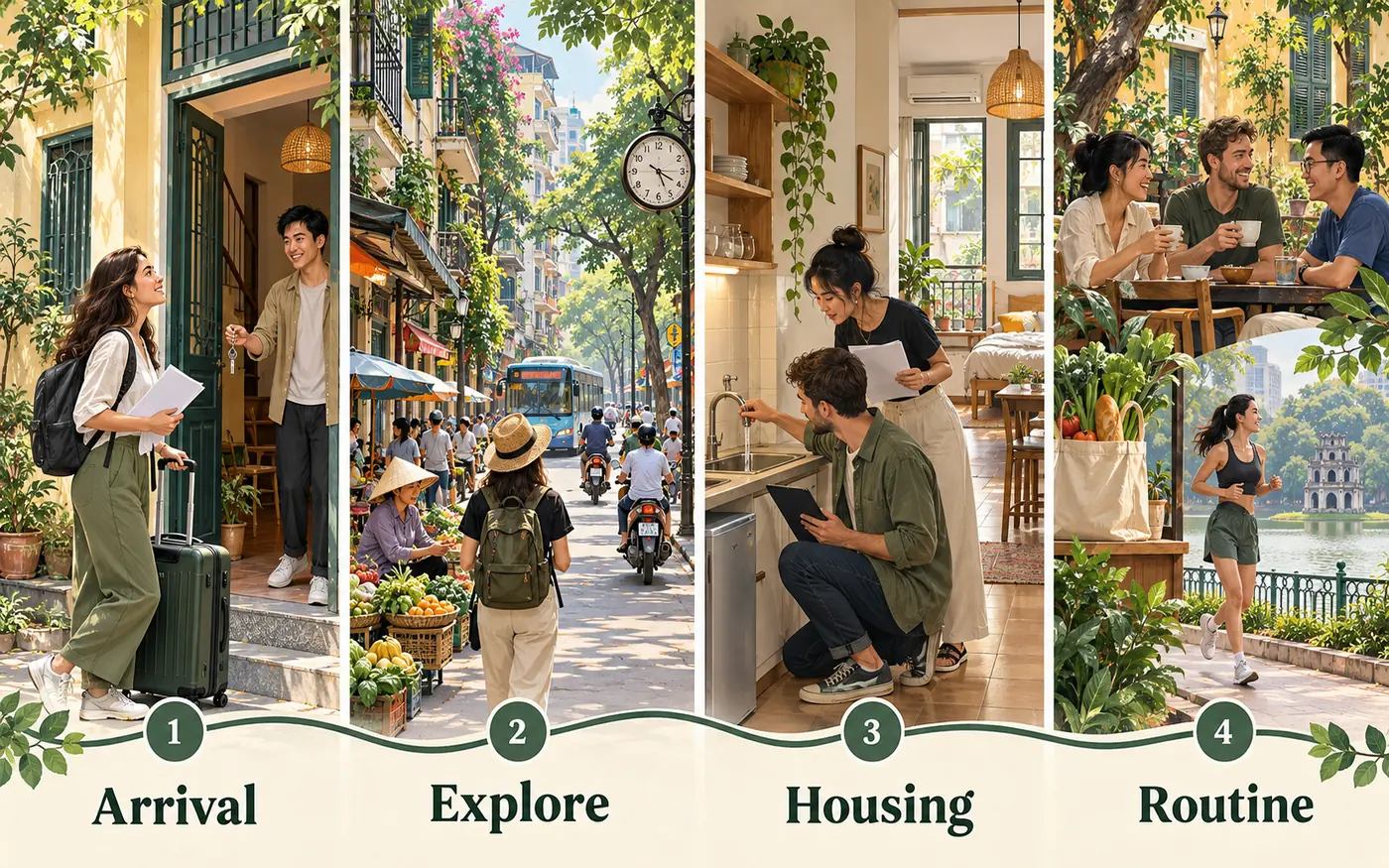
Your first 30 days in Hanoi: a practical settling-in plan
You do not need to solve everything on the first day. Separate urgent compliance and safety matters from decisions that benefit from observation. This timetable is an editorial planning tool, not an official immigration schedule.
| When | Priority | Useful actions |
|---|---|---|
| Days 1–3 | Arrive safely and establish essentials | Confirm accommodation and foreign-guest declaration responsibility; check documents, phone access, payment backup, food and your route home. |
| Days 4–7 | Learn your immediate area | Find groceries and pharmacies, practice crossings, test transport at real travel times and note noise or air-quality patterns. |
| Week 2 | Inspect longer-term options | Compare streets, view homes, request written fees and agreement terms, and investigate connectivity, repairs and deposit conditions. |
| Week 3 | Build a routine | Settle transport and recurring errands; research healthcare access; attend a repeat social activity and practice helpful Vietnamese phrases. |
| Week 4 | Review what works | Revisit your priorities, resolve open admin questions with the correct provider or authority, and adjust your housing or commute plan if needed. |
Save these questions before committing to a home
- Have I visited this exact property and checked the written total charges?
- Have I tested my commute at the times I will actually travel?
- Who is responsible for the legally required temporary-stay declaration?
- Can I get groceries, transport and medical help from this address?
- What will I do if the apartment is noisy, damp or unsuitable?
Living in Hanoi: frequently asked questions
Is Hanoi a good city for first-time expats?
It can be, especially if you enjoy an active urban setting and are prepared to learn local routines. The bigger questions are your tolerance for traffic and seasonal air conditions, your housing standards and whether you have a realistic plan for work, residence and health needs.
Where do expats usually look for housing in Hanoi?
Common starting points in expat discussions include Tây Hồ, Ba Đình, Trúc Bạch, Cầu Giấy and central neighborhoods. These are research starting points, not verified population rankings or guarantees. Choose based on your actual workplace, desired routine and property inspection.
Is Tây Hồ automatically the best place for foreigners?
No. It may be worth exploring if lakeside life and social options appeal to you, but another area may offer a better school commute, quieter street or more suitable home. Compare precise addresses rather than labels.
Can I live in Hanoi without a motorbike?
Many daily trips can be planned using walking, metro, buses and booked rides, depending on where you live. Check the full route, especially the last part between a station or stop and your destination. Never ride a motorbike without checking the relevant legal and insurance requirements.
How much money do I need each month?
There is no single figure for everyone. Build a budget from a current written rent quote, all recurring property charges, food, local transport, healthcare and personal spending. Be cautious when comparing online estimates that use different assumptions or exclude rent.
Is air pollution a problem in Hanoi?
Yes, it is a significant consideration, with reported deterioration during cooler periods. Check date-specific air-quality information, avoid treating a single reading as a permanent neighborhood score and seek individual health guidance when appropriate.
Does my landlord have to register my stay?
Accommodation operators or authorized responsible parties have official foreign-guest declaration duties, including for overnight stays. Ask who will carry this out for your specific property and provide the documents requested. This process is not a visa, TRC or work-permit application.
Can I teach English in Hanoi with a tourist visa?
Do not assume that tourist entry or an e-visa gives you the right to work. Employment eligibility depends on applicable immigration and labor rules and the details of your case. Confirm the current requirements with the employer and competent authorities before beginning paid work.
How long does it take to feel settled?
There is no universal timetable. Give yourself enough time to learn the route to essential places, understand your rental terms and build one or two regular social or leisure activities. For many people, a stable routine matters more than completing a large checklist immediately.
Sources and editorial scope
Source review: 30 October 2026. The links below are official public explanations, operator information or government records rather than endorsements of any housing, job or immigration provider. Check changing services and legal requirements again when using this guide.
- Ministry of Public Security: foreign-guest accommodation declaration (23 October 2026)
- Hanoi government: 126 wards and communes (1 July 2025)
- Hanoi Metro: operating timetable effective February 2026
- Hanoi Metro: passenger app and ticketing questions
- WHO and UNDP: air pollution and seasonal conditions (28 September 2026)
- Government legal record: Decree 219/2025 and Decree 393/2026
- UK government: Vietnam health and emergency advice
This is general informational content, not personalized legal, medical or property advice. No apartment listings, job vacancies, referrals, immigration filings or partner services are offered or verified by this guide.