How much does it cost to live in Vietnam? The useful answer depends less on a single national average and more on where you rent, how you eat, how you travel, and who is moving with you. This guide compares Hanoi, Ho Chi Minh City and Da Nang, explains real price sources, and offers editable-style examples to help you build your own monthly plan.
How to read the numbers
All amounts are in Vietnamese dong (VND). The monthly budgets below are illustrative planning models, not surveyed expat averages or guaranteed quotes. Selected rents are advertised asking prices; food, travel, lifestyle and miscellaneous categories are planning assumptions. The evidence review was prepared on 21 October 2026. Check current prices before signing a lease or making a financial commitment.
How Much Does It Cost to Live in Vietnam Each Month?
In an illustrative set of privately rented accommodation budgets, a single person might plan around VND 16.1–19.6 million per month for a relatively modest setup, or around VND 26.7–32.9 million for a more comfortable setup across the three cities considered here. These are not statistical ranges of actual residents' spending: each figure is the sum of a specific example basket with its own rent, food and lifestyle assumptions.
Hanoi · Single, modest model
17.0m VND/mo
Assumes an 8.0m VND apartment rent and a 4.5m food allocation.
HCMC · Single, modest model
19.6m VND/mo
Assumes 9.5m VND rent plus a higher transport allocation.
Da Nang · Single, modest model
16.1m VND/mo
Assumes a compact 7.0m VND rental and 4.5m food allocation.
These figures include a hypothetical medical-spending reserve but do not include a priced insurance policy, school tuition, income tax, immigration fees or one-off relocation expenses. City differences largely reflect selected scenario assumptions, not an independently estimated city cost index.
Why Published “Average Living Costs” Can Be Misleading
Different sites calculate living costs in different ways. An advertised apartment rent is an offer, a crowdsourced database reflects its contributors, and a national household survey reflects the population it sampled. They cannot be combined into a reliable expatriate average without a consistent method.
Vietnam's National Statistics Office household living standards survey reported 2024 monthly spending of nearly VND 3 million per person nationally and nearly VND 3.8 million in urban areas. These are surveyed household expenditure statistics for Vietnam's resident population; they are not the monthly budget of a newly arriving foreigner renting a private, furnished apartment. The survey's published expenditure estimates are not representative city-level expat rent quotes.
| Evidence | What it shows | What it does not establish |
|---|---|---|
| Official household survey | Resident household consumption for a stated survey year and population | Typical expat costs for a private rental |
| Rental advertisement | An asking price for a stated property and date | A completed transaction or citywide mean rent |
| Provider tariff | The published tariff under its specified conditions | Every tenant's final bill or landlord's submeter charges |
| Budget scenario | What a defined lifestyle and set of assumptions add up to | Measured spending by an actual representative sample |
Example Monthly Budgets: Hanoi, Ho Chi Minh City and Da Nang
The table below combines selected rent examples with planning allowances for food, utilities, internet, phone, local transport, ordinary medical spending, recreation and miscellaneous purchases. It is intended to help you start a spreadsheet, replace assumptions, and test affordability rather than act as a published market average.
| Household model | Hanoi | Ho Chi Minh City | Da Nang |
|---|---|---|---|
| Single person · modest | 17.0 | 19.6 | 16.1 |
| Single person · comfortable | 26.7 | 32.9 | 26.7 |
| Couple · two adults | 33.7 | 36.5 | 31.9 |
| Family · two adults and one child | 46.9 | 49.9 | 43.7 |
Budget construction: rent from selected asking-price observations or clearly modeled rent choices; other spending allowances are editorial assumptions; electricity follows the cited EVN residential tariff before VAT, with a separate approximate utility/fee reserve. No family model includes childcare, school tuition or a quoted insurance premium. Do not interpret the row-to-row differences as measurements of citywide affordability.
Worked example: a modest single-person budget in Hanoi
| Monthly category | Modeled VND |
|---|---|
| Private apartment rent | 8,000,000 |
| Food, groceries and meals | 4,500,000 |
| Electricity, water/building allowance, internet, phone and utility-fee buffer | 904,300 |
| Local transport | 800,000 |
| Ordinary health-spending reserve (not insurance) | 800,000 |
| Recreation and miscellaneous reserve | 2,000,000 |
| Illustrative total | 17,004,300 |
Change the assumptions first
- Compare the exact size, location and furnishing level of your rental.
- Adjust meal frequency and imported-food spending.
- Estimate air-conditioning usage during hot months.
- Enter your real health insurance premium separately.
- Add schooling, childcare or car expenses where applicable.
Hanoi vs Ho Chi Minh City vs Da Nang: Which Budget Fits You?
No city is automatically the cheapest for every household. A small rental farther from an office may reduce rent while increasing transport costs. Likewise, a furnished coastal unit, serviced apartment or international-school commute can change the calculation.
Hanoi
Compare Long Bien, Ha Dong and central districts by commute, building fees, insulation and winter/summer electricity use. Metro access can matter for some routes, but not all trips.
Sample 1-bedroom asking price observed: VND 8m/month for a 51 m² Khai Son listing in Long Bien.
Ho Chi Minh City
Distinguish central apartments from areas such as Thu Duc. Include commuting, possible frequent ride-hailing, building management charges and the electricity use of air conditioning.
Sample 1-bedroom asking price observed: VND 9.5m/month for a furnished 50 m² listing in Thu Duc.
Da Nang
Compare beachfront, Son Tra, Hai Chau and residential areas inland. Proximity to the coast, apartment servicing and seasonal availability can influence asking prices.
Sample 1-bedroom asking price observed: VND 9m/month for a furnished 50 m² listing in Son Tra.

Rental sources checked 21 October 2026: Hanoi listing page, Thu Duc listing page, and Da Nang property advertisement. These three listings have different locations, terms and amenities. They are examples, not matched-city averages; availability and advertised prices can change.
Rent in Vietnam: Apartments, Furnishing and Hidden Costs
For many foreign renters, housing is the largest single budget decision. A studio may not have the same floor space or kitchen as a one-bedroom apartment. A higher-priced serviced apartment may include cleaning or internet, whereas a conventional lease may charge these separately.
Questions to ask before comparing two rentals
Property and location
- Net usable area and actual bedroom count
- Furnishing, appliances and internet inclusion
- Commute and road-access realities
- Building management fees and parking
Payment and contract
- Deposit and rent paid in advance
- Actual electricity and water billing method
- Maintenance, cleaning and repairs
- Contract length, notice and refund conditions
Ask for a dated written breakdown before transferring money. Advertised prices may not include VAT or ancillary charges, and a property listing is not proof that the property is still available. Read any lease clauses about deposits and early departure carefully; legal rights depend on the contract and applicable law, not a generic assumption in a cost guide.
Food and Grocery Costs: Local Markets, Supermarkets and Eating Out
Food is highly sensitive to habits. Regular home cooking with locally available ingredients can produce a different budget from imported groceries, frequent delivery and international restaurants. One meal price does not provide a reliable monthly estimate unless the number of meals and their composition are known.
To compare cities fairly, price the same grocery basket at the same type of store, using identical product weights, equivalent brands and an explicit date. A useful basket might include rice, chicken, pork or fish, eggs, milk, leafy vegetables, tomatoes, fruit and cooking oil. Record promotions separately from regular prices.
A practical monthly food formula
Food budget = groceries cooked at home + meals eaten outside + coffee and drinks + delivery charges + a small price buffer.
For example, the VND 4.5m Hanoi and Da Nang modest-single budgets above are editorial allocations, not store-verified grocery baskets or observed average food expenses. Replace them with prices from stores that actually deliver to your address and your realistic weekly eating pattern.
- Check prices for your exact city and selected store branch; a national retailer's generic catalog is not necessarily a city-specific quotation.
- Distinguish raw groceries from restaurant bills and food delivery.
- Budget separately for imported products, dietary restrictions and alcohol if relevant.
- Watch for changes in product weight or packaging when comparing promotions.
Electricity, Water, Internet and Mobile Phone Costs
Electricity: calculate usage, not just a flat monthly fee
EVN's published residential tariff under Decision 1279/QD-BCT dated 9 May 2025 uses consumption bands. For ordinary tiered residential billing, its listed pre-VAT prices begin at VND 1,984/kWh for the first 50 kWh and rise across higher bands. A tenant's payable charge can differ according to the contracted arrangement, meter or additional charges.
| Monthly consumption | Illustrative pre-VAT tariff total | Why it varies |
|---|---|---|
| 200 kWh | 439,700 VND | May suit some smaller or lower-AC setups |
| 300 kWh | 739,500 VND | More cooling or additional appliances |
| 450 kWh | 1,247,500 VND | Higher usage can enter more expensive bands |
The kWh examples illustrate the bill calculation, not typical measured usage. Verify the latest tariff, VAT, contractual billing and seasonality. A landlord's separately charged rate is not automatically the published tiered-household invoice.
Water: city tariffs are not directly interchangeable
For Hanoi, HAWACOM's 2026 residential schedule lists VND 8,500/m³ for the first 10 m³ under its ordinary household category, before VAT and applicable wastewater charges. In Da Nang, DAWACO's schedule effective 1 January 2025 listed VND 4,550/m³ for the first 10 m³ for urban households, including VAT. These are different local tariff structures and tax treatments; they should not be compared as final apartment water bills. Obtain the current local schedule and the owner's billing method.
Internet and mobile data
As a provider-plan example, VNPT Home 1 advertises 300 Mbps packages with prices shown as VND 235,000/month in Hanoi/HCMC inner-city zones and VND 190,000/month in specified outer areas and provinces. Availability, installation charges and promotional terms matter. VinaPhone BIG90 is advertised at VND 90,000/month for eligible subscribers, with plan conditions. A serviced apartment may include internet, so do not automatically budget it twice.
Transport: Metro, Buses, Ride-Hailing and Motorbikes
Travel costs are a function of daily routes, not merely city size. A short commute near public transport can be less expensive than regular peak-hour ride-hailing. Compare workplace location, rental location, rainy-season alternatives, parking and occasional longer trips before choosing a housing budget.
Public transport
Check the operator's current route network, fare type and monthly pass eligibility; not every journey can be completed on metro lines.
Ride-hailing
Model your own number of trips, expected distance and time of day. Peak pricing and longer airport rides may change the total.
Private vehicles
Add legitimate rental or ownership costs, fuel, parking, maintenance and suitable licensing and insurance considerations.
Healthcare and Health Insurance: Keep the Costs Separate
Routine medical spending and health insurance are not the same budget line. A reserve for occasional clinic appointments does not mean you have insurance against a major hospital bill. Likewise, no single insurance price is meaningful without age, residency, coverage limits, deductible, copayment, exclusions and geography.
- Ask for written quotes based on the same applicant profile and coverage conditions.
- Compare inpatient coverage, outpatient options, waiting periods, existing-condition rules, annual limits, hospital networks and emergency assistance.
- Check the policy's actual territorial coverage and whether any domestic or employer coverage applies to your circumstances.
- Enter the quoted annual premium as a separate monthly planning equivalent, while retaining the real payment date and any excess.
Examples of insurer quotation channels include Pacific Cross Vietnam, Allianz Care and Cigna Global. These are starting points for comparison, not endorsements, price comparisons or guarantees of eligibility.
Important exclusion: The monthly budget models in this article contain a hypothetical ordinary medical-spending allowance but no independently quoted health-insurance premium. Add your actual insurance plan separately before relying on a total.
Cost of Living for Couples and Families
A couple may share housing and internet, but food and transport generally grow with household size. Families face additional questions: childcare, school admissions, medical cover, larger accommodation and how much time the family spends traveling.
Schooling can change the budget more than almost any ordinary grocery choice. For an illustration of scale only, the United Nations International School of Hanoi publishes annual tuition of USD 33,330 for Grades 1–5 in the 2026–2027 school year under its annual-payment option. This is a particular international school's published fee, not an average for Hanoi or Vietnam. Additional charges and other schools can differ materially.
The family figures in the monthly comparison table exclude school tuition and childcare. If these apply, obtain actual admissions/fee schedules for your child's age and chosen school before deciding that a city or salary is affordable.
How Much Money Should You Prepare Before Moving?
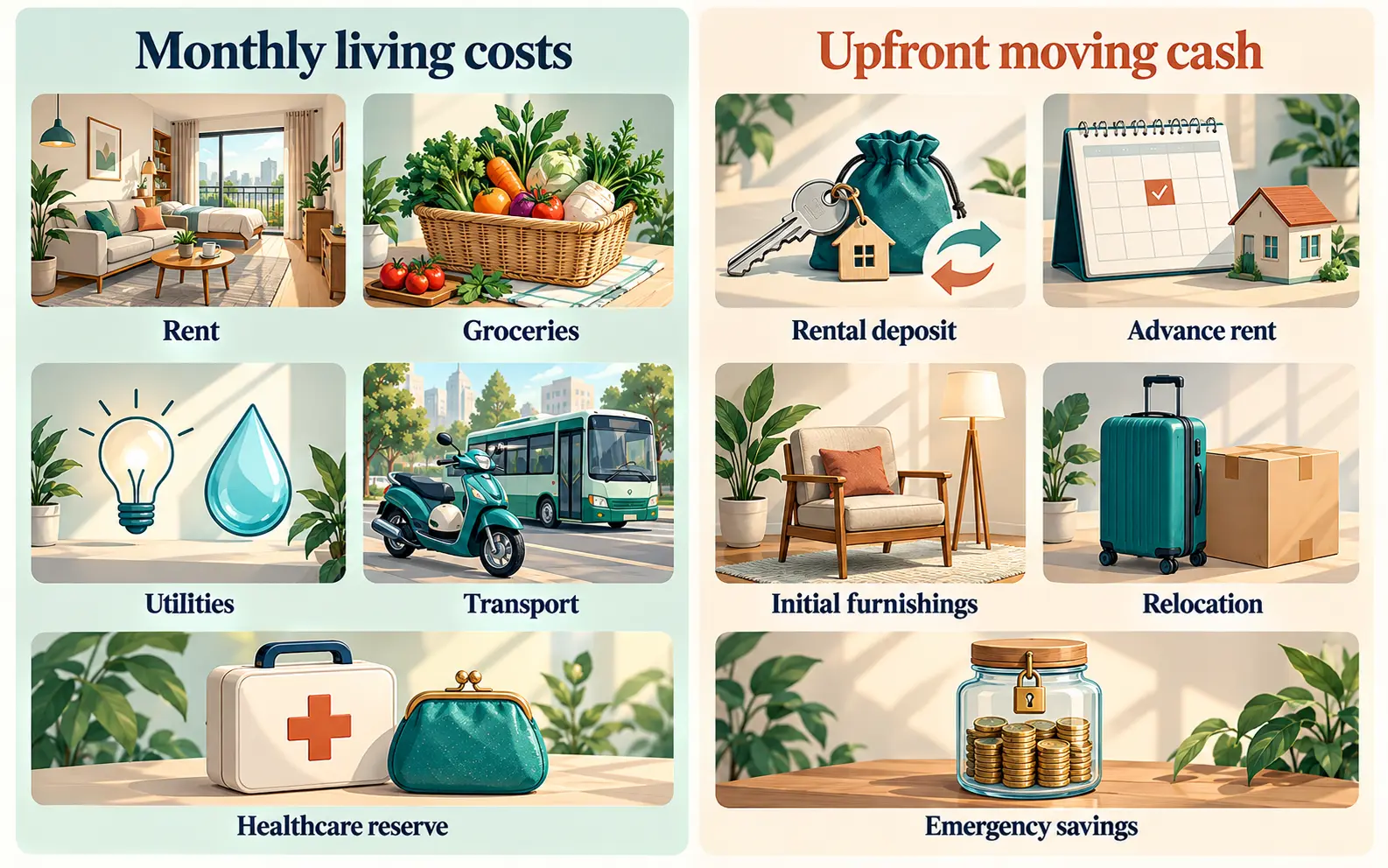
The amount you must pay up front is different from your recurring monthly cost. Rent paid in advance is not an additional month's consumption; a refundable deposit is tied-up cash, not necessarily an expense. Still, both affect what you need in your bank account when you arrive.
Illustrative rental cash requirement
Imagine a property asking VND 9 million per month. If its actual written agreement requires one month's deposit and one month's rent in advance, you would initially need VND 18 million for those two items alone, before furniture, transport, temporary accommodation or other charges. This is an example agreement, not a universal deposit rule or a legal requirement.
If a landlord requests a different deposit or prepayment period, recompute from the offered contract. Track deposits as money that may later be returned, subject to the agreed conditions.
One-time moving checklist
- Temporary accommodation until a suitable property is verified
- Written deposit and advance-rent requirements
- Transport of belongings and household setup purchases
- Internet installation or prepaid phone needs
- Emergency savings and an exchange-rate buffer
- Any case-specific immigration, work authorization or document costs verified from current official rules
Build Your Own Vietnam Cost-of-Living Budget
Use the blank worksheet below as a starting checklist. Put your negotiated rent or realistic quoted apartment price first, then add store-level spending, expected utility consumption and other household-specific expenses. Update the plan after your first full month of receipts rather than assuming your first estimate will be exact.
| Budget line | Your amount (VND) | Evidence to collect |
|---|---|---|
| Rent and building fees | __________ | Written offer and lease |
| Groceries and meals | __________ | Local store prices and dining frequency |
| Electricity and water | __________ | Meter, tariff and sample bill |
| Internet and mobile | __________ | Provider offer for your address |
| Transport | __________ | Commute and ride estimates |
| Healthcare and insurance | __________ | Personal policy quote and medical reserve |
| Schooling or childcare | __________ | School-specific written fee schedule |
| Lifestyle, subscriptions and contingency | __________ | Expected usage and savings target |
| Your monthly total | __________ | Review against take-home income |
When comparing your budget with income, distinguish gross salary from take-home pay, and verify any relevant taxes, benefit deductions and compensation terms for your own circumstances. This article does not provide individual tax, immigration or legal advice.
Frequently Asked Questions
Is Vietnam an inexpensive country to live in?
Some locally sourced goods and services may be relatively affordable for particular visitors, but rent, international education, private healthcare, imported food and travel can increase total spending. Compare the actual lifestyle you want rather than relying on a nationwide “cheap” label.
Is USD 1,000 per month enough to live in Vietnam?
It may be workable for some individuals sharing housing or keeping expenses low, but cannot be promised for a private apartment or a particular city. Convert at a current exchange rate, subtract rent and insurance needs, then test food, utilities, transport and emergencies with local quotes. The scenarios on this page are denominated in VND specifically to avoid an undated USD conversion.
Which is cheaper, Hanoi, Ho Chi Minh City or Da Nang?
There is no defensible universal ranking from the small, non-matched rental examples used here. Within each city, district, apartment quality, commute and household choices often matter more than a generic city label. The table compares example lifestyles, not a statistically measured index.
How much does a one-bedroom apartment cost?
The observed examples on this page include VND 8m in Long Bien, VND 9.5m in Thu Duc and VND 9m in Son Tra. Each is a specific asking-price example, subject to availability and property terms; none is the average for its city.
Should I include a rental deposit in my monthly budget?
Track the deposit separately as upfront cash, and account for potential deductions or refunds under the actual lease. Do not count a refundable deposit as a recurring expense every month, and do not confuse rent paid in advance with an extra month's consumption.
Are health insurance and international school fees included?
No. The models include a basic hypothetical medical-spending allowance, but not a comparable insurance-policy premium. Family models exclude school tuition and childcare. Obtain personalized quotes and school-specific fee schedules to complete your budget.
Sources, Methodology and Important Limitations
Evidence checked: 21 October 2026. Official statistical and tariff data use the publication and effective dates stated by each source; they should not be mistaken for new 2026 surveys when based on earlier periods. Rental advertisements are point-in-time asking prices and may expire, be reposted or differ from the eventual lease.
- National Statistics Office — 2024 Household Living Standards Survey press release (resident household expenditure; not expat average).
- EVN — residential electricity tariffs under Decision 1279/QD-BCT (pre-VAT usage rates).
- HAWACOM — Hanoi residential water tariff 2026 and DAWACO — Da Nang water tariff effective 2025 (different local rules).
- VNPT — Home 1 internet plan and VinaPhone — BIG90 data plan (eligibility and offers may change).
- Rental observations: Hanoi, Ho Chi Minh City, Da Nang (not a random or matched sample; asking prices only).
- UNIS Hanoi — 2026–2027 tuition and fees (individual school only).