Getting a work permit in Vietnam is not just a matter of collecting a passport, a degree and a police check. The required documents depend on your job classification, how you will work in Vietnam, where each supporting document was issued and when the employer submits the application.
This guide explains the Vietnam work permit documents normally considered for a new application, who prepares each item, how to check an overseas document for Apostille or consular legalization, and which legal changes are scheduled for December 2026.
Check your filing date first
Information checked against the legal framework in force on 28 October 2026. Decree 219/2025/ND-CP currently governs the standard work-permit application. Decree 393/2026/ND-CP is scheduled to take effect on 5 December 2026. The two sets of requirements must not be mixed. See the date comparison below.
Vietnam work permit documents: the quick checklist
For an ordinary new work-permit application under Article 18 of Decree 219/2025, the employer generally coordinates the request and the worker provides identity and supporting evidence. Think of the list below as a starting map, not a universal submission pack: some items have exceptions, and additional evidence depends on the particular work arrangement.
| Document or evidence | Usually coordinated by | What to verify |
|---|---|---|
| Employer's work-permit request and explanation | Vietnam-side employer / submitting organization | Applicable Form 03, correct role, employer details and intended start date |
| Medical / health certificate | Worker, with employer guidance | Qualified medical provider; permitted use of any overseas certificate; date and required format |
| Valid passport | Worker | Identity details and validity; confirm the receiving office's copy/original requirements |
| Criminal record or equivalent confirmation | Worker, sometimes via an authorized linked procedure | Issued by Vietnam or the relevant foreign authority; generally within 6 months before filing |
| Two color photographs | Worker | 4 × 6 cm, white background and the specified portrait presentation |
| Proof of the form of work | Employer and/or overseas organization | Only the evidence applicable to the specific arrangement under Article 2 |
| Evidence for the proposed position | Worker and employer | Manager, executive director, expert or technical-worker documentation under Article 19 |
Source: Decree 219/2025/ND-CP, signed official PDF, Articles 18–19. This checklist addresses new permits, not every reissuance, extension or exemption procedure.
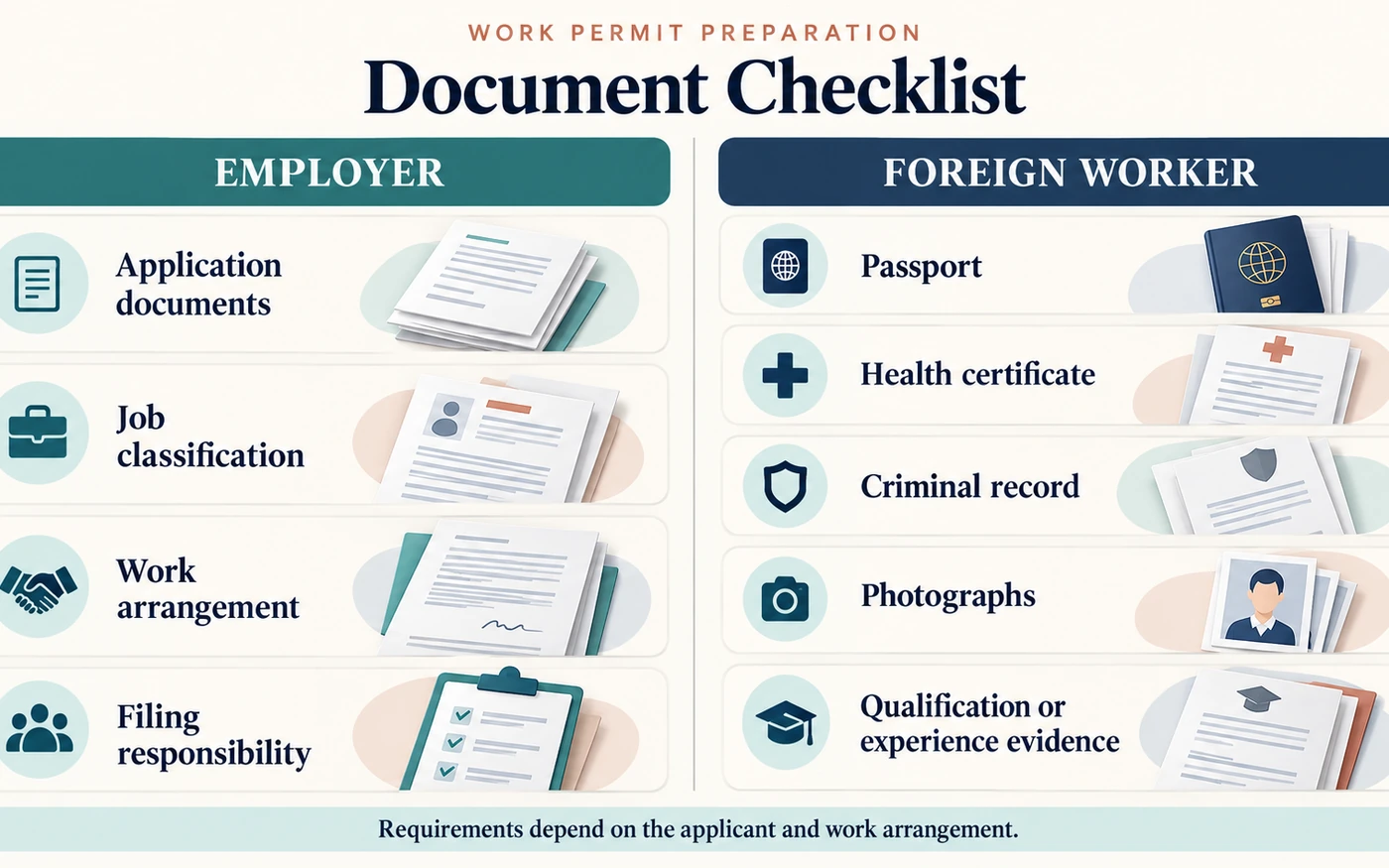
What the foreign worker normally prepares
- Passport and matching personal information.
- Health and criminal-record documents where required.
- Portrait photographs in the prescribed format.
- Degree, professional qualifications or experience records relevant to the exact role.
- Overseas authentication and Vietnamese translations where the document requires them.
What the employer normally coordinates
- Correct request form and demand explanation.
- Job title, workplace, proposed start date and legal entity details.
- Evidence of a transfer or service arrangement if applicable.
- Review of document consistency and accepted submission formats.
- Submission to the competent authority and follow-up on requests for correction.
Which law applies: Decree 219 now or Decree 393 from December?
The date of application matters. Decree 393/2026 was issued on 20 October 2026 but is not effective on 28 October. Its stated effective date is 5 December 2026. Do not download a future form or follow a new filing window without first confirming that it applies to your actual dossier.
| Issue | As of 28 Oct 2026 | From 5 Dec 2026, subject to transitions |
|---|---|---|
| Governing decree | 219/2025/ND-CP | 393/2026/ND-CP |
| New application dossier | Article 18 | Article 19 |
| Evidence for job classification | Article 19 | Article 20 |
| Employer request | Form 03 in Decree 219's appendix | Form 03 in Appendix I to Decree 393; verify the new template |
| When to file before intended work starts | Within 60 days, but not less than 10 days | Within 60 days, but at least 10 working days, according to Article 23 |
| Authority's standard review period | 10 working days after a complete dossier | 10 working days after a complete dossier under Article 23 |
Sources: Government register: Decree 219; Government register: Decree 393 and effective date. Detailed future provisions should be confirmed against the signed 393 text and the receiving authority before reliance.
Which qualifications or experience documents prove your position?
A frequent mistake is treating a university degree or a certain number of years of experience as the one rule for every foreign worker. Vietnam's work-permit framework distinguishes positions. The employer must identify the legal category and assemble evidence that matches its definition; a general job advertisement title is not enough.
Manager
Corporate establishment documents, company charter, appointment or transfer decisions, and evidence of the person's management authority may be relevant. The organization type and legal status affect the applicable proof.
Executive director
Appointment and organizational records should show the actual executive function. The legal definition and employer structure matter more than simply including “director” in a job title.
Expert
Qualifications, field of study, records of relevant experience and special-sector credentials may be needed in combinations prescribed for the role. Not every expert follows exactly the same education route.
Technical worker
Technical training and relevant experience records should match the statutory category. The employer should map duties to the applicable technical-worker definition rather than copying an expert checklist.
For each qualification or experience record, check the issuing institution, position, field, employment dates, signatory and legal authentication path. If an employer-issued letter is a private document, it may need a jurisdiction-specific notarial or other permitted public-document route before Apostille can apply.
Do you need transfer letters, service contracts or other employment papers?
Not every applicant has the same relationship with a Vietnamese employer. Article 18(6) of Decree 219 calls for evidence corresponding to the relevant forms of working under Article 2. Examples include:
- Intra-company transfers: an overseas employer's assignment letter and qualifying evidence of prior overseas employment, where that statutory route is used.
- Contract-based assignments: the relevant assignment letter together with the contract or agreement for the specific legal arrangement.
- Service-provider arrangements: evidence of the cross-border service contract and, when the category calls for it, the worker's qualifying relationship with the foreign provider.
- Other statutory work forms: letters of assignment or documents proving the stated role and form of work, as specifically required.
These are examples of possible evidence, not an instruction to submit all of them. An ordinary local-employment application should not automatically be treated as an intra-company transfer, nor does a transfer letter automatically establish exemption from a work permit.
Before paying for overseas certification, have the employer name the exact work form and legal position used in the application. This single step can prevent multiple unnecessary or incorrect documents.
Apostille vs consular legalization for Vietnam work permits
One of the biggest recent changes is that the 1961 Apostille Convention began applying to Vietnam on 11 September 2026. For an eligible foreign public document from a country or territory where the Convention is effective in relation to Vietnam, a valid Apostille can replace the traditional consular legalization chain.
An Apostille verifies the origin of a public document, including the relevant signature, official capacity and seal. It does not certify that the underlying degree, employment history or statement is factually correct, and it does not guarantee that a Vietnamese work-permit authority will accept the document for a particular application.
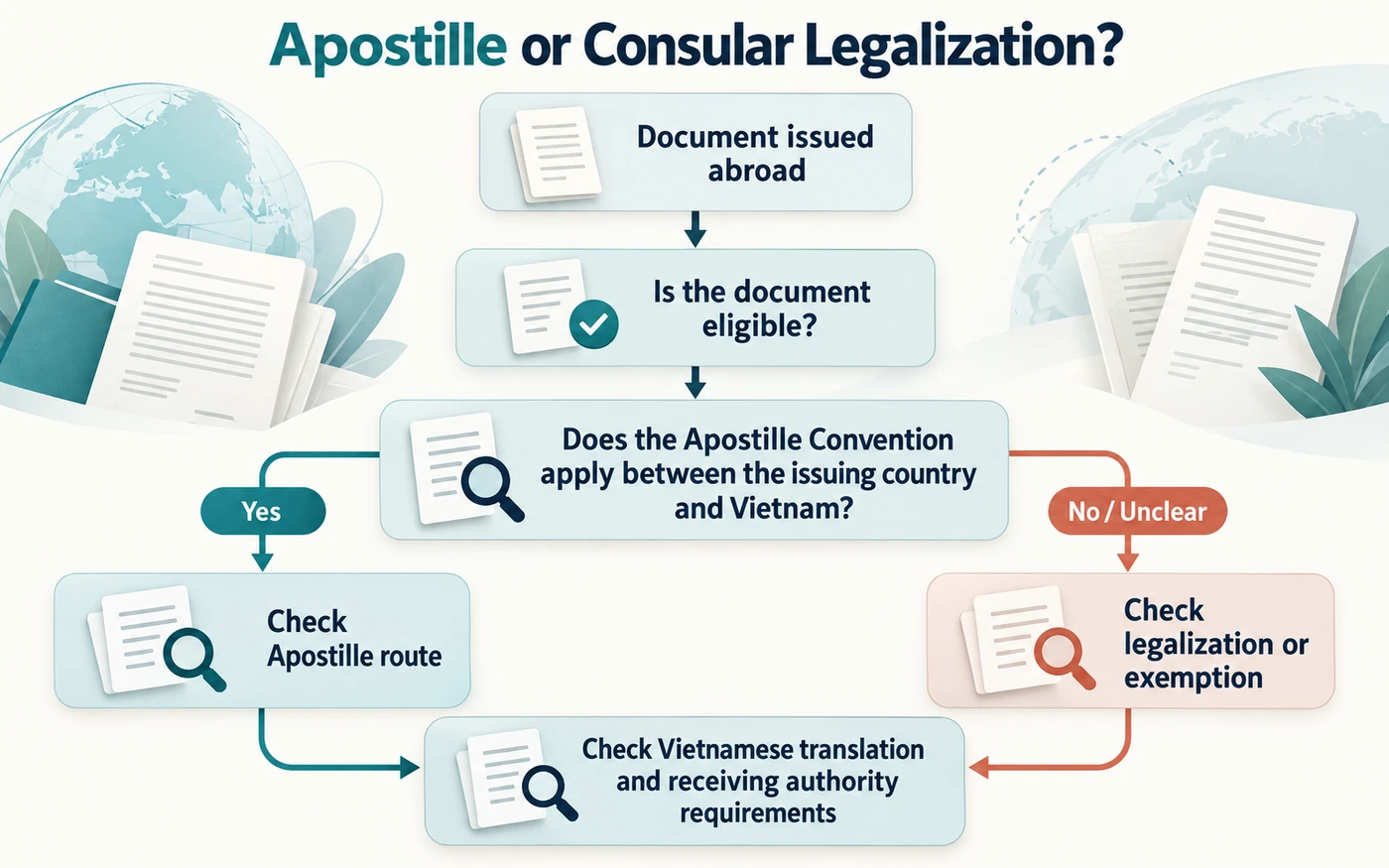
A five-step document authentication decision
- Identify the issuing jurisdiction. Check where the document was legally created and which authority is responsible for its signature or seal, not merely the applicant's nationality.
- Classify the document. Is it a qualifying public document, notarial act or official certification on a private document under the issuing jurisdiction's rules? A private company letter is not automatically eligible for direct Apostille.
- Check the Convention relationship. Membership alone is not enough: confirm that the Convention actually applies between the issuing country or territory and Vietnam on the relevant date, including any objections or territorial exceptions.
- Use the correct verification route. If eligible, obtain an Apostille from the competent authority in the issuing jurisdiction. If not, check traditional consular legalization and any treaty, reciprocity or statutory exemption.
- Prepare the Vietnamese-use version. Check translation, notarization/certification, document condition and whether the receiving authority accepts the specific original, certified copy or electronic format.
Potential Apostille route
A covered public document, a valid Convention relationship with Vietnam and a certificate issued by the competent authority in the country of origin. A Vietnamese translation may still be required.
Check the other route
A non-covered document, an issuing jurisdiction without an operative Convention relationship, or a document requiring a different official authentication process. Check exemptions before paying for consular legalization.
Do not rely on an old country list. At the start of implementation in September 2026, Vietnam's diplomatic missions identified country-level objections and future effective dates, so the answer is not simply “all Apostille countries are accepted.” Consult the HCCH Apostille Convention status information and the Vietnam Ministry of Foreign Affairs guidance before acting.
If a document was properly consular-legalized before 11 September 2026, Vietnam's foreign-affairs guidance says it does not need a replacement Apostille merely because the new system began. It must still satisfy any document-age, accuracy and application-specific rules.
Legal basis: Decree 293/2026/ND-CP, official signed text, particularly Articles 3–5 and 25–27.
Translation, notarization and certified copies are different tasks
These terms are often used interchangeably in informal advice, but they perform different functions:
| Step | What it addresses | What it does not establish |
|---|---|---|
| Apostille | Authenticity of the origin, signature, official capacity and seal on a qualifying public document | The truth of every statement in that document or job eligibility |
| Consular legalization | A recognized official-signature/seal authentication route where applicable | Automatic acceptance of the document's substantive content |
| Vietnamese translation | Makes the document's content usable in Vietnamese | Authenticity of the original document by itself |
| Notarization / certification | Authenticates a copy, signature or translation as prescribed by the relevant rules | An Apostille or consular legalization where one is required |
Decree 293/2026, Article 27, generally requires qualifying foreign public documents with Apostilles that are not in Vietnamese to be translated into Vietnamese and the translation to be notarized or certified, unless a specialized law provides otherwise. Decree 219/2025, Article 5, also addresses translation and certification in the work-permit context.
Before translating, check whether the authority needs the original, a certified copy or a permitted electronic version, and whether the Apostille/legalization step should happen first. Check that names, dates, qualifications and employer names are consistent across all translations.
How recent must work permit documents be?
Different papers have different rules. The common advice that “everything must be issued within six months” is misleading.
Criminal-record evidence
6 months
Generally issued no more than six months before the filing date under Article 18(4) of Decree 219, subject to the linked-procedure exception.
Eligible overseas health certificate
Up to 12 months
Under Article 18(2), an overseas certificate is subject to an applicable mutual-recognition arrangement and the stated period; do not assume every foreign clinic qualifies.
Passport and role evidence
Check each item
The passport must remain valid. Degrees, appointment records and experience letters require separate checks for authenticity, relevance and accepted form.
A certificate's date is only one test. An unexpired document can still be unusable because it does not match the required job classification, lacks accepted authentication or contains inconsistent names.
Who files the application, and how long does it take?
Under the current Decree 219 framework, the employer generally submits the request through the prescribed channels to the competent authority, with the worker providing supporting documents. Article 22 sets a filing window of no earlier than 60 days and no later than 10 days before the intended start, and a standard assessment period of 10 working days after a complete, valid dossier is received.
Those 10 working days are not a promise that someone can gather and authenticate every overseas document in 10 days. Police checks, medical examinations, degree or employment verification, Apostille or consular legalization, translation and requests for corrections can add preparation time.
Classify the case
Identify new permit versus extension/exemption, employer, role and work form.
Prepare evidence
Gather the correct identity, qualification and assignment documents.
Authenticate and file
Complete required cross-border authentication and Vietnamese-use formalities.
Track the decision
Employer follows the official process and responds to any correction request.
When this standard checklist is not the right one
Pause before using this article as a filing list if any of the following applies: you are seeking reissuance or extension, believe you qualify for a work-permit exemption, have already been issued a permit, are changing employers or roles, are moving under a special intra-company arrangement, or have a dossier pending when the new decree becomes effective.
Each scenario may have different forms and evidence. A change in employer or work location should not be handled by simply editing a previous permit document yourself. Ask the employer to identify the applicable statutory procedure and competent authority.
For cases around 5 December 2026, confirm whether Decree 393's transitional provisions cover your existing application or permit. The incoming rules contain multiple specific transition situations; there is no blanket requirement for every foreign worker to restart the process.
Seven common document mistakes to avoid
- Using an old checklist. A page based on Decree 152/2020 or a 2016 photograph specification may not reflect the governing 2026 rules.
- Using the wrong decree's form. Check the filing date and any transitional rule before selecting Form 03.
- Misclassifying the position. “Expert,” “manager” and “technical worker” require their own supporting evidence.
- Assuming Apostille always works. The country relationship, eligible document and authorized issuer must all fit.
- Confusing translation with authentication. A translated photocopy does not automatically prove the original signature or seal.
- Missing a document date or name mismatch. Check issuance dates, passport name order, spelling and any former names.
- Counting administrative decision days as total preparation time. Overseas records and cross-border document handling can take significantly longer.
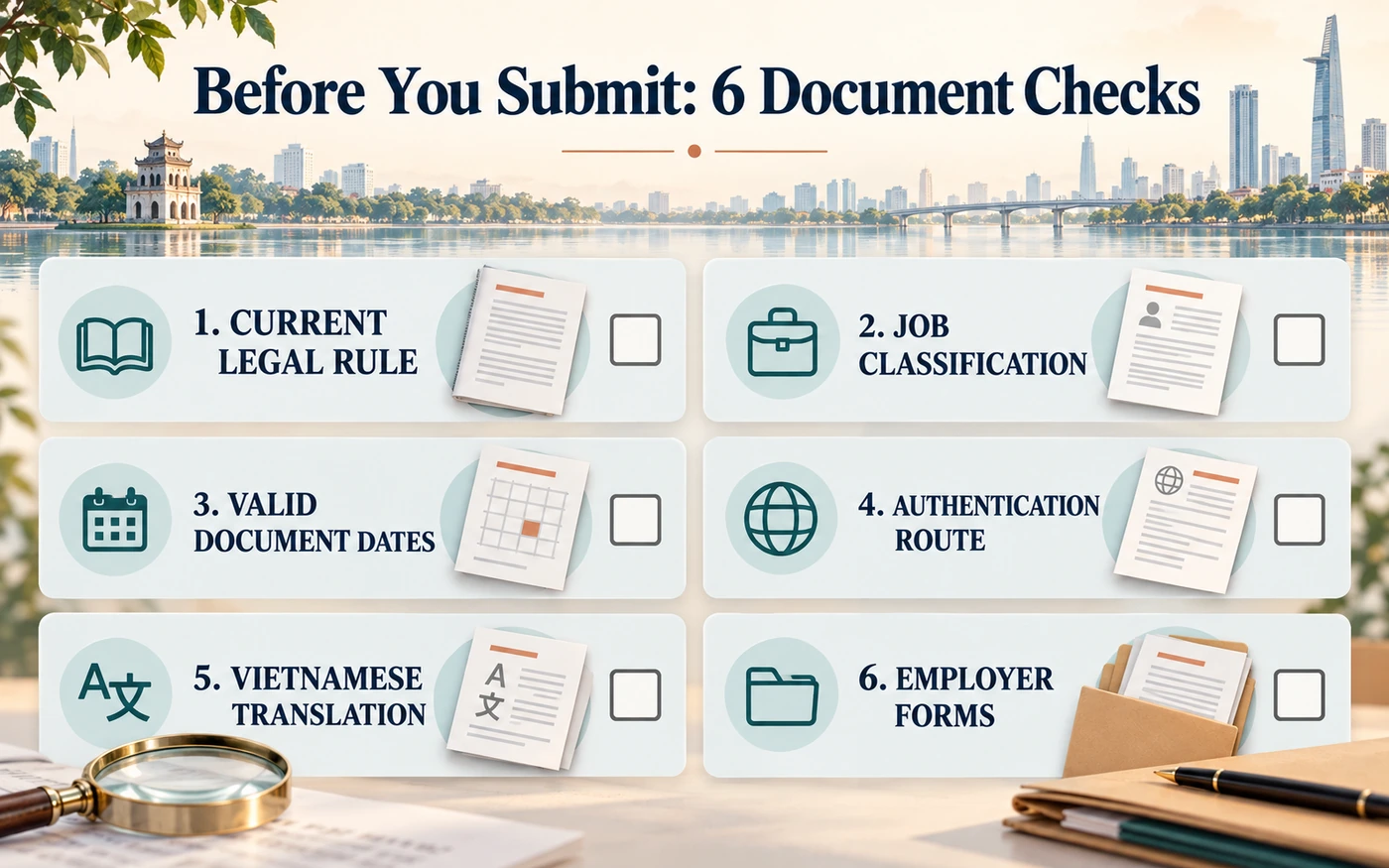
Final pre-filing review
Frequently asked questions
What documents do I need for a Vietnam work permit?
For a typical new application, the categories include the employer's request, passport, suitable health document, criminal-record evidence, photographs, proof of the form of work where applicable and evidence for the legally defined job position. The precise pack depends on your case and filing date.
Can I Apostille my university degree instead of consular-legalizing it?
Potentially, if the relevant document is covered, the issuing jurisdiction has an operative Apostille relationship with Vietnam, the certificate is issued by the proper authority and there is no applicable exception. Check the degree's legal form and the receiving authority's requirements before paying.
Do all foreign experience letters qualify for Apostille?
No. A privately signed employer letter is not automatically a qualifying public document. Depending on where it was issued, a valid notarial or other official certification route may be needed first. Confirm the route in the issuing country and its acceptance for the Vietnamese filing.
Can I submit a police check older than six months?
Under the ordinary new-application rule in Decree 219, the criminal-record document is generally issued no more than six months before filing, subject to specified linked-administration exceptions. Do not assume another document type shares this six-month rule.
Will any medical certificate from overseas be accepted?
No. Under the current Article 18(2), the use of an overseas health certificate depends on an applicable mutual-recognition arrangement and prescribed validity conditions. Check provider eligibility and the exact filing rules; different requirements are described in the incoming December decree.
Do I need a bachelor's degree for every work permit?
No single educational rule covers every foreign-work classification. The required evidence depends on the legal position, role, relevant training and experience and, where applicable, a separate sector-specific professional requirement.
Do I need to redo a document legalized before September 2026?
Not just because the Apostille Convention became effective for Vietnam on 11 September 2026. Vietnamese diplomatic guidance allows previously properly legalized documents to continue to be used, subject to their independent validity and acceptance requirements.
What happens if my application is pending on 5 December 2026?
The incoming Decree 393 includes transitional rules, including for dossiers submitted before its effective date. The employer should check the precise provision and current receiving-office practice; a pending dossier does not automatically mean filing from scratch.
Official sources and important limits
The following sources are a better starting point than undated online checklists. Open the relevant law and verify the version in force when the application is actually filed:
- Vietnam Government: Decree 219/2025/ND-CP, signed PDF — Articles 5 and 18–22; Form 03 in the appendix.
- Vietnam Government: Decree 393/2026/ND-CP register and signed-document attachment — issued 20 October 2026; effective 5 December 2026.
- Vietnam Government: Decree 293/2026/ND-CP, signed PDF — Apostille framework and use of foreign public documents.
- Vietnam Ministry of Foreign Affairs: Apostille notice, September 2026 — applicability and documents legalized before the new system.
- HCCH: Apostille Convention status table — country relationships, dates and objections; recheck before use.
Important
This is general information, not an individualized eligibility decision, legal opinion or an offer to file work-permit applications. Rules and competent-authority procedures can change, and a specific dossier may require additional documents. Ask the actual employer and competent authority to confirm the current requirement; obtain qualified professional advice for consequential or unusual cases. Legal reference date: 28 October 2026.