Living in Vietnam · Healthcare & Insurance
Choosing health insurance in Vietnam is less about finding a famous insurer and more about understanding your legal status, the care you expect to use, and what a specific policy will actually pay for.
For foreign residents, the choices may include Vietnam's statutory health insurance system (BHYT), an employer's medical benefits, local private coverage, international health insurance, or a travel medical policy. These options are not interchangeable. Eligibility, hospital access, exclusions, renewals and claims procedures can matter more than an attractive headline premium.
The short answer
Some foreign employees must participate in Vietnam's statutory health insurance under specific employment conditions. Other foreigners should not assume they can simply buy household BHYT. Private and international plans may be worth comparing, but coverage and acceptance are contract-specific. Before paying, request a written quote, full policy wording, benefits schedule and provider-network information.
Research checked 3 November 2026. This is independent educational information, not an insurance quote, personalised recommendation, legal opinion or referral service.
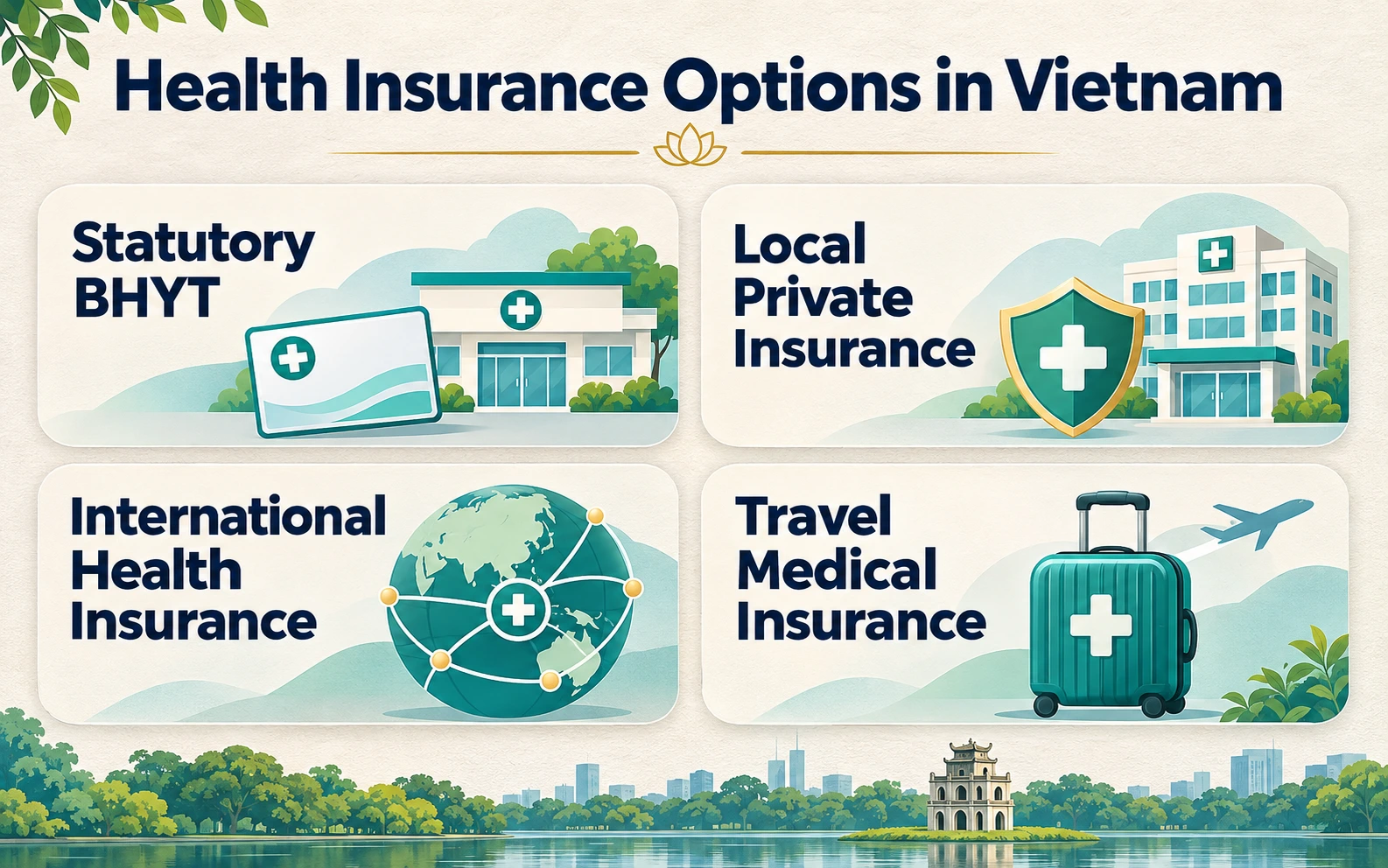
1. The four main ways to cover healthcare in Vietnam
The first step is to identify which type of cover you already have. A Vietnamese employer may enroll an eligible employee in BHYT and separately provide a group private medical benefit. An independent resident may need to investigate an individual policy. A visitor may have travel medical insurance from another country. These arrangements serve different purposes.
| Type of cover | Typical purpose | What to verify | Main limitation |
|---|---|---|---|
| Statutory BHYT | Eligible participants receive defined healthcare benefits through Vietnam's public insurance system. | Your legal enrollment category, registered facility, treatment route and reimbursement conditions. | Not automatically open to every foreign resident; not identical to private international cover. |
| Local private medical insurance | Policy-defined medical or hospital benefits, often focused on care in Vietnam. | Residency/age acceptance, hospital network, inpatient and outpatient coverage, exclusions. | Benefits and cashless access differ substantially between products. |
| International resident health insurance | Longer-term medical coverage with a selected geographic area and optional modules. | Countries covered, annual limits, overseas treatment, evacuation, deductibles, renewal. | Global branding does not mean every country, treatment or add-on is included. |
| Travel medical insurance | Medical protection for eligible short trips and unexpected travel incidents. | Maximum trip duration, residency restrictions, emergency-only terms and return-home requirements. | May not substitute for ongoing resident, chronic-condition or routine outpatient coverage. |
For example, someone staying in Vietnam for a year should check whether a 30- or 90-day travel policy would cease to apply during a long continuous stay. Conversely, a person visiting for two weeks may not need to purchase an annual resident product. The correct comparison starts with length of stay, insurance territory and the treatment you might require.
2. Is health insurance mandatory for foreigners working in Vietnam?
For certain foreign employees, yes. Article 12(1)(c) of Vietnam's amended Health Insurance Law, Law 51/2024/QH15, covers foreign citizens working in Vietnam under a fixed-term labour contract of at least 12 months with a Vietnam-based employer. It also specifies exceptions, including legally defined intra-company transferees, individuals already at the relevant statutory retirement age when signing the contract and circumstances governed differently by applicable treaties.
A work permit, resident card or visa alone does not answer the BHYT question. The employment contract and applicable legal category matter. If you teach English, work in a company or have recently changed employers, ask HR to confirm the exact statutory enrollment basis and when it starts or ends. See the official text of Law 51/2024/QH15.
How much does employed-worker BHYT cost?
Under Vietnam Social Security's 2026 explanation, the standard employed-worker BHYT contribution is 4.5% of the applicable monthly salary used as the compulsory social-insurance contribution base: 3% paid by the employer and 1.5% paid by the employee. Applicable salary bases and ceilings need to be checked; this figure is not the employee's entire social-insurance payroll deduction and is not the price of private medical insurance. See the 2026 Vietnam Social Security explanation.
Total statutory BHYT rate
4.5%
Of the relevant contribution salary base
Employer share
3%
Eligible employed-worker category
Employee share
1.5%
Eligible employed-worker category
The reference/base salary was adjusted to VND 2,530,000 per month from 1 July 2026. That figure influences some statutory contribution and benefit calculations, but it is not a universal salary base for employed foreigners or a quotation for private cover. Verify your own payroll treatment with HR and the relevant social security authority.
Can foreigners buy BHYT through the household scheme?
Do not assume that household BHYT is available to every foreign resident.
A Vietnam Social Security answer dated 3 June 2026 and a Ho Chi Minh City Social Security answer published on the Government Newspaper on 8 July 2026 state that the law does not currently provide a basis for foreign nationals to join household BHYT in the situations discussed. An older official answer from January 2024 suggested a different outcome for a foreign spouse registered in a household. Because these explanations differ across dates and factual contexts, seek case-specific written guidance from Vietnam Social Security or the Ministry of Health rather than relying on an online enrollment price or a private seller's statement.
Read the 3 June 2026 Social Security response and the 8 July 2026 official follow-up. In particular, the published household contribution figure for an eligible household member is not proof that any expat can purchase that form of coverage.
What BHYT does and does not tell you
Statutory health insurance has its own treatment routes, covered services, co-payments and reimbursement conditions. A claim such as “BHYT covers 80% at every hospital” leaves out participant categories and treatment circumstances. Verify your card status, initial registration facility, applicable referral arrangements and current rules before assuming that a particular private clinic or specialist will be reimbursed.
Being enrolled in BHYT also does not answer whether an employer's optional group policy pays for private rooms, outpatient consultations, overseas treatment or other services. Ask for both sets of documents if you have two forms of cover.
3. How much does health insurance cost for expats in Vietnam?
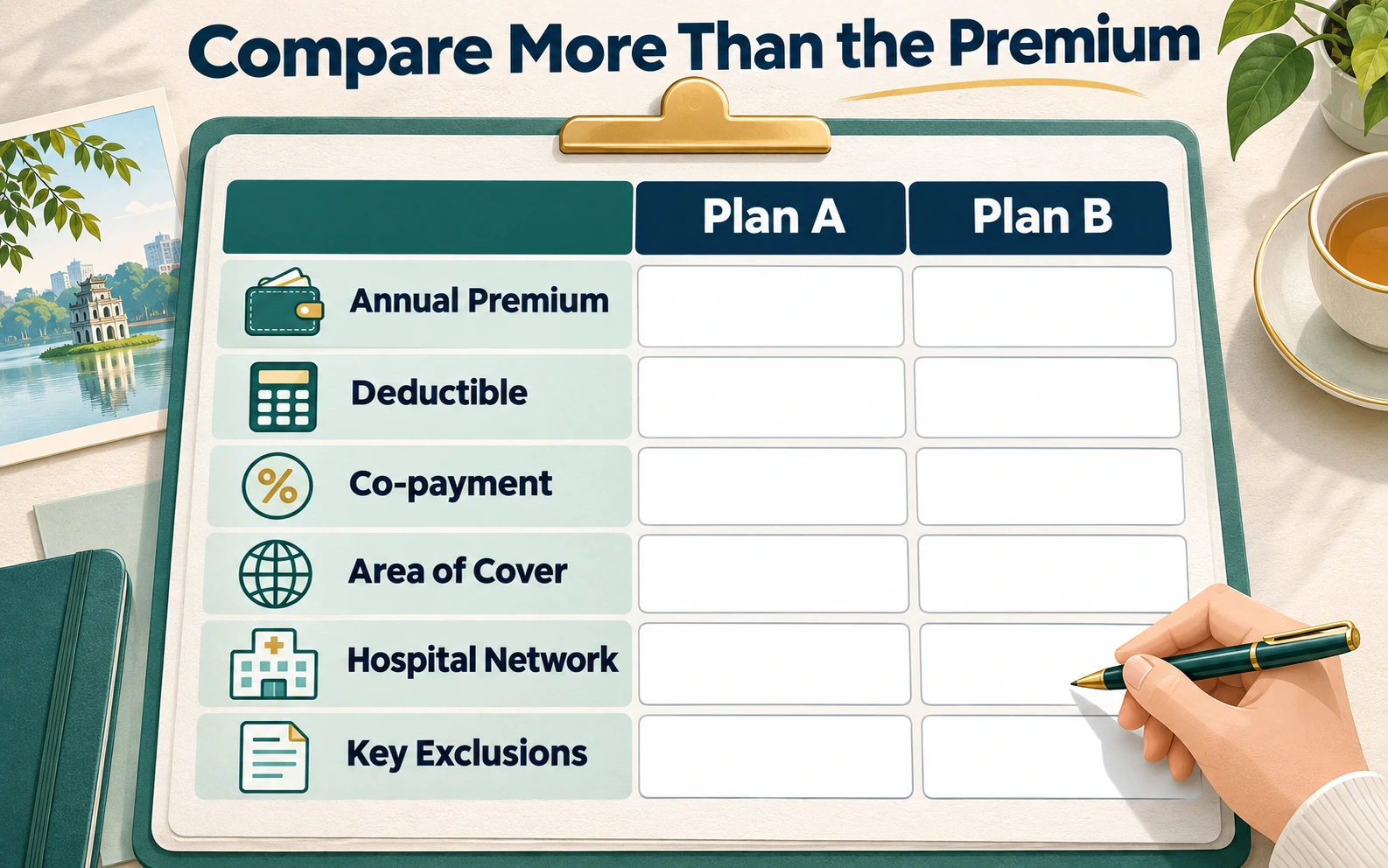
There is no reliable single premium that applies to everyone moving to Vietnam. A quoted price can vary with age, medical disclosures, country of residence, area of cover, benefit ceiling, excess or deductible, co-payment, outpatient and maternity options, contract duration and payment frequency. Group insurance through an employer is also not directly comparable with an individual policy.
What to put side by side on a real quote
| Comparison field | Quote A | Quote B | Why it matters |
|---|---|---|---|
| Insured age and residence | Confirm | Confirm | Affects availability and price |
| Annual premium and currency | Written amount | Written amount | Compare the actual payable amount |
| Period and payment schedule | Dates and instalments | Dates and instalments | Monthly instalments may still fund an annual contract |
| Inpatient limit | Benefit schedule | Benefit schedule | Watch annual, condition and procedure sub-limits |
| Outpatient, dental, maternity | Included or extra? | Included or extra? | Options change the comparison |
| Deductible and co-pay | Policy wording | Policy wording | Premium alone misses out-of-pocket cost |
| Territory and hospital network | Confirmed list | Confirmed list | Impacts access where you live and travel |
| Exclusions, waiting and renewal | Full wording | Full wording | May change the value of cover over time |
Why public price lists are not personal premiums
A useful real-world warning comes from Pacific Cross Vietnam. On 3 November 2026, its own health premiums page and Foundation Series page displayed different component tables under similar product labels. Without a confirmed effective tariff, product version and underwriting conditions, selecting one number as the current guaranteed price would be misleading.
This does not mean a provider is necessarily more or less expensive. It means an online table is a starting point, not an accepted policy. Ask the insurer to identify the tariff date, currency, included benefits, exclusions, tax or fees where applicable, and final payable premium in writing. Do not combine two advertised components into a supposed all-in price unless the issuer confirms that combination.
Think about total cost, not only the annual fee
A lower premium may come with an excess that you pay first, a percentage co-payment, restricted outpatient coverage, a smaller hospital network or limits on treatment abroad. Conversely, a broader product may include benefits you are unlikely to use. A sensible comparison considers the annual premium and the money you could have to pay during a covered or excluded medical event.
Ask the insurer to explain the result in two simple situations: an outpatient consultation and an unplanned hospital admission. The answers should identify who pays the bill first, when pre-authorisation is required, which costs are excluded and what documentation is needed for reimbursement.
4. Where to research actual insurance products
Rather than ranking providers without matched quotes, start with original product pages and request the contract documents that apply to you. The examples below are independent research links, not StartInVietnam partners, approved recommendations or confirmation of individual acceptance.
PVI Insurance
Its specific Combined Health page describes eligible Vietnamese nationals and foreigners lawfully residing in Vietnam, with product-specific age conditions. Confirm the actual combination of hospital, illness and accident benefits and the current policy wording.
Read the original PVI product pageAllianz Care
Its Vietnam-focused international plans publish different maximum plan-benefit limits and optional modules. Those large USD figures are benefit ceilings, not premiums. Check the named insurer, geographic area and relevant benefit guide.
Read the Vietnam plan overviewCigna Global
The Vietnam landing page introduces tiers and optional coverage for international customers. Ask which product is available to a person with your residence and travel pattern and obtain the complete written schedule.
Read Cigna's Vietnam informationPacific Cross Vietnam
The Foundation Series pages publish age-based tables, but their displayed figures were not consistent across two official pages when checked. Seek a dated written tariff and terms from the issuer instead of assuming a table is a final quote.
Read the product informationOther international providers, including AXA Global Healthcare, publish Vietnam-oriented information. A promotional discount or a marketing statement visible on one day should never be treated as a permanent, universal contract feature. The correct next step is to compare current documents on identical assumptions, not to select a provider solely because it appears first on Google.
5. Ten insurance terms that determine what you actually receive
Insurance vocabulary can make two policies look similar when their practical protections are very different. These are the clauses worth locating in the policy wording and schedule of benefits, not only in a brochure.
1. Inpatient and day-patient care
Check admission definitions, surgery, intensive care, room limits and whether a procedure without an overnight stay counts as covered care.
2. Outpatient care
Consultations, tests, prescriptions and follow-up visits may be optional or subject to separate limits, provider rules or a co-payment.
3. Annual and sub-limits
A high headline annual limit does not remove smaller caps for particular treatments, room rates or specialist services.
4. Deductible or excess
The amount the policyholder must pay before eligible benefits begin, subject to the exact definition and period in the contract.
5. Co-payment
Your percentage or fixed share of eligible treatment costs after any deductible, sometimes varying by network or type of treatment.
6. Hospital network and direct billing
Whether a named hospital participates for your product and treatment, and whether you must pay first or obtain advance approval.
7. Pre-existing conditions
The disclosure rules, accepted conditions, exclusions, loading, moratorium or individual underwriting decisions relevant to your application.
8. Waiting periods
Time between policy commencement and eligibility for named benefits such as maternity, certain conditions or selected procedures.
9. Medical evacuation and repatriation
Whether medically necessary transport is covered, who authorises it, destination rules, geographic restrictions and benefit ceilings.
10. Renewal and cancellation
Price review, maximum entry age, renewability, portability after leaving a job and whether monthly payments can be cancelled mid-term.
A policy may cover an illness in principle while limiting the doctor, provider, territory or reimbursement route. The current written contract controls. Sales summaries, “unlimited” advertising and illustrations cannot replace it.
6. Choosing insurance for your situation in Vietnam
There is no universal “best health insurance for expats” because a newly hired teacher, a family with children and a retired resident have different exposure and eligibility questions. Use the following starting points to decide what to check, not as personalised product recommendations.
| Situation | Start by checking | Then compare |
|---|---|---|
| English teacher or locally employed professional | Employment contract, BHYT category, employer group benefits and expiry dates. | Gaps in private hospital, outpatient, dental and overseas cover; what happens when the job ends. |
| Freelancer or remote worker | Residence and employment status; whether any existing overseas policy genuinely covers living and working from Vietnam. | Resident eligibility, long-stay conditions, inpatient protection and country-of-cover restrictions. |
| Retired long-term resident | Age at entry and renewal, medical disclosures, chronic conditions and home-country arrangements. | Renewability, inpatient limits, continuity of care and access to a preferred hospital. |
| Family with children | Separate eligibility and documents for each family member, not only the employed parent. | Paediatrics, vaccinations, emergency cover, maternity, waiting periods and family out-of-pocket costs. |
| Short-term visitor | Trip dates, actual residency, travel-policy duration and purpose of travel. | Emergency treatment, transport, exclusions and whether coverage ends during a longer-than-planned stay. |
| Resident outside Hanoi or Ho Chi Minh City | Hospitals and clinics actually reachable near home. | Network availability, transfer procedures, out-of-network reimbursement and evacuation wording. |
Three short decision examples
Example A — An employee with BHYT: An employer confirms statutory enrollment and offers a separate medical policy. Instead of buying a third product immediately, the worker requests the BHYT information and the employer plan's benefit guide, then checks whether inpatient, private-room and outpatient needs are already addressed.
Example B — A remote worker staying for a year: A low-priced travel policy looks attractive, but its trip-duration and country-of-residence terms may not fit. The worker asks for resident-policy eligibility and checks treatment in Vietnam and abroad before comparing price.
Example C — A parent with a young child: A family plan may still have separate terms for outpatient paediatrics, vaccines or maternity. The family asks for the policy's exact wording and the hospitals that will accept the relevant product, rather than assuming every family-related expense is covered.
7. Motorbike accidents, existing conditions, maternity and other special questions
These are frequent sources of expensive misunderstandings. Avoid blanket statements such as “all motorcycle accidents are excluded” or “all international policies cover evacuation”. The details depend on the contract, circumstances and applicable law.
Motorbike and road accidents
If you ride a motorbike or travel as a passenger, ask the insurer how the policy treats motorcycle use, licence and helmet requirements, alcohol-related exclusions, personal injury and emergency transport. Do not assume accident cover means every riding scenario is eligible. Insurers may define these risks differently; obtain a written answer for your actual circumstances.
Pre-existing and chronic conditions
Ask what counts as a pre-existing condition, what medical information you must disclose, whether the insurer requires underwriting, and whether an accepted condition is covered, excluded or covered with special terms. Do not omit information because it seems minor or because an online application looks simple. Read the policy's disclosure and claims provisions carefully.
Pregnancy, childbirth and newborns
Maternity benefits may be separate optional modules, with waiting periods, benefit limits, provider restrictions and special newborn rules. A policy stating that it has “family coverage” does not establish that pregnancy or planned delivery is covered. Ask about prenatal visits, normal delivery, complications, neonatal treatment and adding a newborn to the policy.
Emergency medical evacuation
Medical evacuation is not the same as choosing to fly home for treatment. Policies may require a medical necessity determination, insurer authorisation, specific transport arrangements and a covered destination. Check limits, exclusions, how an emergency is assessed and who makes the arrangements. Do not rely on an unsupported online average cost for evacuation.
8. Hospitals, direct billing and claiming medical costs
A hospital logo on an insurer's website is not a guarantee that every appointment at that hospital will be cashless. Network status can depend on the actual policy, department, treatment, provider contract and authorisation. Before an important appointment, check directly with both the insurer and the healthcare facility.
Before planned treatment
- Confirm the treatment is a listed benefit.
- Check the exact hospital, clinic and specialist.
- Ask whether pre-authorisation is necessary.
- Get written confirmation of direct payment or reimbursement procedure.
- Understand your deductible, co-pay and potential exclusions.
After receiving care
- Keep itemised invoices and receipts.
- Request discharge summaries, prescriptions and test results where relevant.
- Record claim numbers and communication with the insurer.
- Submit within the specific policy deadline.
- Ask for an explanation if a claim is reduced or declined.
For example, Allianz Care's published pre-authorisation guidance explains that certain high-cost or inpatient treatments require approval and that direct hospital payment is arranged where possible. That is one insurer's documented workflow, not a rule for all providers or a promise that a claim will be paid.
For emergencies, seek necessary medical attention promptly and use the emergency instructions provided by your insurer. Ask a companion or hospital administrator to help contact the insurer when appropriate. Do not delay urgent medical care simply to follow an editorial checklist.
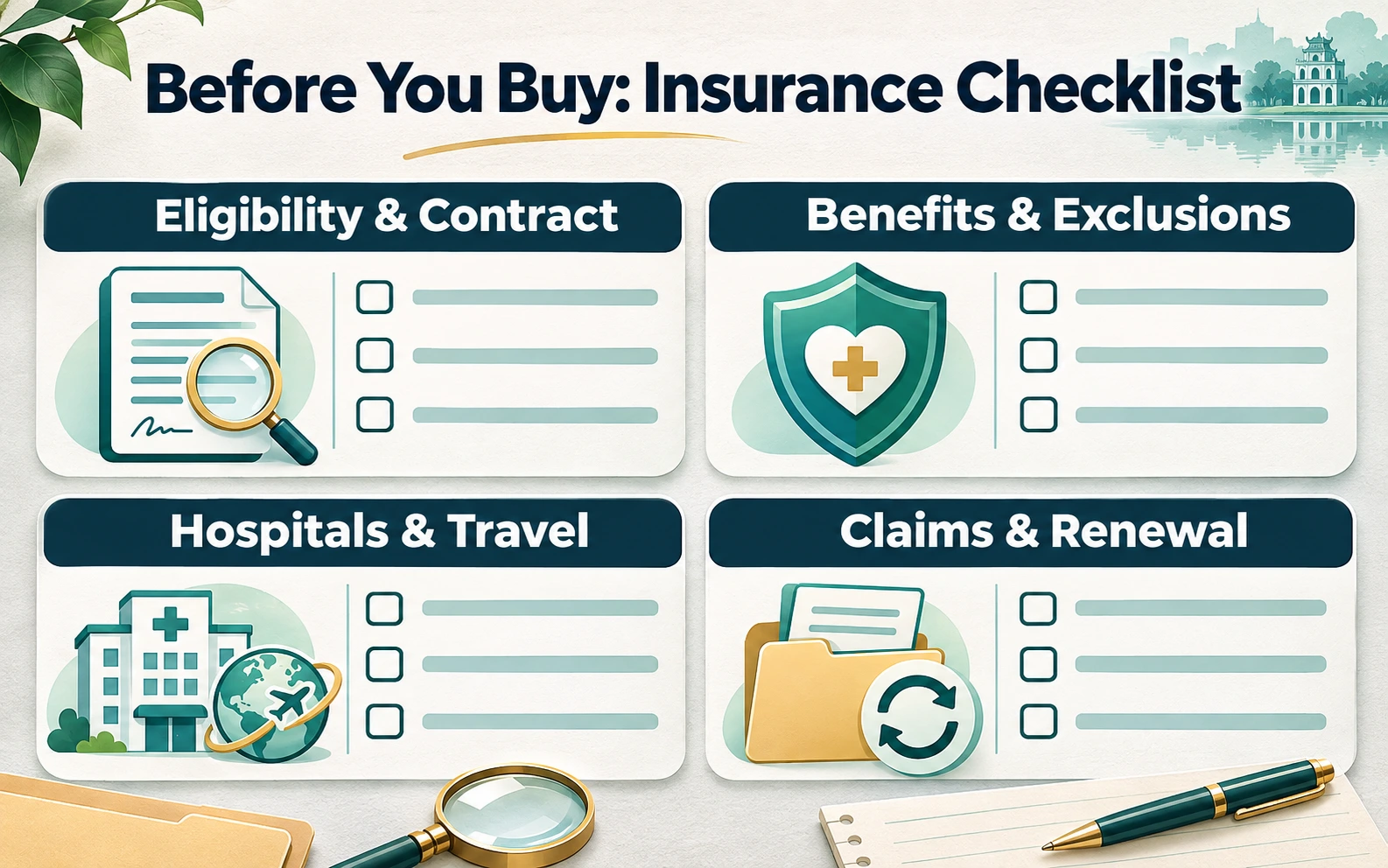
9. A practical checklist before you buy or renew
Copy these questions into your notes and request written answers. You can use the same list with multiple providers without sharing your private medical records with an unrelated comparison website.
Eligibility and contract
- Does the policy accept my residence, nationality and age?
- What are the start and expiry dates?
- Is the quote final after underwriting?
- Is monthly payment an instalment of an annual contract?
- How does renewal pricing or cancellation work?
Benefits and exclusions
- What are the inpatient and outpatient limits?
- Which deductibles and co-pays apply?
- How are pre-existing conditions handled?
- Are maternity, dental and evacuation included or optional?
- What are the waiting periods and activity exclusions?
Hospitals and travel
- Which nearby hospitals accept my exact plan?
- Which treatments require advance approval?
- Where is direct billing available, if anywhere?
- Am I covered outside Vietnam or on visits home?
- Who authorises emergency transfers?
Proof and claims
- Can I read the complete policy and benefit schedule?
- Who is the actual underwriting insurer?
- How do I file, track and appeal a claim?
- Which original invoices or translations are needed?
- Whom do I contact during an emergency?
If you are considering changing insurers, compare the continuity of coverage, existing-condition decisions and waiting periods before cancelling your current policy. Keep copies of the final signed contract and insurer correspondence in a secure place.
10. Frequently asked questions
How much does health insurance cost for expats in Vietnam?
It depends on age, residence, medical underwriting, selected benefits, deductible, geographic coverage and policy duration. Statutory employed-worker BHYT uses a defined contribution system; private and international plans require current written quotes. A public price table is not automatically the premium you will be charged.
What is the best health insurance for expats in Vietnam?
There is no independently verified single best provider for every foreign resident. Compare eligibility, the actual contract, hospital access, exclusions, claims procedure and comparable written pricing. A product designed for one person's needs can be inappropriate for another.
Can foreigners buy health insurance in Vietnam?
Some foreigners are enrolled in statutory BHYT through qualifying employment, and certain private products explicitly describe eligible foreign residents. Acceptance is scheme- or product-specific. Do not assume that all foreigners can join the household BHYT scheme; seek current official confirmation for your circumstances.
Is BHYT mandatory for foreign English teachers?
Not automatically because someone teaches English. The relevant conditions include the legal employment arrangement and Article 12(1)(c) of the amended Health Insurance Law, including the 12-month fixed-term contract criterion and exceptions. Ask your employer to verify your status and contributions.
Do Vietnamese citizens receive completely free healthcare?
Not universally. Statutory BHYT eligibility, participant groups, covered services and reimbursement arrangements matter. Having a BHYT card does not mean every treatment at every provider is free of charge.
Can I use travel insurance if I live in Vietnam?
Only if your specific policy permits your actual residence, trip duration and activities and covers the care you need. Many travel products are designed for temporary trips rather than ongoing resident healthcare, so check the wording before relying on one for a long stay.
Will my insurance cover a motorbike accident?
Do not assume yes or no. Ask your insurer to confirm motorcycle-specific terms, licence requirements, exclusions, emergency care and any other conditions for your exact policy and riding circumstances.
Can I use private hospitals with insurance?
Some policies include access to named private hospitals, but networks, authorisation and direct payment vary. Check that your exact plan covers your chosen treatment and facility before attending whenever practical.
Does international health insurance always include medical evacuation?
No universal promise is justified. Evacuation benefits, medical necessity, approval, transport, destination and limits must be confirmed in the applicable wording and benefit schedule.
Original sources and how this guide was checked
The legal statements above are based on Vietnamese official text and dated agency guidance. Product descriptions link to issuer-published information; those descriptions are not independently verified personal policy terms, prices or provider recommendations. Pages and offerings can change after the review date.
- Vietnam Government: Law 51/2024/QH15, amended Health Insurance Law.
- Vietnam Social Security: 2026 employed-worker BHYT contribution explanation.
- Vietnam Social Security: household BHYT answer of 3 June 2026.
- Government Newspaper: household BHYT clarification of 8 July 2026.
- Historical 2024 response showing a different interpretation in a different case.
- PVI: Combined Health product information.
- Allianz Care: Vietnam international plans and pre-authorisation process.
- Pacific Cross: published premium table and Foundation Series product page.
Independent editorial disclosure: StartInVietnam does not claim to underwrite insurance, act as an appointed agent or broker, provide approved insurance quotations, or operate a health-data intake or policy-referral service through this guide. External links are provided for reader research, not as verified affiliate agreements or recommendations.
Important: Insurance terms, eligibility, medical underwriting, hospital networks and regulatory guidance may change. The policy contract and the relevant Vietnamese authorities determine the outcome in individual cases. For treatment decisions consult a qualified healthcare professional; for legal or insurance-specific questions seek the relevant qualified adviser or issuer.