A Hanoi food tour can be an enjoyable way to understand the capital through bowls of noodles, small neighbourhood kitchens and the stories behind everyday meals. But a good choice depends on more than how many dishes appear in a listing. Price, group size, walking distance, food allergies, meeting arrangements, cancellation terms and the exact places a tour proposes to visit all matter.
This independent guide explains the main types of Hanoi food tours, how to compare tour costs and how to assess safety and operator terms before making your own decision. It is written for international visitors comparing guided street food walks with exploring on their own. StartInVietnam does not operate or sell the tours discussed here, has not independently inspected the eateries or completed a test booking, and does not guarantee availability, licensing, food safety or refunds.
Quick answer
For many first-time visitors, an English-language small-group walking tour in the Old Quarter is a straightforward introduction to Hanoi's food traditions. A private tour may offer more flexibility, but dietary requests, mobility needs and actual inclusions must be confirmed in writing. Self-guided eating gives you control over pace and spending, while making you responsible for research, communication and food choices.
Prices, routes, availability and booking rules can change. Use this guide to compare options, then confirm the selected departure and binding terms before paying. This is editorial guidance, not an offer to book.
Is a Hanoi food tour worth it?
A useful food tour does more than deliver a succession of samples. A knowledgeable guide may explain how a dish is ordered, why a particular preparation is associated with northern Vietnam, what an unfamiliar ingredient is, and how the Old Quarter changes between morning and evening. Someone arriving for a short stay may value that context more than the number of stops.
The case for a guide is strongest when you want an introduction without spending your first afternoon comparing menus or navigating unfamiliar lanes. It is weaker if you already know what you want to eat, prefer long unstructured breaks, have serious dietary restrictions that cannot be managed reliably, or are travelling on a tight budget. No guide can remove every risk of foodborne illness or cross-contact with allergens.
The Old Quarter is a practical focus because of its dense mix of food businesses and historic streets. Vietnam's tourism information offers a general overview of exploring the Old Quarter. That article is cultural context, not a guarantee that a particular eatery is open, accessible or included in any advertised tour.
Which Hanoi food tour format should you choose?
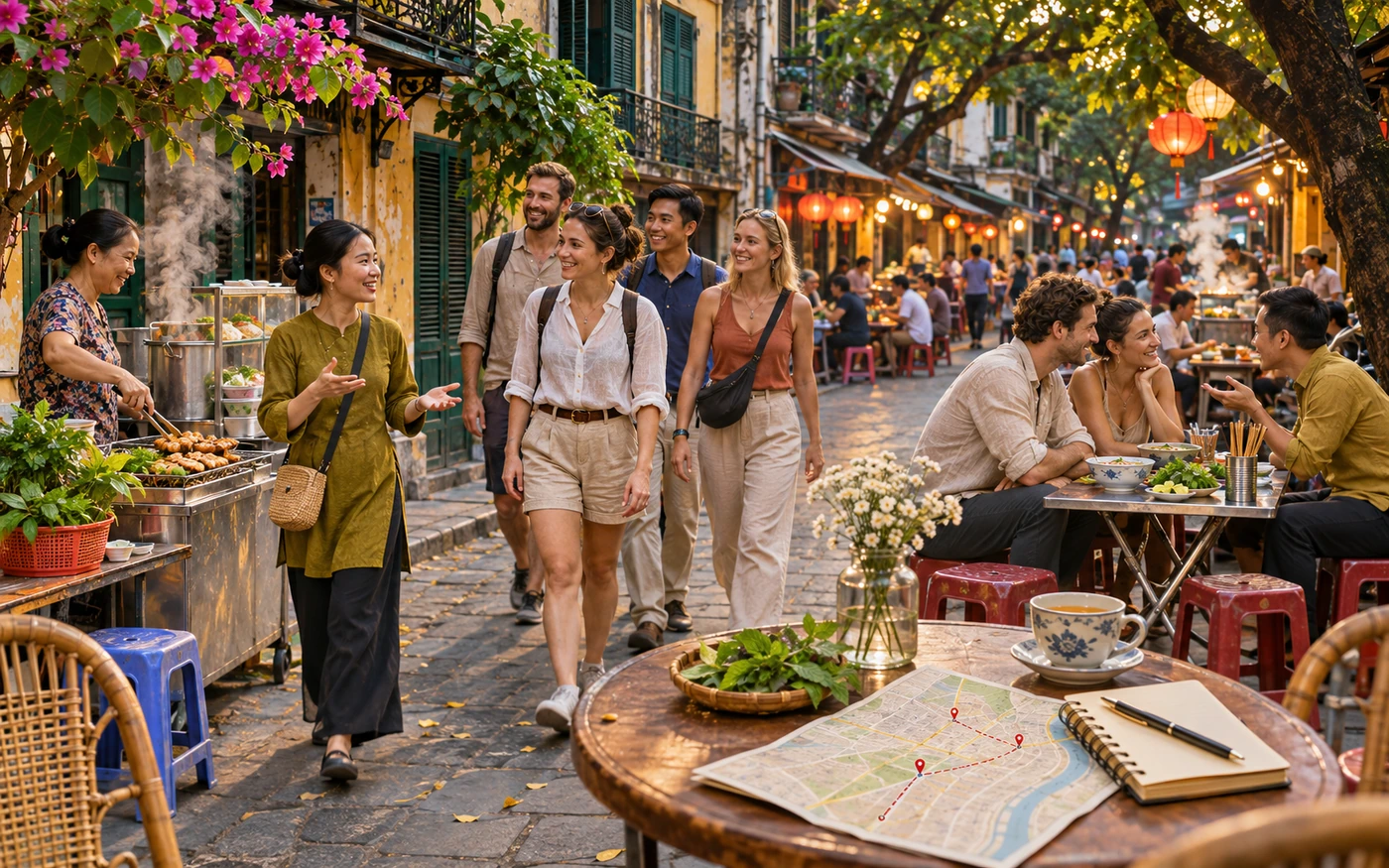
Listings use overlapping labels such as street food tour, Old Quarter food walk, private food experience and night food tour. The meaningful differences are pace, group arrangement, hours, transport and the amount of control you have over the route. Ask for the actual itinerary and product variant rather than judging only by the headline.
| Format | Good fit for | Questions to ask |
|---|---|---|
| Small-group walking | First-time visitors who like a social, structured introduction | Maximum participants, walking distance, shared portions and exact meeting place |
| Private walking | Families or friends wanting a different pace or more conversation | Price per person at your group size; whether any requested changes are actually possible |
| Afternoon or early evening | Visitors who want food exploration without a very late finish | Start/end time, seasonal hours, return transport and after-dark walking conditions |
| Late-night or midnight | Adults interested in a different eating rhythm and overnight markets | Whether the product has launched, confirmed departure, safe return and clearly stated cancellation terms |
| Scooter-based | Visitors considering a wider geographic area beyond a short food walk | Rider/driver qualifications, helmets, insurance, passenger rules and traffic exposure |
| Self-guided | Independent travellers who want flexibility and control of purchases | Opening hours, language, food hygiene, traffic and how to return safely |
Walking tours may be advertised at roughly three hours, but that does not reveal whether you will spend most of the time sitting, standing or walking. Similarly, a private label does not prove one-to-one service or a fully customizable route. If mobility or timing matters, request a plain-language explanation before paying.
Hanoi food tour prices: how to compare the real cost
There is no single reliable market-wide price. A walking tour for a shared group, a private tour with two guests and a four-hour late-night experience are different products. Marketplace cards can also show one amount while the product page, selected date or final payment screen shows another. Compare the specific tour, duration, group size, inclusions, currency and cancellation rules rather than sorting a mixed list by the lowest visible number.
Some listings show a price per person for a shared walking group. A private tour may quote a different per-person rate depending on the number of guests, or a single amount for the whole group. A marketplace's starting price may correspond to a specific date or basic package rather than the option you intend to book. Instead of using an old price list as a current quote, compare the cost structure for the exact departure you want.
| Tour or offer type | How prices may be shown | Check before budgeting |
|---|---|---|
| Shared Old Quarter walking tour | Per person, sometimes a promotional starting rate | Confirmed departure, minimum guests, food/drink portions and the final total with fees |
| Private food walk | Per guest for a given party size, or a group total | Whether the quote changes for solo travellers, couples, families or larger groups |
| Evening or late-night experience | Per person or premium package rate | Actual operating status, finish time, return travel, included drinks and cancellation cutoff |
| Marketplace listing | “From” price before date and variant selection | Chosen date, language, operator, join-in/private option, optional stops and platform fees |
| Self-guided food walk | Individual food and transport purchases | Your meal budget, drinks, travel to and from the area, and dietary choices |
For price research, look at the published walking-tour options from Hanoi Street Food Tour, Secret Food Tours' Hanoi listing, A Chef's Tour's afternoon listing and Klook's Old Quarter product. These links are examples for comparing different product descriptions, not confirmed current offers, recommendations or StartInVietnam booking partners.
Research provenance: vendor pages and saved competitor material were reviewed on 12 November 2026. Their displayed prices and product terms were not verified by completing a selected checkout. This evergreen guide therefore does not present archived rates as today's prices.
How to calculate the real cost
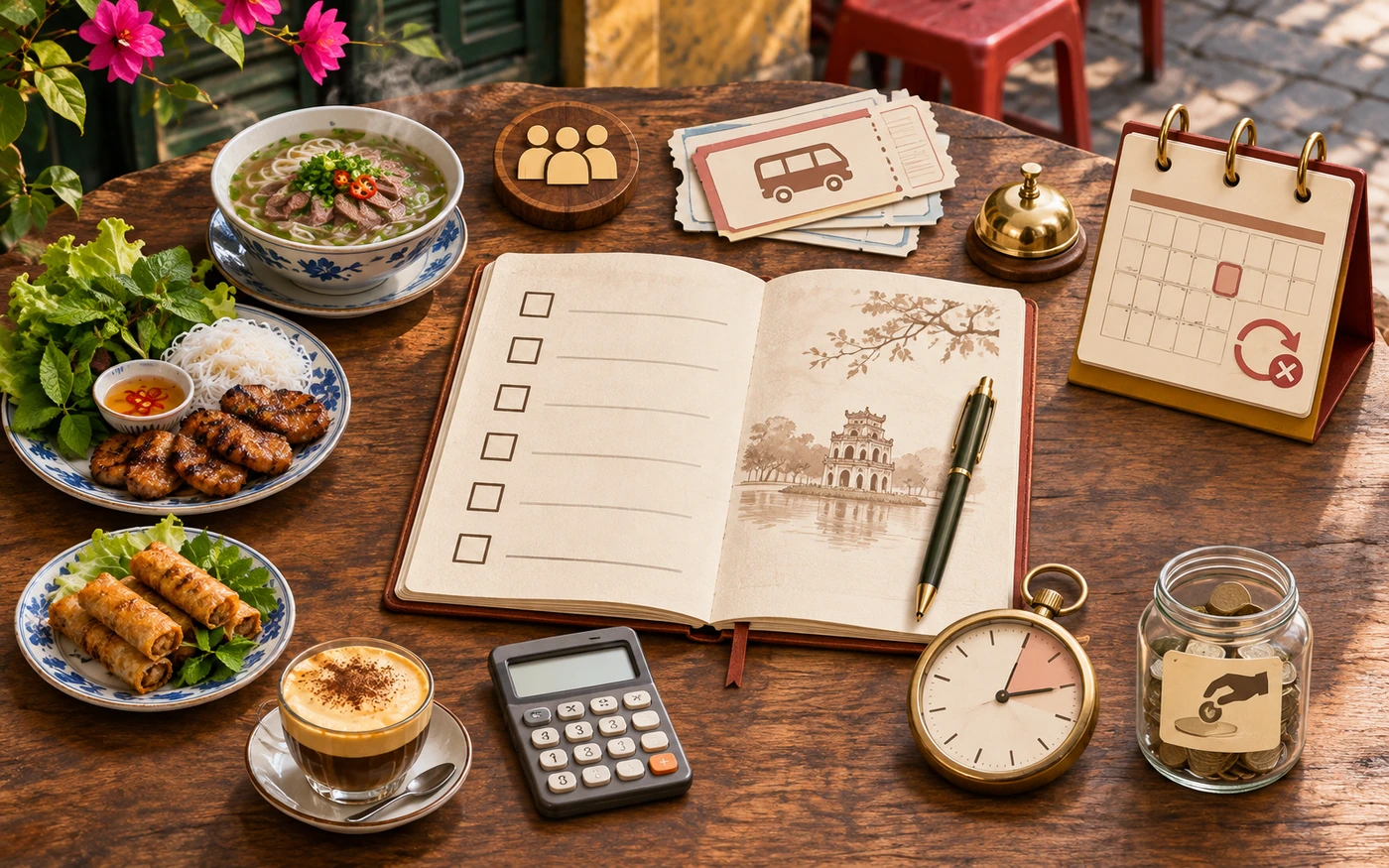
Start with the ticket amount for your exact date and party size. Add any disclosed service or collection fee, separately priced drinks or tastings, transport to the meeting point, the return trip after the tour, and any optional tip. Ask whether taxes are already included and in what currency your payment provider will settle the charge. If a provider advertises “all-inclusive,” request an explicit list of exclusions.
Read the cancellation terms alongside the rate. A lower price is not necessarily the better purchase when severe weather, flight delays, minimum-group rules or a non-refundable ticket could prevent you from taking part. Keep a copy of the chosen product description and order confirmation instead of relying on a generic landing page.
What is usually included in a Hanoi street food tour?
Food tours commonly advertise a guide, a scheduled series of tastings and commentary about local dishes. However, “eight stops” is not the same as eight complete meals, and “ten tastings” can describe small portions, drinks or desserts. Even when meals are included, transport, alcohol, coffee options, premium additions or tips may be extra. Product descriptions change, and a stop can be substituted when a kitchen is closed or a particular dish is unavailable.
For example, saved descriptions of Hanoi Street Food Tour and Secret Food Tours included different stop and tasting counts. These are operator-published descriptions, not verified meals or an itinerary that StartInVietnam has purchased or personally observed. Avoid using advertised review totals as proof that a particular guide or venue will meet your requirements.
| Detail to confirm | Why it matters |
|---|---|
| Food portions | Snacks, shared platters and full dishes leave you feeling very different at the finish |
| Beverages | Water, coffee, beer and alcoholic drinks may follow different inclusion rules |
| Group maximum | Affects pace, conversation, waiting time and ability to ask dietary questions |
| Meeting and finishing point | Necessary for arrival, evening return and travellers with limited mobility |
| Language and guide identity | Confirm the language actually offered and the company responsible for delivering the tour |
| Excluded extras | Know whether tips, transport, premium dishes, booking fees and taxes are additional |
For photography, ask before taking close-up pictures of chefs, staff or other guests. Respect a business's request not to film a kitchen or photograph customers. Tour marketing photos are not evidence that any pictured place will be available on your date.
Hanoi foods worth learning about before you go
A memorable food walk may revolve around well-known dishes or surprise you with small regional preparations. The following are examples of foods associated with Hanoi, not a promise that any provider serves them. For additional cultural context, see the Vietnam Tourism Hanoi food guide and its overview of Hanoian dishes.
Phở
Rice noodles in a fragrant broth, often with beef or chicken, offer a familiar starting point. Broth, garnishes and condiments differ across kitchens. If you avoid particular ingredients, do not assume the absence of visible meat means the broth is vegetarian.
Bún chả
Grilled pork served with rice vermicelli, herbs and dipping liquid is closely associated with Hanoi. Confirm the ingredients of the dipping sauce and accompaniments if fish products, soy or other triggers are a concern.
Bánh cuốn
Delicate steamed rice rolls may contain pork, mushrooms or egg and are often served with sauces and aromatic garnishes. Fillings vary and small additions are not always obvious from the plate.
Chả cá
This fish preparation, often served with herbs and noodles, is another northern specialty. Travelers with fish or shellfish allergies should never assume that a restaurant can safely adapt it without detailed confirmation.
Egg coffee and sweets
Hanoi's egg coffee is frequently mentioned in food-tour advertising and travel writing. It may contain egg, dairy and caffeine; do not assume a dairy-free or egg-free substitute is available. Desserts, sticky rice and sweet drinks also vary by vendor and time of day.
Street food reflects ordinary daily life, rather than a fixed tasting menu. A dish's fame does not establish that it is safe for every visitor or that a particular restaurant is licensed, open, hygienic or part of the route.
Old Quarter routes, timing and a sensible walking pace
The Old Quarter has narrow lanes, active businesses, motorbikes, delivery activity and changing pedestrian conditions. A walking tour can be a practical way to discover the area, but access and comfort depend on the specific route and time. The words “easy walk” are subjective; ask for approximate distance, stairs, surfaces, rest stops and whether the route crosses busy streets.
Morning outings may suit early risers, while late afternoon and evening walks show a different rhythm. A tour running after 22:00 needs especially clear finishing arrangements. Night-time listings may sound atmospheric but should not be mistaken for confirmation that every advertised vendor or market is operational on every date. Seasonal rain, heat, poor air quality and unexpected closures can also change the experience.
Instead of relying on an imagined sequence of named restaurants, ask the operator for the confirmed neighbourhood, approximate walking distance, meeting-point instructions and end location. Consider whether you can comfortably stand, eat at low stools, navigate uneven pavements and reach your accommodation afterwards. If you are travelling independently, leave enough flexibility to stop when tired or uncomfortable.
Vegetarian, vegan, gluten-free and allergy requirements
Dietary needs should be discussed directly with the actual tour operator before booking, not inferred from a marketplace badge. “Vegetarian options” may mean one substitute at certain stops, not a wholly vegetarian tour. A dish without visible meat may still use meat stock, fish sauce or shared cooking equipment. Gluten-free and dairy-free requests also need ingredient-level questions rather than a broad promise of suitability.
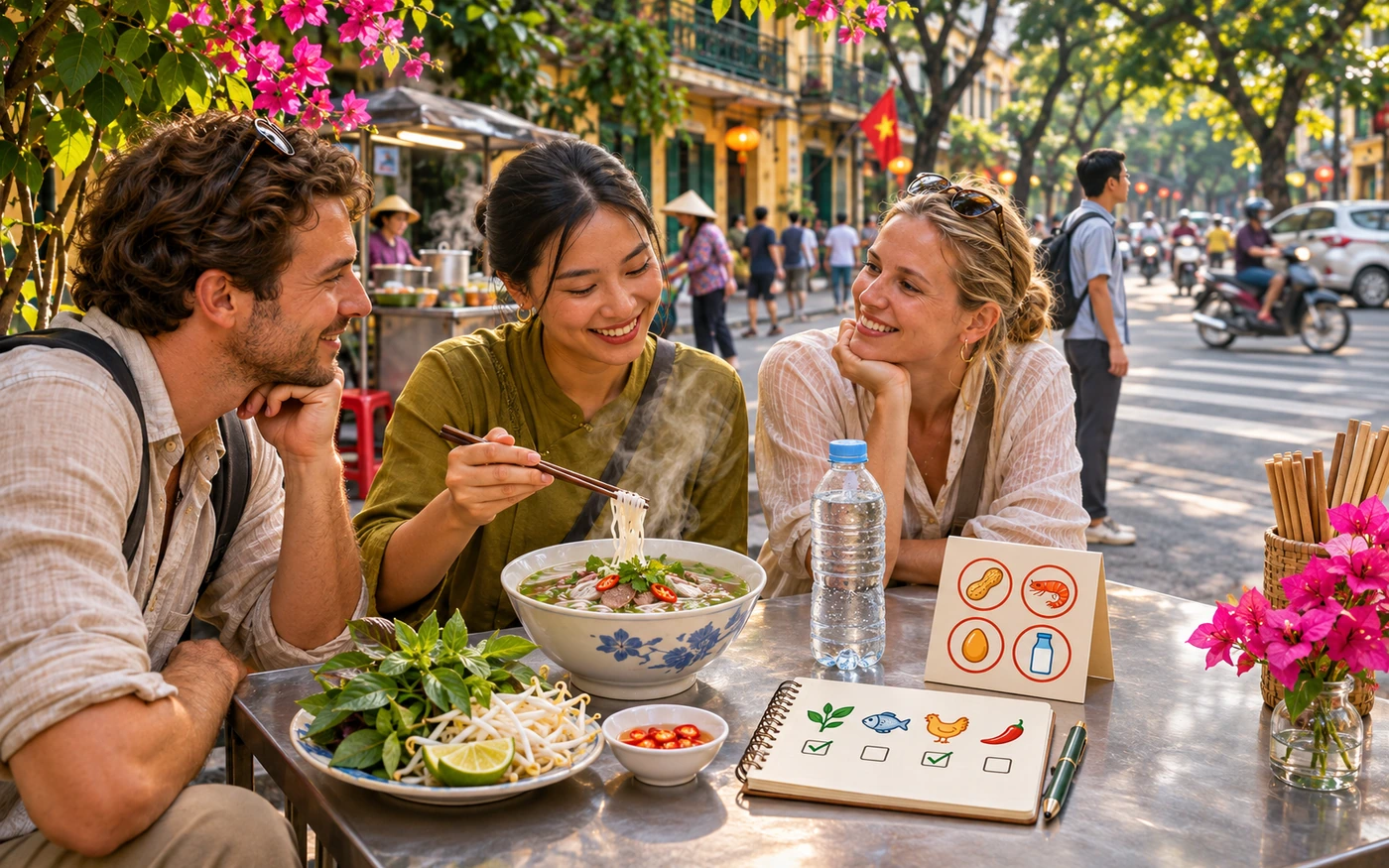
Severe food allergies require a higher threshold. The US Centers for Disease Control and Prevention warns that allergens may be unmarked in Vietnam and recommends advance planning, translated food-allergy cards, appropriate prescribed medication and confirmation that a food business can safely accommodate the person. A provider saying it can “adapt” the menu does not guarantee an absence of peanut, fish, shellfish, egg, dairy or other allergen cross-contact. See the CDC's guidance for severely allergic travellers.
If a mistake would create a serious health emergency, discuss your travel plan with your own clinician and consider whether guided street-food tasting is appropriate at all. Do not rely on a guide alone for emergency readiness or assume staff can identify every ingredient in a sauce, garnish or broth.
A practical message to send before paying
You can ask: “I have a dietary restriction involving [ingredient]. Can you tell me which specific dishes and cooking areas you can verify, whether ingredients or utensils are shared, and whether you recommend that I skip this tour if you cannot ensure my safety?” Request a written answer about the actual departure, and do not interpret silence as approval.
Food and water safety: realistic precautions
Street-food experiences come with food and water risks that a tour ticket cannot eliminate. The CDC's travel-health guidance for Vietnam advises caution with tap water and ice, uncooked produce, raw or undercooked animal products and food from street vendors. Its broader food and water guidance describes fully cooked food served hot and factory-sealed beverages as generally lower-risk choices. These are public-health precautions, not certification of any particular Hanoi stall.
Look at how food is being handled, ask how drinking water and ice are sourced, and do not feel obliged to sample something that appears improperly stored or undercooked. Choose factory-sealed water when you cannot establish water safety. Fresh raw garnishes and shared condiments may be integral to a dish, but you can decline them. If you are pregnant, older, immunocompromised or travelling with a young child, seek appropriate professional travel-health advice about extra precautions.
Alcohol should not be treated as protection against contaminated ice or food. Keep hydrated, especially in hot weather, and consider that rich food, spicy sauces and unfamiliar ingredients can cause discomfort even when no infection occurs. A respectful response to a dish you are not comfortable eating is to pass rather than take an avoidable health risk.
Important: Train Street is not an ordinary guaranteed food-tour stop
Do not buy a food tour on the assumption that railway-side access or train viewing is permitted.
Vietnam News Agency reported on 10 March 2025 that Hanoi's tourism department requested travel agencies not to organise tours to the railway-side café area. Published accounts of policing and railway incidents underline the safety concern. The current permissions and site-specific enforcement status require direct verification with the competent local authorities.
Some marketplace and operator pages still market combinations of Old Quarter food tastings and Train Street. That advertising is not evidence of approved routing, a right to enter the rail corridor or a guaranteed passing train. A listing may also contain both a with-Train and a without-Train variant, so the headline alone can be misleading.
For a food-first trip, choose an itinerary that does not depend on a railway-corridor visit. Never walk onto tracks, stand inside a restricted railway area or rely on an unofficial invitation to enter. Ask for a lawful alternative route if a proposed tour includes a railway-side stop, and do not presume a refund simply because a marketed photo opportunity cannot take place. See the dated VNA report and verify current instructions independently.
Walking, scooters, rain and getting home
Street crossings and mixed traffic can be stressful in an unfamiliar city. On a walking tour, listen to the guide's route instructions while still paying attention yourself; a guide cannot make moving traffic disappear. For night tours, arrange your return transport in advance, keep your phone charged and make sure the final meeting or drop-off location is clear.
Scooter food tours are a separate risk decision. Ask who drives, whether passengers receive correctly fitting helmets, what insurance applies and what happens if the itinerary changes. Check whether your own travel insurance covers motorbike-related activity. The UK government's Vietnam travel advice offers background for its nationals, but local requirements and personal policy coverage must be checked separately.
Rain is part of practical planning, not automatically a reason a provider must refund you. Confirm whether the operator runs in light rain, postpones for unsafe conditions, changes stops or cancels for severe weather. Request the exact written rule that applies to the package and booking channel you intend to use, particularly if the operator and marketplace impose separate conditions.
Cancellation, minimum groups and refund terms: read the actual contract
A prominently displayed promise such as “free cancellation,” “instant confirmation” or “small group guaranteed” is only useful when it matches the selected product and binding conditions. Policy cutoffs can refer to the local departure time, not your home time zone. Some bookings are not formed until a confirmation email is issued, and refunds may involve credits or separate requests.
An earlier source review found conflicting cancellation windows on different parts of a late-night Hanoi product page. That kind of disagreement illustrates a lasting rule: never assume a landing-page summary overrides the selected booking contract. Ask the provider to confirm in writing the exact departure, meeting point and refund deadline that apply to your purchase. A product featured in archived research is not proof it operates today.
A separate archived comparison found different minimum-group language in a tour FAQ and the operator's general terms. Because FAQs, package pages, platform rules and checkout policies may not match, request the conditions for the exact package and sales channel. Do not treat an older discrepancy as a claim about today's contract without checking again.
Before using a payment screen
Confirm the legal contracting party, exact product name, departure date and time, total payable amount, payment currency, refund deadline, weather policy and minimum required participants. Check how to contact the operator during the trip and who is responsible if a third-party vendor cancels. Take a screenshot of the selected checkout summary and retain the confirmation. A saved advertisement is not proof of payment or of a fulfilled service.
Families, solo travellers and accessibility considerations
A small group can be a pleasant social choice for someone travelling alone, but confirm the scheduled departure will run and whether there is a minimum guest count. Ask whether the group contains children and what pace and food environment to expect if you want a quieter experience. “Family friendly” does not automatically mean child-sized portions, accessible toilets, a stroller-friendly route or a suitable late finish.
Private tours may make it easier to ask for slower walking, fewer stops or a quieter seat, but the operator must confirm what it can actually provide. Accessibility matters extend beyond distance: narrow footpaths, steps, short stools, crowded entrances and uneven surfaces can affect wheelchair users, people using walking aids and travellers who need frequent rest breaks.
Ask specific questions: Are there steps at any planned stop? Is there a seated alternative to a street stool? Can the group avoid a long standing queue? How much of the route can be navigated with a stroller or mobility device? An accurate answer may be that a particular operator cannot accommodate the request. That is more useful than an unsupported promise.
Guided tour or self-guided food walk?
Choose guided exploration when you place a high value on a structured introduction, cultural explanation and a known meeting time, and when the specific product terms fit your needs. Choose a self-guided outing when you want to select every kitchen, manage the pace yourself, spend according to appetite and change plans without a group.
Neither route is universally cheaper or safer. A guided ticket may cover several portions and explanations but includes a service margin; a DIY walk can cost less or more depending on what you order. A guide's local familiarity is useful but is not proof that every food business has been independently inspected. Conversely, self-guided travel does not mean you should ignore hygiene or traffic.
| Your priority | Likely better starting point | Check before deciding |
|---|---|---|
| Learning context and meeting other visitors | Small-group guided walk | Guide language, size, pace, hours |
| Flexible pacing with familiar companions | Private tour or DIY | Actual private quote and customization limits |
| Strict personal food control | Carefully planned DIY, or reconsider street-food tasting | Ingredients, food safety and professional allergy advice |
| Shortest possible evening | Early walking departure or DIY | Ending time and return travel |
| Lowest predictable total cost | Compare exact products and DIY purchases | Service fees, transport, tips and cancellation exposure |
A good self-guided plan can simply be one or two meals and a coffee break, without a manufactured multi-stop route. Check real opening hours on the day, use reputable local directions, and avoid suggesting that social media popularity is a hygiene certificate.
Pre-booking checklist for a Hanoi food tour
Use these questions whether you are contacting a tour operator directly or reviewing a marketplace listing. The aim is to obtain a clear, date-specific product description, not to collect more promotional claims.
- Is this an actual departure for my chosen date, with written availability and a named contracting operator?
- What is the final price in the payment currency, including taxes, service fees and optional additions?
- How many guests may join, and can the operator cancel below a minimum group size?
- What time and location do we meet and finish? What walking distance, transport or late return is involved?
- Which tastings and drinks are included, and what may be substituted on the day?
- Can the actual kitchens assess my dietary requirements? Are there limitations or shared preparation areas?
- Does the itinerary include Train Street or a scooter? If so, what is the lawful, safe alternative without that element?
- What are the precise cancellation, refund, weather and rescheduling terms for this product and booking channel?
- Who handles a complaint, emergency or interruption, and what insurance or operational documentation is applicable?
- Have I retained the selected product terms and confirmed order instead of relying on the headline advertisement?
It is reasonable to walk away when a seller cannot explain a material term, an allergy risk or a proposed unsafe route. Do not send passport scans, payment details or sensitive medical records through unverified social messages merely to ask general tour questions.
Frequently asked questions
How long is a typical Hanoi Old Quarter food tour?
Walking tours are often described as outings of several hours, but the duration varies by supplier and package. Night-time experiences may take longer. Verify the exact start and finish for the departure you select.
How much should I budget?
There is no dependable fixed amount for every tour. Ask for the selected date, party size, duration, variant and final charge in the payment currency, including any platform fees, drinks, transport or other extras. Compare the total rather than an advertised starting figure.
Are food tastings always included in the ticket?
Not always in the same way. Read the exact inclusions: tasting count, drinks, special classes, tips and transport may be treated separately. A quoted number of stops does not promise a full meal at each stop.
Can vegetarians or vegans join?
Sometimes, depending on the operator and route. Do not assume that a vegetarian adaptation makes all broths, sauces and utensils suitable for your diet. Ask for a product-specific written answer. Severe allergies require particular caution.
Is Hanoi street food guaranteed safe on a guided tour?
No. An operator's selection process is not proof of zero foodborne illness or allergen exposure. Follow CDC precautions and your own medical advice; decline any food you cannot safely assess.
Will a food tour include Hanoi Train Street?
Some advertisers offer it and others have variants without it. A 2025 Hanoi tourism-department instruction opposed organising tours to the railway-side café area. Current local access and enforcement must be checked; no visit or train viewing should be promised.
Do food tours run in rain?
Policies vary. Some operators may continue with a modified route, while others may reschedule or cancel for safety. Ask for the exact weather rule, refund procedure and notice period before paying.
Can I reserve a Hanoi food tour through StartInVietnam?
No. This page is an independent editorial guide. StartInVietnam has not announced an operating Hanoi food tour, booking inventory, affiliated sales service or payment facility for these products. Any supplier links here are provided as research references, not StartInVietnam booking confirmations.
Sources, research scope and ongoing checks
This evergreen guide draws on a dated Google results capture, saved competitor pages and source-specific terms reviewed on 12 November 2026, together with travel-health and safety guidance. The lasting comparison principles are presented separately from prices and operating rules that can change. Recheck every linked seller page, local instruction and selected contract before relying on it.
- Hanoi Street Food Tour — group/private formats and example inclusions; verify current pricing and terms.
- Secret Food Tours Hanoi listing and general terms — examples of fee and contractual details that require a current check.
- A Chef's Tour afternoon listing and midnight listing — separately described products in archived research; recheck current operation and terms.
- Klook Old Quarter product — example of date and route variants; not a verified checkout.
- Vietnam Tourism's Hanoian food guide — cultural and dish background.
- CDC Yellow Book: Vietnam, food and water precautions, and severe-allergy travel guidance.
- Vietnam News Agency, 10 March 2025 — Hanoi tourism department's Train Street tour instruction.
- UK foreign travel advice for Vietnam — travel and traffic background for UK nationals.
Editorial scope: StartInVietnam does not represent any named vendor as a vetted partner, guarantee a restaurant or tour's compliance, sell tickets, process payment, provide personal medical advice or certify current railway access. This is a research-based comparison, not first-hand product testing or a professional legal assessment. Underlying desk research: 12 November 2026. This is not a live price, inventory, access-permission or checkout feed; confirm time-sensitive details independently before booking.